




The correct statement about diborane is:
A. All B–H–B angles are \[{\rm{120^\circ }}.\]
B. Its fragment, \[{\rm{B}}{{\rm{H}}_{\rm{3}}}\] behaves as a Lewis base.
C. Terminal B–H bonds have less p-character when compared to bridging bonds.
D. The two B–H–B bonds are not of the same length.
Answer
 Verified
268.2k+ views
Hint: Diborane is one of the important hydrides of boron. It is an electron-deficient compound. It has a bridge structure.
Complete Step by Step Solution:
Diborane has a bridge structure in which each boron atom is attached to two hydrogen atoms by regular electron-pair bonds.
These bonds are called terminal bonds.
The bridging H-atoms are in a plane perpendicular to the plane of \[{\rm{B}}{{\rm{H}}_{\rm{2}}}\]fragments which means one lies above and another one lies below the plane.
This prevents the rotation of the two boron atoms.
There are eight bonds in this structure.
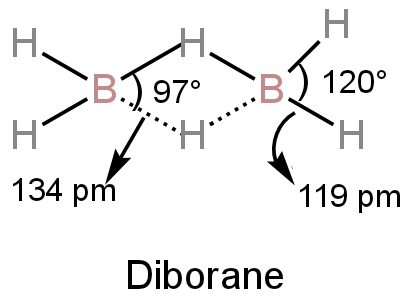
Image: Structure of diborane
A. We can see from the structure of the diborane that the angles of the terminal bonds are \[{\rm{120^\circ }}.\]
The bridge bond's bond angle is \[{\rm{97^\circ }}.\]
So, option A is incorrect.
B. There are eight bonds in this structure and twelve electrons are available for bonding.
This is because the boron has only three valence electrons.
There is one electron contribution from hydrogen.
Two boron atoms contribute six electrons and six electrons are contributed by six hydrogen atoms.
If all the bonds in this molecule will be electron-pair then sixteen electrons are required.
Hence, \[{\rm{B}}{{\rm{H}}_{\rm{3}}}\] is electron-deficient and hence can not act as a Lewis base, but rather acts as a Lewis acid.
Hence, option B is incorrect.
C. The bond angle of terminal bonds is more than the bond angle of bridge bonds.
It means that terminal bond electrons lie farther from the nucleus than the electrons of the bridge bonds.
We know that p-orbitals lie farther from the nucleus than the s-orbitals.
So, the terminal bond electrons lying farther from the nucleus will only result in the p-orbital electrons lying farther from the nucleus.
So, as a result, the p-character decreases.
So, option C is correct.
D.The bond length between boron and hydrogen at the bridges is 134 pm.
The bond length of terminal bonds is 119 pm.
Hence, the four-terminal bonds have the same bond length and the four bridge bonds have the same bond length.
So, option D is incorrect.
So, option C is correct.
Note: While attempting the question, one must have the structure of diborane in mind. The bridge bonds are formed due to the electron deficiency of boron. The terminal B-H bonds are normal two-centre-two-electron bonds while the two bridge bonds are three-centre-two-electron bonds. The bridge bonds are also called banana bonds.
Complete Step by Step Solution:
Diborane has a bridge structure in which each boron atom is attached to two hydrogen atoms by regular electron-pair bonds.
These bonds are called terminal bonds.
The bridging H-atoms are in a plane perpendicular to the plane of \[{\rm{B}}{{\rm{H}}_{\rm{2}}}\]fragments which means one lies above and another one lies below the plane.
This prevents the rotation of the two boron atoms.
There are eight bonds in this structure.
Image: Structure of diborane
A. We can see from the structure of the diborane that the angles of the terminal bonds are \[{\rm{120^\circ }}.\]
The bridge bond's bond angle is \[{\rm{97^\circ }}.\]
So, option A is incorrect.
B. There are eight bonds in this structure and twelve electrons are available for bonding.
This is because the boron has only three valence electrons.
There is one electron contribution from hydrogen.
Two boron atoms contribute six electrons and six electrons are contributed by six hydrogen atoms.
If all the bonds in this molecule will be electron-pair then sixteen electrons are required.
Hence, \[{\rm{B}}{{\rm{H}}_{\rm{3}}}\] is electron-deficient and hence can not act as a Lewis base, but rather acts as a Lewis acid.
Hence, option B is incorrect.
C. The bond angle of terminal bonds is more than the bond angle of bridge bonds.
It means that terminal bond electrons lie farther from the nucleus than the electrons of the bridge bonds.
We know that p-orbitals lie farther from the nucleus than the s-orbitals.
So, the terminal bond electrons lying farther from the nucleus will only result in the p-orbital electrons lying farther from the nucleus.
So, as a result, the p-character decreases.
So, option C is correct.
D.The bond length between boron and hydrogen at the bridges is 134 pm.
The bond length of terminal bonds is 119 pm.
Hence, the four-terminal bonds have the same bond length and the four bridge bonds have the same bond length.
So, option D is incorrect.
So, option C is correct.
Note: While attempting the question, one must have the structure of diborane in mind. The bridge bonds are formed due to the electron deficiency of boron. The terminal B-H bonds are normal two-centre-two-electron bonds while the two bridge bonds are three-centre-two-electron bonds. The bridge bonds are also called banana bonds.
Recently Updated Pages
Algebra Made Easy: Step-by-Step Guide for Students

JEE Isolation, Preparation and Properties of Non-metals Important Concepts and Tips for Exam Preparation
JEE Energetics Important Concepts and Tips for Exam Preparation
Chemical Properties of Hydrogen - Important Concepts for JEE Exam Preparation
JEE General Topics in Chemistry Important Concepts and Tips
JEE Amino Acids and Peptides Important Concepts and Tips for Exam Preparation
Trending doubts
JEE Main 2026: Exam Dates, Session 2 Updates, City Slip, Admit Card & Latest News
JEE Main Participating Colleges 2026 - A Complete List of Top Colleges
Understanding the Electric Field of a Uniformly Charged Ring
Derivation of Equation of Trajectory Explained for Students
Understanding Atomic Structure for Beginners
How to Convert a Galvanometer into an Ammeter or Voltmeter
Other Pages
JEE Advanced 2026 Notification Out with Exam Date, Registration (Extended), Syllabus and More
JEE Advanced Percentile vs Marks 2026: JEE Main Cutoff, AIR & IIT Admission Guide
CBSE Class 12 Chemistry Question Paper 2026 PDF Download (All Sets) with Answer Key
NCERT Solutions For Class 12 Chemistry Chapter 2 Electrochemistry - 2025-26
NCERT Solutions For Class 12 Chemistry Chapter 1 Solutions - 2025-26
NCERT Solutions For Class 12 Chemistry Chapter 3 Chemical Kinetics - 2025-26