




The correct expression for Lorentz force is
(A) $q\left[ {\vec E + \left( {\vec B \times \vec V} \right)} \right]$
(B) $q\left[ {\vec E + \left( {\vec V \times \vec B} \right)} \right]$
(C) $q\left( {\vec V \times \vec B} \right)$
(D) $q\vec E$
Answer
 Verified
300k+ views
Hint Before solving this problem, we have to remember that a charged particle moving through a magnetic field experiences a force, which is at the right angle to both the direction in which the particle is moving and the direction of the applied magnetic field. This force is called the Lorentz force.
Complete Step-by-step solution
Lorentz force is defined as the mixture of the magnetic force and the electric force on a point charge when placed in an electromagnetic field. The Lorentz force is used in electromagnetism, a combination of electricity and magnetism, and is also known as the electromagnetic force.
The electric force on a charged particle is,
${\vec F_E} = q\vec E$
where,
$q$ is the electric charge on the particle.
$\vec E$ is the external electric field.
Magnetic force on a charged particle is,
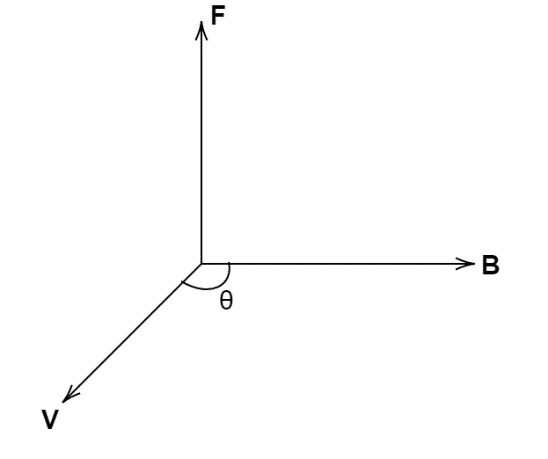
${\vec F_B} = q\left( {\vec V \times \vec B} \right)$
${\vec F_B} = qVB\sin \theta $
$q$ is the electric charge on the particle.
$V$ is the velocity of the particle.
$B$ is the external magnetic field.
$\theta $ is the angle between velocity and the magnetic field.
The expression for the Lorentz force experienced by a charged particle is given as:
$\vec F = {\vec F_E} + {\vec F_B}$
On putting the value of ${\vec F_E}$ and${\vec F_B}$, we get
$\vec F = q\vec E + q\left( {\vec V \times \vec B} \right)$
Taking the $q$ common out, we get
$\vec F = q\left[ {\vec E + \left( {\vec V \times \vec B} \right)} \right]$
Lorentz force helps to clarify the mathematical equations along with the physical significance of the forces, electric force and magnetic force, acting on the charged particles that are traveling through the space having the electric field as well as the magnetic field. This is the importance of the Lorentz force.
So, the correct answer is (B) $q\left[ {\vec E + \left( {\vec V \times \vec B} \right)} \right]$ .
Additional Information
The applications of the Lorentz force are:
1. Cyclotrons and other particle accelerators use the phenomenon of Lorentz force.
2. A bubble chamber uses Lorentz force to generate the graph for getting the trajectories of the charged particles
3. Cathode ray tube televisions use the concept of Lorentz force to deviate the path of the electrons in a straight line to make them land on the specific spots on the screen.
Note The Lorentz force is the force exerted on an electrically charged particle that moves through a magnetic field and electric field. The Lorentz force is composed of two vector components, one proportional to the magnetic field and the other proportional to the electric field. These components must be added in vector form, to obtain the total force.
Complete Step-by-step solution
Lorentz force is defined as the mixture of the magnetic force and the electric force on a point charge when placed in an electromagnetic field. The Lorentz force is used in electromagnetism, a combination of electricity and magnetism, and is also known as the electromagnetic force.
The electric force on a charged particle is,
${\vec F_E} = q\vec E$
where,
$q$ is the electric charge on the particle.
$\vec E$ is the external electric field.
Magnetic force on a charged particle is,
${\vec F_B} = q\left( {\vec V \times \vec B} \right)$
${\vec F_B} = qVB\sin \theta $
$q$ is the electric charge on the particle.
$V$ is the velocity of the particle.
$B$ is the external magnetic field.
$\theta $ is the angle between velocity and the magnetic field.
The expression for the Lorentz force experienced by a charged particle is given as:
$\vec F = {\vec F_E} + {\vec F_B}$
On putting the value of ${\vec F_E}$ and${\vec F_B}$, we get
$\vec F = q\vec E + q\left( {\vec V \times \vec B} \right)$
Taking the $q$ common out, we get
$\vec F = q\left[ {\vec E + \left( {\vec V \times \vec B} \right)} \right]$
Lorentz force helps to clarify the mathematical equations along with the physical significance of the forces, electric force and magnetic force, acting on the charged particles that are traveling through the space having the electric field as well as the magnetic field. This is the importance of the Lorentz force.
So, the correct answer is (B) $q\left[ {\vec E + \left( {\vec V \times \vec B} \right)} \right]$ .
Additional Information
The applications of the Lorentz force are:
1. Cyclotrons and other particle accelerators use the phenomenon of Lorentz force.
2. A bubble chamber uses Lorentz force to generate the graph for getting the trajectories of the charged particles
3. Cathode ray tube televisions use the concept of Lorentz force to deviate the path of the electrons in a straight line to make them land on the specific spots on the screen.
Note The Lorentz force is the force exerted on an electrically charged particle that moves through a magnetic field and electric field. The Lorentz force is composed of two vector components, one proportional to the magnetic field and the other proportional to the electric field. These components must be added in vector form, to obtain the total force.
Recently Updated Pages
If the magnetizing field on a ferromagnetic material class 12 physics JEE_Main

A point charge is placed at the corner of a cube The class 12 physics JEE_Main
What changes occur if the monochromatic light used class 12 physics JEE_Main
The unit of specific conductance is A Ohm B Ohmmetre class 12 physics JEE_Main
Which lens is used in magnifying glass A Concave lens class 12 physics JEE_Main
Sir C V Raman won the Nobel Prize in which year A 1928 class 12 physics JEE_Main
Trending doubts
JEE Main 2026: Exam Dates, Session 2 Updates, City Slip, Admit Card & Latest News
Understanding the Electric Field of a Uniformly Charged Ring
Electron Gain Enthalpy and Electron Affinity Explained
Derivation of Equation of Trajectory Explained for Students
Understanding Atomic Structure for Beginners
How to Convert a Galvanometer into an Ammeter or Voltmeter
Other Pages
CBSE Class 12 Physics Question Paper 2026: Download SET-wise PDF with Answer Key & Analysis
JEE Advanced Percentile vs Marks 2026: JEE Main Cutoff, AIR & IIT Admission Guide
Understanding Uniform Acceleration in Physics
Effective Nuclear Charge for JEE
Hybridisation in Chemistry – Concept, Types & Applications
Isoelectronic Species: Definition, Examples & Importance