




The capacitor shown in fig A2.11 is in steady state.
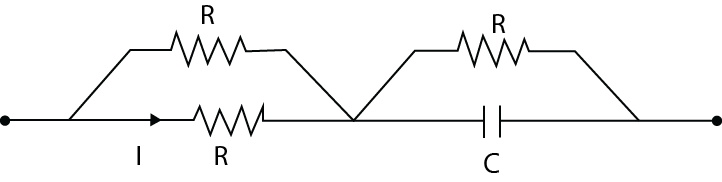
The energy stored in the capacitor is
(A) $C{I^2}{R^2}$
(B) $2C{I^2}{R^2}$
(C) $4C{I^2}{R^2}$
(D) None of these
Answer
 Verified
252.9k+ views
Hint: R is resistor, C is capacitor and I is current flowing in wire. We will now consider wire containing capacitors as current is flowing in steady state in that branch of wire. We will find energy stored in the capacitor using $U = \dfrac{1}{2}C{V^2}$ formula where V is the potential difference across the capacitor.
Complete step by step answer
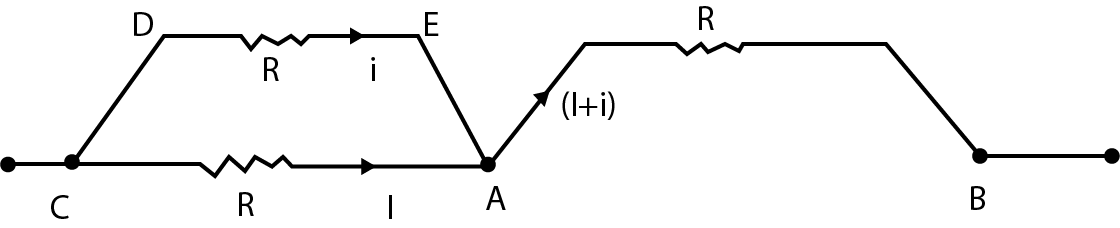
Fig A2.12.
Capacitor:
It is a two terminal device which is used to store energy in the form of an electric field. It is also known as condenser. Basically, two metallic plates are separated by a dielectric constant. S.I. unit is farad.
Resistor:
It is used to resist the flow of current. It is a passive element. S.I. unit is ohm.
Circuit:
It is a path used to conduct electricity. It consists of various elements like resistor, capacitor, wire, key, etc.
A steady state current flows through a capacitor (given). So the new circuit is as shown in fig A2.12.
Now applying loop rule or Kirchhoff’s voltage law in loop CDEAC, we get
$IR = iR$
$ \Rightarrow I = i$
Now, current that flows in AB branch
$AB = I + i$
$AB = 2I$
Therefore, voltage in branch AB will be
$\Delta V = iR$
$\Delta {V_{AB}} = 2IR$
Energy stored in capacitor will be
$U = \dfrac{1}{2}C\Delta {V_{AB}}^2$
$U = \dfrac{1}{2}C{(2IR)^2}$
$U = 2C{I^2}{R^2}$
Therefore, energy stored in the capacitor is $2C{I^2}{R^2}$. So, option B is the correct
Note
If we had used energy stored formula directly without applying loop rule then instead of 2I we would have used the same current flowing in the circuit say I which is wrong. Because of which we might have got $\dfrac{{C{I^2}{R^2}}}{2}$ as our solution. But this won’t satisfy any option hence we would choose the option.
Complete step by step answer
Fig A2.12.
Capacitor:
It is a two terminal device which is used to store energy in the form of an electric field. It is also known as condenser. Basically, two metallic plates are separated by a dielectric constant. S.I. unit is farad.
Resistor:
It is used to resist the flow of current. It is a passive element. S.I. unit is ohm.
Circuit:
It is a path used to conduct electricity. It consists of various elements like resistor, capacitor, wire, key, etc.
A steady state current flows through a capacitor (given). So the new circuit is as shown in fig A2.12.
Now applying loop rule or Kirchhoff’s voltage law in loop CDEAC, we get
$IR = iR$
$ \Rightarrow I = i$
Now, current that flows in AB branch
$AB = I + i$
$AB = 2I$
Therefore, voltage in branch AB will be
$\Delta V = iR$
$\Delta {V_{AB}} = 2IR$
Energy stored in capacitor will be
$U = \dfrac{1}{2}C\Delta {V_{AB}}^2$
$U = \dfrac{1}{2}C{(2IR)^2}$
$U = 2C{I^2}{R^2}$
Therefore, energy stored in the capacitor is $2C{I^2}{R^2}$. So, option B is the correct
Note
If we had used energy stored formula directly without applying loop rule then instead of 2I we would have used the same current flowing in the circuit say I which is wrong. Because of which we might have got $\dfrac{{C{I^2}{R^2}}}{2}$ as our solution. But this won’t satisfy any option hence we would choose the option.
Recently Updated Pages
States of Matter Chapter For JEE Main Chemistry

Young’s Double Slit Experiment Derivation Explained
JEE Main Participating Colleges 2026 - A Complete List of Top Colleges
Wheatstone Bridge – Principle, Formula, Diagram & Applications
Circuit Switching vs Packet Switching: Key Differences Explained
Mass vs Weight: Key Differences Explained for Students
Trending doubts
JEE Main 2026: Exam Dates, Session 2 Updates, City Slip, Admit Card & Latest News
JEE Main Marking Scheme 2026- Paper-Wise Marks Distribution and Negative Marking Details
Hybridisation in Chemistry – Concept, Types & Applications
JEE Main 2026 Application Login: Direct Link, Registration, Form Fill, and Steps
Understanding the Electric Field of a Uniformly Charged Ring
Derivation of Equation of Trajectory Explained for Students
Other Pages
CBSE Class 12 Physics Question Paper 2026: Download SET-wise PDF with Answer Key & Analysis
JEE Advanced 2026 - Exam Date (Released), Syllabus, Registration, Eligibility, Preparation, and More
JEE Advanced Marks vs Ranks 2025: Understanding Category-wise Qualifying Marks and Previous Year Cut-offs
JEE Advanced Weightage 2025 Chapter-Wise for Physics, Maths and Chemistry
Ideal and Non-Ideal Solutions Explained for Class 12 Chemistry
Electron Gain Enthalpy and Electron Affinity Explained