




Rays from the Sun converge at a point 15 cm in front of a concave mirror. Where should an object be placed so that the size of its image is equal to the size of the object?
A) 15 cm in front of the mirror
B) 30 cm in front of the mirror
C) Between 15 cm and 30 cm in front of the mirror
D) More than 30 cm in front of the mirror
Answer
 Verified
555.5k+ views
Hint: A focus is a point at which rays of light, heat, or other radiation meet after being reflected or refracted. The focal point is the point in the space at which light incident towards the mirror and traveling parallel to the principal axis will meet after the reflection.
Complete step by step solution:
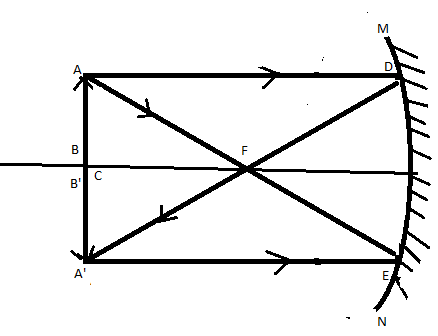
We know that from the surface of the earth, the Sun is at an infinite distance. So light rays from sun rays after the reflection from the concave mirror will converge at the focus.
From the above ray diagram it is clear that in the case of a concave mirror, the image size becomes equals to the object size when the object distance equals the radius if the curvature $ = $twice the focal length.
In the problem, it is given that the sun rays converge at 15 cm. So, the focal length of the mirror $ = $f $ = $ 15 cm.
In the case of a concave mirror, the size of the image and object will be the same if the object is placed at 2f.
$\therefore $ In this case, the object must be placed at 2f.
So substituting the value of f $ = $ 15 cm, we get
Object distance $ = 2 \times f = 2 \times 15 = 30$ cm
Hence the correct option for the problem is B.
Note: 1) A focus is also called an image point.
2) The principal focus is defined as the point where a beam parallel to the principal axis appears to diverge or converge from a point on the principal axis after passing through the lens.
3) A real image is formed by the collection of focus points made by the converging rays.
4) A virtual image is formed by the collection of focus points made by the extensions of diverging rays.
Complete step by step solution:
We know that from the surface of the earth, the Sun is at an infinite distance. So light rays from sun rays after the reflection from the concave mirror will converge at the focus.
From the above ray diagram it is clear that in the case of a concave mirror, the image size becomes equals to the object size when the object distance equals the radius if the curvature $ = $twice the focal length.
In the problem, it is given that the sun rays converge at 15 cm. So, the focal length of the mirror $ = $f $ = $ 15 cm.
In the case of a concave mirror, the size of the image and object will be the same if the object is placed at 2f.
$\therefore $ In this case, the object must be placed at 2f.
So substituting the value of f $ = $ 15 cm, we get
Object distance $ = 2 \times f = 2 \times 15 = 30$ cm
Hence the correct option for the problem is B.
Note: 1) A focus is also called an image point.
2) The principal focus is defined as the point where a beam parallel to the principal axis appears to diverge or converge from a point on the principal axis after passing through the lens.
3) A real image is formed by the collection of focus points made by the converging rays.
4) A virtual image is formed by the collection of focus points made by the extensions of diverging rays.
Recently Updated Pages
States of Matter Chapter For JEE Main Chemistry

Young’s Double Slit Experiment Derivation Explained
Wheatstone Bridge – Principle, Formula, Diagram & Applications
Circuit Switching vs Packet Switching: Key Differences Explained
Mass vs Weight: Key Differences Explained for Students
[Awaiting the three content sources: Ask AI Response, Competitor 1 Content, and Competitor 2 Content. Please provide those to continue with the analysis and optimization.]
Trending doubts
JEE Main 2026: Exam Dates, Session 2 Updates, City Slip, Admit Card & Latest News
JEE Main Participating Colleges 2026 - A Complete List of Top Colleges
Kinematics Mock Test for JEE Main 2025-26: Practice & Ace the Exam
Kinematics Mock Test for JEE Main 2025-26: Comprehensive Practice
Hybridisation in Chemistry – Concept, Types & Applications
Understanding the Electric Field of a Uniformly Charged Ring
Other Pages
CBSE Class 12 Physics Question Paper 2026: Download SET-wise PDF with Answer Key & Analysis
JEE Advanced 2026 Notification Out with Exam Date, Registration (Extended), Syllabus and More
JEE Advanced Percentile vs Marks 2026: JEE Main Cutoff, AIR & IIT Admission Guide
JEE Advanced 2026 Marks vs Rank: Estimate IIT Rank from Your Score
JEE Advanced Weightage Chapter Wise 2026 for Physics, Chemistry, and Mathematics
Derivation of Equation of Trajectory Explained for Students