




Rainbow appears due to dispersion of sunlight by __________.
(A) Water droplets
(B) Prism
(C) Glass Block
(D) All
Answer
 Verified
253.8k+ views
Hint To find the correct answer, you firstly need to know that rainbow is a naturally occurring phenomenon and why and how it is produced. Also, as the name suggests, rainbow has a close correlation with the rain as rainbow is produced after the rain has stopped and there is still moisture in the air.
Complete step by step answer
As mentioned in the hint section of the solution, to solve the question, you first need to have a basic understanding about the rainbow. Let us share some information about rainbow first:
Rainbows are formed by a combination of refraction and reflection. You may have noticed that you see a rainbow only when you look away from the sun. It is so as the light from the sun enters a drop of water and is reflected from the back of the drop, as shown in the image. This is the only time when reflection happens in the whole process. As for refraction of the sunlight, the light rays from the sun are refracted both as they enter and as they leave the drop. Since the index of refraction of water varies with wavelength, the light is dispersed, and a rainbow is observed. Keep in mind that there is no dispersion caused by reflection at the back surface, since the law of reflection does not depend on wavelength. The actual rainbow of colors seen by an observer depends on the myriad of rays being refracted and reflected toward the observer’s eyes from numerous drops of water.
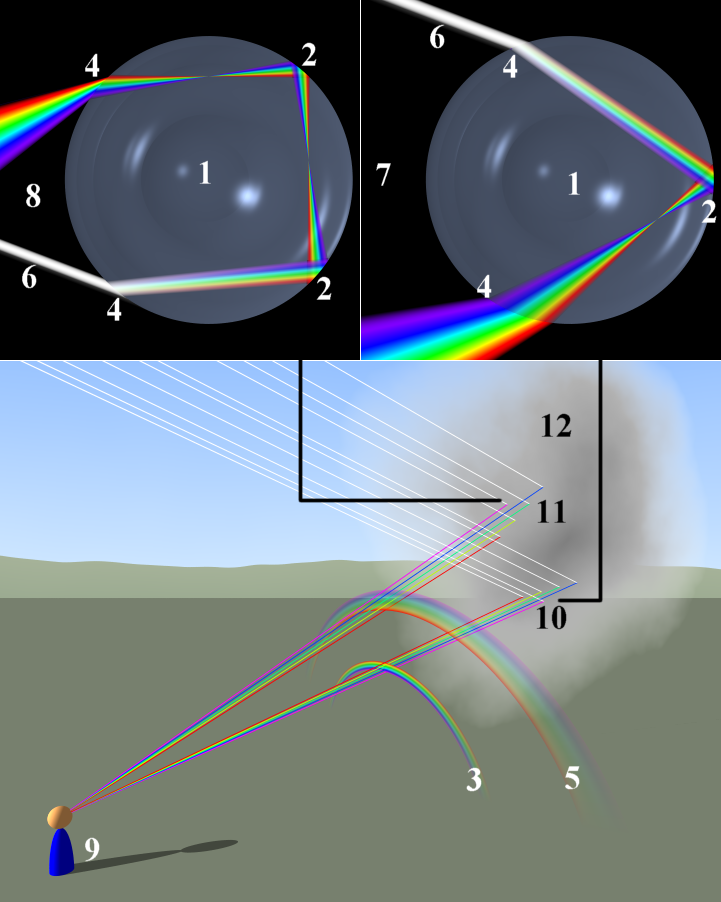
As we have described about the rainbow, it must be clear that the rainbow appears due to the dispersion of sunlight by water droplets that are present in the air due to the rain.
Hence, the correct option is option (A).
Note It should be noted that even though the VIBGYOR effect of white light or sun rays can be observed in a lab through the help of a prism, it would not be considered a rainbow since rainbow is a naturally occurring phenomenon and only the one due to the dispersion of light rays from water droplets is referred to as the rainbow.
Complete step by step answer
As mentioned in the hint section of the solution, to solve the question, you first need to have a basic understanding about the rainbow. Let us share some information about rainbow first:
Rainbows are formed by a combination of refraction and reflection. You may have noticed that you see a rainbow only when you look away from the sun. It is so as the light from the sun enters a drop of water and is reflected from the back of the drop, as shown in the image. This is the only time when reflection happens in the whole process. As for refraction of the sunlight, the light rays from the sun are refracted both as they enter and as they leave the drop. Since the index of refraction of water varies with wavelength, the light is dispersed, and a rainbow is observed. Keep in mind that there is no dispersion caused by reflection at the back surface, since the law of reflection does not depend on wavelength. The actual rainbow of colors seen by an observer depends on the myriad of rays being refracted and reflected toward the observer’s eyes from numerous drops of water.
As we have described about the rainbow, it must be clear that the rainbow appears due to the dispersion of sunlight by water droplets that are present in the air due to the rain.
Hence, the correct option is option (A).
Note It should be noted that even though the VIBGYOR effect of white light or sun rays can be observed in a lab through the help of a prism, it would not be considered a rainbow since rainbow is a naturally occurring phenomenon and only the one due to the dispersion of light rays from water droplets is referred to as the rainbow.
Recently Updated Pages
Mass vs Weight: Key Differences Explained for Students

Uniform Acceleration Explained: Formula, Examples & Graphs
JEE Main 2022 (June 25th Shift 2) Chemistry Question Paper with Answer Key
Average Atomic Mass - Important Concepts and Tips for JEE
JEE Main 2023 (April 15th Shift 1) Physics Question Paper with Answer Key
JEE Main 2022 (June 27th Shift 2) Chemistry Question Paper with Answer Key
Trending doubts
JEE Main 2026: Exam Dates, Session 2 Updates, City Slip, Admit Card & Latest News
JEE Main Marking Scheme 2026- Paper-Wise Marks Distribution and Negative Marking Details
JEE Main 2026 Application Login: Direct Link, Registration, Form Fill, and Steps
Hybridisation in Chemistry – Concept, Types & Applications
Understanding the Electric Field of a Uniformly Charged Ring
Derivation of Equation of Trajectory Explained for Students
Other Pages
JEE Advanced 2026 - Exam Date (Released), Syllabus, Registration, Eligibility, Preparation, and More
JEE Advanced Marks vs Ranks 2025: Understanding Category-wise Qualifying Marks and Previous Year Cut-offs
CBSE Notes Class 11 Physics Chapter 1 - Units And Measurements - 2025-26
NCERT Solutions For Class 11 Physics Chapter 1 Units And Measurements - 2025-26
Important Questions For Class 11 Physics Chapter 1 Units and Measurement - 2025-26
CBSE Notes Class 11 Physics Chapter 4 - Laws of Motion - 2025-26