




Obtain an expression for the period of a simple pendulum. On what factors does it depend on?
Answer
 Verified
258.3k+ views
Hint: To derive the time period of a simple pendulum. We first find all the forces acting on the pendulum for the oscillation to take place. From the force formula we find an equation for acceleration. Comparing this equation with the acceleration equation in simple harmonic motion we find the time period.
Complete step by step solution:
The free body diagram of a simple pendulum is as given below
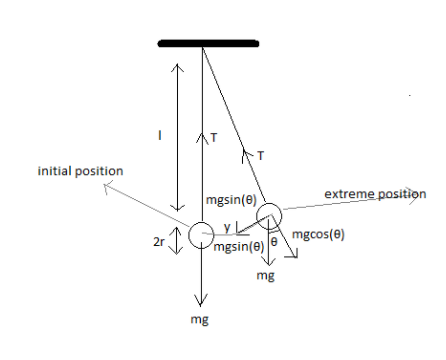
The tension force is represented by $T$
Weight of the bob is represented by$mg$
Gravity is represented by $g$
Mass of bob is represented by $m$
The horizontal component of weight is represented by
\[mgsin\theta \]
Vertical component of weight is represented by
\[mgcos\theta \]
Angle \[\theta \] is the angle made by the initial position with the extreme position. This is also equal to the angle between weight and its horizontal component from internal angles.
At the initial position there are no components for the weight of Bob. At the extreme position the weight of the Bob is divided into vertical and horizontal components as in the diagram. The tension force and the vertical component of the weight cancel each other.
And the remaining force acting on the pendulum to cause oscillation is
\[ - mgsin\theta \]
Negative sign represented the direction.
Let us take the length of the pendulum as $l$
Radius of Bob as $r$
Total length is represented by $t = r + l$
Taking the diagram as a right angled triangle
\[sin\theta \] From the diagram is $\dfrac{y}{l}$
Where $y$ is the displacement of bob
Now the force \[ - mgsin\theta \] becomes
$\Rightarrow$$ - mg\dfrac{y}{l} = F$
Acceleration is equal to
$\Rightarrow$$F = ma$
\[a = \dfrac{F}{m} = \dfrac{{ - mg\dfrac{y}{l}}}{m} = - g\dfrac{y}{l}\]
Taking $\dfrac{g}{l}$ as constant we get
\[a = - cy\].....(1)
From shm acceleration is equal to
$\Rightarrow$\[a = - {\omega ^2}y\]......(2)
Equating (1) and (2)
We get
$\Rightarrow$${\omega ^2} = \dfrac{g}{l}$
$\Rightarrow$$\omega $ is angular frequency which is equal to $\dfrac{{2\pi }}{T}$
Here, $T$ represented time period
Substituting this in the above equation we get
$\Rightarrow$ ${(\dfrac{{2\pi }}{T})^2} = \dfrac{g}{l}$
$\Rightarrow$$\dfrac{{2\pi }}{T} = \sqrt {\dfrac{g}{l}} $
$\Rightarrow$$T = 2\pi \sqrt {\dfrac{l}{g}} $
Hence time period is $T = 2\pi \sqrt {\dfrac{l}{g}} $
From the final equation we can say that the time period of a pendulum depends on length and acceleration due to gravity.
Note: We can consider the oscillations in a pendulum as simple harmonic motion because if a graph of the displacement of the Bob and the time is drawn it shows a simple harmonic motion. Hence, we can say that an oscillating pendulum is a simple harmonic motion.
Complete step by step solution:
The free body diagram of a simple pendulum is as given below
The tension force is represented by $T$
Weight of the bob is represented by$mg$
Gravity is represented by $g$
Mass of bob is represented by $m$
The horizontal component of weight is represented by
\[mgsin\theta \]
Vertical component of weight is represented by
\[mgcos\theta \]
Angle \[\theta \] is the angle made by the initial position with the extreme position. This is also equal to the angle between weight and its horizontal component from internal angles.
At the initial position there are no components for the weight of Bob. At the extreme position the weight of the Bob is divided into vertical and horizontal components as in the diagram. The tension force and the vertical component of the weight cancel each other.
And the remaining force acting on the pendulum to cause oscillation is
\[ - mgsin\theta \]
Negative sign represented the direction.
Let us take the length of the pendulum as $l$
Radius of Bob as $r$
Total length is represented by $t = r + l$
Taking the diagram as a right angled triangle
\[sin\theta \] From the diagram is $\dfrac{y}{l}$
Where $y$ is the displacement of bob
Now the force \[ - mgsin\theta \] becomes
$\Rightarrow$$ - mg\dfrac{y}{l} = F$
Acceleration is equal to
$\Rightarrow$$F = ma$
\[a = \dfrac{F}{m} = \dfrac{{ - mg\dfrac{y}{l}}}{m} = - g\dfrac{y}{l}\]
Taking $\dfrac{g}{l}$ as constant we get
\[a = - cy\].....(1)
From shm acceleration is equal to
$\Rightarrow$\[a = - {\omega ^2}y\]......(2)
Equating (1) and (2)
We get
$\Rightarrow$${\omega ^2} = \dfrac{g}{l}$
$\Rightarrow$$\omega $ is angular frequency which is equal to $\dfrac{{2\pi }}{T}$
Here, $T$ represented time period
Substituting this in the above equation we get
$\Rightarrow$ ${(\dfrac{{2\pi }}{T})^2} = \dfrac{g}{l}$
$\Rightarrow$$\dfrac{{2\pi }}{T} = \sqrt {\dfrac{g}{l}} $
$\Rightarrow$$T = 2\pi \sqrt {\dfrac{l}{g}} $
Hence time period is $T = 2\pi \sqrt {\dfrac{l}{g}} $
From the final equation we can say that the time period of a pendulum depends on length and acceleration due to gravity.
Note: We can consider the oscillations in a pendulum as simple harmonic motion because if a graph of the displacement of the Bob and the time is drawn it shows a simple harmonic motion. Hence, we can say that an oscillating pendulum is a simple harmonic motion.
Recently Updated Pages
Circuit Switching vs Packet Switching: Key Differences Explained

Dimensions of Pressure in Physics: Formula, Derivation & SI Unit
JEE General Topics in Chemistry Important Concepts and Tips
JEE Extractive Metallurgy Important Concepts and Tips for Exam Preparation
JEE Atomic Structure and Chemical Bonding important Concepts and Tips
JEE Amino Acids and Peptides Important Concepts and Tips for Exam Preparation
Trending doubts
JEE Main 2026: Exam Dates, Session 2 Updates, City Slip, Admit Card & Latest News
JEE Main Participating Colleges 2026 - A Complete List of Top Colleges
JEE Main Marking Scheme 2026- Paper-Wise Marks Distribution and Negative Marking Details
Hybridisation in Chemistry – Concept, Types & Applications
Understanding the Electric Field of a Uniformly Charged Ring
Derivation of Equation of Trajectory Explained for Students
Other Pages
JEE Advanced 2026 - Exam Date (Released), Syllabus, Registration, Eligibility, Preparation, and More
JEE Advanced Marks vs Ranks 2025: Understanding Category-wise Qualifying Marks and Previous Year Cut-offs
CBSE Notes Class 11 Physics Chapter 1 - Units And Measurements - 2025-26
NCERT Solutions For Class 11 Physics Chapter 1 Units And Measurements - 2025-26
Important Questions For Class 11 Physics Chapter 1 Units and Measurement - 2025-26
JEE Advanced Weightage 2025 Chapter-Wise for Physics, Maths and Chemistry