




Lenz’s law is in accordance with the law:
A) Conservation of charge
B) Conservation of flux
C) Conservation of momentum
D) Conservation of energy
Answer
 Verified
555.5k+ views
Hint: Following points are important for the given problem:
(1) Explanation of Faraday’s law of EMI
(2) Direction of induced EMF in the circuit
Complete step by step solution:
According to Lenz's law if the magnetic flux associated with the loop changes, then the induced current is produced in the loop, such that the magnetic field due to the induced current opposes the change in the magnetic flux.
The direction of the magnetic field depends on the condition of the magnetic flux increasing or decreasing.
Remember:
(1) For counter clockwise current, EMF is positive.
(2) For clockwise current, EMF is negative.
Consider when the north pole of the magnet is brought near the force of the coil becomes the North pole according to Lenz’s law due to which the repulsive force acts between the magnet and the coil. Same work has to be done against the repulsive force in bringing the North pole of magnet towards the coil. This mechanical work is obtained in the form of electrical energy i.e. induced current (i) in the coil.
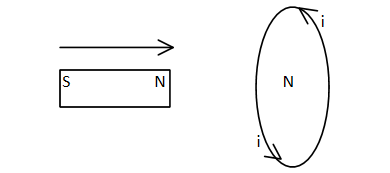
Similarly if the north pole is taken away from the coil, the face becomes the South pole and the attractive forces act between them. In this case the work done is against this attractive force, resulting electrical energy (current)
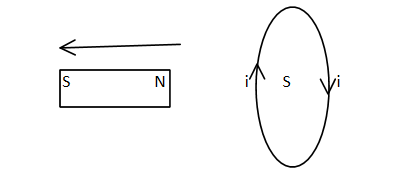
Thus it is clear that Lenz's law is based on the law of conservation of energy.
Note: For such type of problems, the detailed explanation of the following terms is necessary:
(1) Faraday’s law of EMI (experimentally)
(2) Law of conservation of energy
(3) Lenz’s law statement
(1) Explanation of Faraday’s law of EMI
(2) Direction of induced EMF in the circuit
Complete step by step solution:
According to Lenz's law if the magnetic flux associated with the loop changes, then the induced current is produced in the loop, such that the magnetic field due to the induced current opposes the change in the magnetic flux.
The direction of the magnetic field depends on the condition of the magnetic flux increasing or decreasing.
Remember:
(1) For counter clockwise current, EMF is positive.
(2) For clockwise current, EMF is negative.
Consider when the north pole of the magnet is brought near the force of the coil becomes the North pole according to Lenz’s law due to which the repulsive force acts between the magnet and the coil. Same work has to be done against the repulsive force in bringing the North pole of magnet towards the coil. This mechanical work is obtained in the form of electrical energy i.e. induced current (i) in the coil.
Similarly if the north pole is taken away from the coil, the face becomes the South pole and the attractive forces act between them. In this case the work done is against this attractive force, resulting electrical energy (current)
Thus it is clear that Lenz's law is based on the law of conservation of energy.
Note: For such type of problems, the detailed explanation of the following terms is necessary:
(1) Faraday’s law of EMI (experimentally)
(2) Law of conservation of energy
(3) Lenz’s law statement
Recently Updated Pages
JEE Main Mock Test 2025-26: Electromagnetic Induction & Alternating Currents

JEE Main Mock Test 2025-26: Optics Chapter Practice Online
JEE Main 2025-26 Mock Test: Properties of Solids and Liquids
JEE Main Mock Test 2025-26: Dual Nature of Matter & Radiation
JEE Main 2025-26 Electromagnetic Waves Mock Test with Solutions
JEE Main 2025-26 Mock Test: Electronic Devices Chapter Practice
Trending doubts
JEE Main 2026: Exam Dates, Session 2 Updates, City Slip, Admit Card & Latest News
JEE Main Participating Colleges 2026 - A Complete List of Top Colleges
JEE Main Marking Scheme 2026- Paper-Wise Marks Distribution and Negative Marking Details
Hybridisation in Chemistry – Concept, Types & Applications
Understanding the Electric Field of a Uniformly Charged Ring
Derivation of Equation of Trajectory Explained for Students
Other Pages
CBSE Class 12 Physics Question Paper 2026: Download SET-wise PDF with Answer Key & Analysis
JEE Advanced 2026 - Exam Date (Released), Syllabus, Registration, Eligibility, Preparation, and More
JEE Advanced Marks vs Ranks 2025: Understanding Category-wise Qualifying Marks and Previous Year Cut-offs
JEE Advanced Weightage 2025 Chapter-Wise for Physics, Maths and Chemistry
Understanding Atomic Structure for Beginners
Understanding Electromagnetic Waves and Their Importance