




When an input signal \[1\] is applied to a NOT gate, its output is:
A) \[1\]
B) \[0\]
C) Either \[0\] or \[1\]
D) Both \[0\] and \[1\]
Answer
 Verified
263.4k+ views
Hint: NOT gate is one of the basic logical gates. It can be remembered from the name itself that NOT implies getting the opposite output. Remember all the basic gates to avoid confusion.
Complete step by step solution:
The various basic logic gates used digital systems are as follows:
1. OR Gate
2. AND Gate
3. NOT Gate
4. XOR Gate
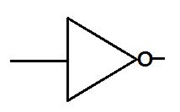
Below is the NOT gate.
OR GATE: In OR gate the output of an OR gate gives the state \[1\] , if one or more inputs attain the state \[1\] i.e. when any one input is \[1\] then the output will be one.
The Boolean expression of the OR gate is given as \[Y=A+B\], which is read as \[Y\] equals \[A\] ‘\[OR\] ’ \[B\].
AND GATE: In AND gate the output of an AND gate is \[1\] if and only if all the inputs are in state \[1\]. The Boolean expression of AND gate is \[Y=A.B\] which is read as Y equals A ‘AND’ B.
NOT GATE: In NOT gate the output of a NOT gate attains the state \[1\] if and only if the input does not attain the state \[1\] . The Boolean expression is \[Y=\overline{A}\] , read as Y equals NOT A.
Hence for input signal \[1\] the output will be \[0\].
Note: All basic gates must be remembered. NAND and XNOR gates are the logical gates which can be obtained using the basic OR, NOT and AND gate. Also the truth table can be easily constructed for each logical gate based on the above definitions. Truth tables make it easier to understand logical gates.
Complete step by step solution:
The various basic logic gates used digital systems are as follows:
1. OR Gate
2. AND Gate
3. NOT Gate
4. XOR Gate
Below is the NOT gate.
OR GATE: In OR gate the output of an OR gate gives the state \[1\] , if one or more inputs attain the state \[1\] i.e. when any one input is \[1\] then the output will be one.
The Boolean expression of the OR gate is given as \[Y=A+B\], which is read as \[Y\] equals \[A\] ‘\[OR\] ’ \[B\].
AND GATE: In AND gate the output of an AND gate is \[1\] if and only if all the inputs are in state \[1\]. The Boolean expression of AND gate is \[Y=A.B\] which is read as Y equals A ‘AND’ B.
NOT GATE: In NOT gate the output of a NOT gate attains the state \[1\] if and only if the input does not attain the state \[1\] . The Boolean expression is \[Y=\overline{A}\] , read as Y equals NOT A.
Hence for input signal \[1\] the output will be \[0\].
Note: All basic gates must be remembered. NAND and XNOR gates are the logical gates which can be obtained using the basic OR, NOT and AND gate. Also the truth table can be easily constructed for each logical gate based on the above definitions. Truth tables make it easier to understand logical gates.
Recently Updated Pages
JEE Main 2025-26 Experimental Skills Mock Test – Free Practice

JEE Main 2025-26 Electronic Devices Mock Test: Free Practice Online
JEE Main 2025-26 Mock Tests: Free Practice Papers & Solutions
JEE Main 2025-26: Magnetic Effects of Current & Magnetism Mock Test
JEE Main 2025-26 Atoms and Nuclei Mock Test – Free Practice Online
JEE Main Mock Test 2025-26: Experimental Skills Chapter Online Practice
Trending doubts
JEE Main 2026: Exam Dates, Session 2 Updates, City Slip, Admit Card & Latest News
JEE Main Participating Colleges 2026 - A Complete List of Top Colleges
Hybridisation in Chemistry – Concept, Types & Applications
Understanding the Electric Field of a Uniformly Charged Ring
Derivation of Equation of Trajectory Explained for Students
Understanding Atomic Structure for Beginners
Other Pages
CBSE Class 12 Physics Question Paper 2026: Download SET-wise PDF with Answer Key & Analysis
JEE Advanced 2026 Notification Out with Exam Date, Registration (Extended), Syllabus and More
JEE Advanced Marks vs Ranks 2025: Understanding Category-wise Qualifying Marks and Previous Year Cut-offs
JEE Advanced Weightage Chapter Wise 2026 for Physics, Chemistry, and Mathematics
JEE Advanced Marks vs Rank 2025 - Predict Your IIT Rank Based on Score
How to Convert a Galvanometer into an Ammeter or Voltmeter