




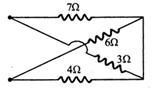
In the given network of four resistances, the equivalent resistance is:
A. \[20\Omega \]
B. \[5.4\Omega \]
C. \[12\Omega \]
D. \[4.5\Omega \]
Answer
 Verified
232.8k+ views
Hint: We have been given in the question a network of four resistances and we are asked to determine the equivalent resistance. For that we have to find the resistance’s algebraic sum. As the given [resistances in the circuit is parallel then the equivalent resistance can be determined using the formula of equivalent resistance of a parallel connection is related to the individual resistance.
Formula used:
\[\frac{1}{{Req}} = \frac{1}{{R1}} + \frac{1}{{R2}} + \frac{1}{{R3}} + \ldots \;\]
Complete answer:
The characteristic of a material that hinders electron passage is called resistance. Four parameters, including temperature, wire length, cross-sectional area, and material type, all have an impact on resistance.
A tool like a digital or analogue multimeter is used to measure resistance. Both types of instruments have the ability to measure resistance as well as current, voltage, and other variables, making them useful in a number of applications.
Ohm's law does not apply everywhere. This is due to the fact that Ohm's law only applies to ohm conductors, like copper and iron, and not to non-ohmic conductors, like semiconductors.
The formula used to calculate the electrical resistance is
\[R = \frac{V}{I}\]
So, the equation becomes,
\[R = \frac{{6 \times 4}}{{6 + 4}} + \frac{{7 \times 3}}{{7 + 3}}\]
By solving the equation, it becomes
\[R = \frac{{24}}{{10}} + \frac{{21}}{{10}}\]
\[R = 2.4 + 2.1\]
Hence, the electrical resistance is determined as,
\[R = 4.5\Omega \]
The unit for the electrical resistance is ohm.
Thus, option (D) is correct.
Note:Students are likely to make mistakes in these types of problems because it is quiet confusing to remember the formulas of equivalent resistance because there are two types such as parallel and series. So first the given series should be observed in order to proceed with the exact formula to get the desired answer. Applying and solving the problem should be done cautiously.
Formula used:
\[\frac{1}{{Req}} = \frac{1}{{R1}} + \frac{1}{{R2}} + \frac{1}{{R3}} + \ldots \;\]
Complete answer:
The characteristic of a material that hinders electron passage is called resistance. Four parameters, including temperature, wire length, cross-sectional area, and material type, all have an impact on resistance.
A tool like a digital or analogue multimeter is used to measure resistance. Both types of instruments have the ability to measure resistance as well as current, voltage, and other variables, making them useful in a number of applications.
Ohm's law does not apply everywhere. This is due to the fact that Ohm's law only applies to ohm conductors, like copper and iron, and not to non-ohmic conductors, like semiconductors.
The formula used to calculate the electrical resistance is
\[R = \frac{V}{I}\]
So, the equation becomes,
\[R = \frac{{6 \times 4}}{{6 + 4}} + \frac{{7 \times 3}}{{7 + 3}}\]
By solving the equation, it becomes
\[R = \frac{{24}}{{10}} + \frac{{21}}{{10}}\]
\[R = 2.4 + 2.1\]
Hence, the electrical resistance is determined as,
\[R = 4.5\Omega \]
The unit for the electrical resistance is ohm.
Thus, option (D) is correct.
Note:Students are likely to make mistakes in these types of problems because it is quiet confusing to remember the formulas of equivalent resistance because there are two types such as parallel and series. So first the given series should be observed in order to proceed with the exact formula to get the desired answer. Applying and solving the problem should be done cautiously.
Recently Updated Pages
JEE Main 2023 April 6 Shift 1 Question Paper with Answer Key

JEE Main 2023 April 6 Shift 2 Question Paper with Answer Key
JEE Main 2023 (January 31 Evening Shift) Question Paper with Solutions [PDF]
JEE Main 2023 January 30 Shift 2 Question Paper with Answer Key
JEE Main 2023 January 25 Shift 1 Question Paper with Answer Key
JEE Main 2023 January 24 Shift 2 Question Paper with Answer Key
Trending doubts
JEE Main 2026: Session 2 Registration Open, City Intimation Slip, Exam Dates, Syllabus & Eligibility
JEE Main 2026 Application Login: Direct Link, Registration, Form Fill, and Steps
Understanding the Angle of Deviation in a Prism
Hybridisation in Chemistry – Concept, Types & Applications
How to Convert a Galvanometer into an Ammeter or Voltmeter
Understanding Uniform Acceleration in Physics
Other Pages
JEE Advanced Marks vs Ranks 2025: Understanding Category-wise Qualifying Marks and Previous Year Cut-offs
Dual Nature of Radiation and Matter Class 12 Physics Chapter 11 CBSE Notes - 2025-26
Understanding the Electric Field of a Uniformly Charged Ring
JEE Advanced Weightage 2025 Chapter-Wise for Physics, Maths and Chemistry
Derivation of Equation of Trajectory Explained for Students
Understanding Electromagnetic Waves and Their Importance