




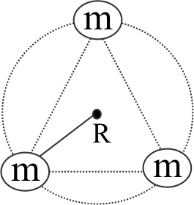
In the given figure, there is a hypothetical planet of mass $M$ at the centre and three moons each of mass $m$ revolves around the planet in the same orbit. The triangle formed in the configuration is an equilateral triangle. If the orbital speed of each moon such that they maintain this configuration is given by $n\sqrt {\dfrac{G}{R}\left( {\dfrac{m}{{\sqrt 3 }} + M} \right)} $ then find $n$. (Neglect the radius of the planet and the moons)
Answer
 Verified
244.8k+ views
Hint: Consider a single moon and find the gravitational forces on that moon due to the planet and the other moons towards the centre of the planet. The sum of these forces towards the centre will be equal to the centripetal force due to which the moons are revolving around the planet.
The gravitational force between two masses ${m_1}$ and ${m_2}$ separated by a distance $r$ is given by ${F_g} = \dfrac{{G{m_1}{m_2}}}{{{r^2}}}$ where $G$ is the gravitational constant.
The centripetal force due to which a body of $m$ revolving in an orbit of radius $r$ with orbital velocity $v$ is given by ${F_c} = \dfrac{{m{v^2}}}{r}$ .
Complete step by step answer:
Let us first consider a moon. The gravitational forces acting on this moon will be due the other two moons and the planet.
We know that the gravitational force between two masses ${m_1}$ and ${m_2}$ separated by a distance $r$ is given by ${F_g} = \dfrac{{G{m_1}{m_2}}}{{{r^2}}}$ where $G$ is the gravitational constant.
As the triangle formed in the configuration is an equilateral triangle so the distance between any two moons will be $\sqrt 3 R$ .
So, the gravitational force due to a moon,
${F_{mm}} = \dfrac{{G{m^2}}}{{{{\left( {\sqrt 3 R} \right)}^2}}} = \dfrac{{G{m^2}}}{{3{R^2}}}$
Now, the gravitational force due to the planet,
${F_{mM}} = \dfrac{{GMm}}{{{R^2}}}$
The total force on the moon towards the centre of the planet
$F = {F_{mM}} + 2{F_{mm}}\cos 30^\circ $
This total force towards the centre will be equal to the centripetal force due to which the moons are revolving around the planet.
We know that the centripetal force due to which a body of $m$ revolving in an orbit of radius $r$ with orbital velocity $v$ is given by ${F_c} = \dfrac{{m{v^2}}}{r}$ .
Therefore substituting the values we have
$\dfrac{{m{v^2}}}{R} = \dfrac{{GMm}}{{{R^2}}} + 2 \times \dfrac{{G{m^2}}}{{3R}} \times \dfrac{{\sqrt 3 }}{2}$
On further solving we have
${v^2} = \dfrac{{GM}}{R} + \dfrac{{Gm}}{{\sqrt 3 R}}$
On simplifying we have
$v = \sqrt {\dfrac{G}{R}\left( {\dfrac{m}{{\sqrt 3 }} + M} \right)} $
On comparing our result from that given in the equation we have
$n = 1$ which is the final answer.
Note: A centripetal force is that force which is necessary to keep a body moving a curved path. The direction of this force is always perpendicular to the motion of the body and towards the centre of rotation which is a fixed point and also called centre of curvature.
The gravitational force between two masses ${m_1}$ and ${m_2}$ separated by a distance $r$ is given by ${F_g} = \dfrac{{G{m_1}{m_2}}}{{{r^2}}}$ where $G$ is the gravitational constant.
The centripetal force due to which a body of $m$ revolving in an orbit of radius $r$ with orbital velocity $v$ is given by ${F_c} = \dfrac{{m{v^2}}}{r}$ .
Complete step by step answer:
Let us first consider a moon. The gravitational forces acting on this moon will be due the other two moons and the planet.
We know that the gravitational force between two masses ${m_1}$ and ${m_2}$ separated by a distance $r$ is given by ${F_g} = \dfrac{{G{m_1}{m_2}}}{{{r^2}}}$ where $G$ is the gravitational constant.
As the triangle formed in the configuration is an equilateral triangle so the distance between any two moons will be $\sqrt 3 R$ .
So, the gravitational force due to a moon,
${F_{mm}} = \dfrac{{G{m^2}}}{{{{\left( {\sqrt 3 R} \right)}^2}}} = \dfrac{{G{m^2}}}{{3{R^2}}}$
Now, the gravitational force due to the planet,
${F_{mM}} = \dfrac{{GMm}}{{{R^2}}}$
The total force on the moon towards the centre of the planet
$F = {F_{mM}} + 2{F_{mm}}\cos 30^\circ $
This total force towards the centre will be equal to the centripetal force due to which the moons are revolving around the planet.
We know that the centripetal force due to which a body of $m$ revolving in an orbit of radius $r$ with orbital velocity $v$ is given by ${F_c} = \dfrac{{m{v^2}}}{r}$ .
Therefore substituting the values we have
$\dfrac{{m{v^2}}}{R} = \dfrac{{GMm}}{{{R^2}}} + 2 \times \dfrac{{G{m^2}}}{{3R}} \times \dfrac{{\sqrt 3 }}{2}$
On further solving we have
${v^2} = \dfrac{{GM}}{R} + \dfrac{{Gm}}{{\sqrt 3 R}}$
On simplifying we have
$v = \sqrt {\dfrac{G}{R}\left( {\dfrac{m}{{\sqrt 3 }} + M} \right)} $
On comparing our result from that given in the equation we have
$n = 1$ which is the final answer.
Note: A centripetal force is that force which is necessary to keep a body moving a curved path. The direction of this force is always perpendicular to the motion of the body and towards the centre of rotation which is a fixed point and also called centre of curvature.
Recently Updated Pages
JEE Main 2026 Session 2 City Intimation Slip Releasing Soon

JEE Main 2027 Exam Date, Syllabus, Pattern, Registration, Eligibility & Updates
JEE Main 2026 Question Papers with Solutions PDF – Free Download
Is a Calculator Allowed in JEE Main 2026? Complete NTA Guidelines
JEE Main 2027 Syllabus: Based on Latest NTA Syllabus with PDF Download
JEE Main Exam Countdown Timer: Track Days Until Exam 2026
Trending doubts
JEE Main 2026: Exam Dates, Session 2 Updates, City Slip, Admit Card & Latest News
Ideal and Non-Ideal Solutions Explained for Class 12 Chemistry
Understanding the Angle of Deviation in a Prism
Hybridisation in Chemistry – Concept, Types & Applications
Understanding the Electric Field of a Uniformly Charged Ring
Derivation of Equation of Trajectory Explained for Students
Other Pages
JEE Advanced Marks vs Ranks 2025: Understanding Category-wise Qualifying Marks and Previous Year Cut-offs
JEE Advanced 2026 - Exam Date (Released), Syllabus, Registration, Eligibility, Preparation, and More
CBSE Notes Class 11 Physics Chapter 1 - Units And Measurements - 2025-26
Important Questions For Class 11 Physics Chapter 1 Units and Measurement - 2025-26
CBSE Notes Class 11 Physics Chapter 4 - Laws of Motion - 2025-26
CBSE Notes Class 11 Physics Chapter 14 - Waves - 2025-26