




In the compound\[C{H_3}COCl\], which type of orbitals have been used by the doubly bonded carbon in bond formation
A. \[s{p^3}\]
B.\[s{p^2}\]
C. sp
D. p
Answer
 Verified
270k+ views
Hint: \[C{H_3}COCl\] is called acetyl chloride which is derived from acetic acid. In this molecule, one carbon is doubly bonded to an oxygen atom. This atom is also bonded to a methyl group and a chlorine atom.
Complete step by step solution:Here in this question, the type of orbitals has been used by the doubly bonded carbon in the bond formation of acetyl chloride.
For this, we have to know the hybridization of this carbon atom. This can be done by using the VSEPR model.
We have learned that the structure and hybridization of a molecule are indicated by the VSEPR model.
This model can be described briefly as follows:-
VSEPR or valence shell electron pair repulsion model says that the shape of the molecule relies on the no.of valence shell electron pairs around the main atom and doesn't matter if they are not bonded.
Pairs of electrons in the valence shell are negatively charged and repulse each other and remain distant from each other.
Lone pair-lone pair repulsion is the highest followed by lone pair-bond pair repulsion and bond pair-bond pair repulsion.
In this molecule, one carbon is doubly bonded to an oxygen atom. This atom is also bonded to a methyl group and a chlorine atom.
There are five bond pairs of electrons and no lone pairs.
There are three sigma bonds and one pi-bond.
Thus, there is \[s{p^2}\] hybridization.
During finding the geometry, we can think that there are 3 bond pairs as multiple bonds are accepted as one electron group.
Using VSEPR theory, we can declare that the geometry is a trigonal planar.
The structure is as follows:-
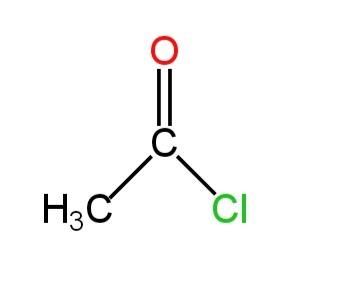
Image: Acetyl chloride
So, option B is correct.
Note: A molecule having four electron groups around the central atom puts the four groups in the direction of a tetrahedron.
If there are four atoms connected to these electron groups the molecular shape is tetrahedral. For instance, methane
Complete step by step solution:Here in this question, the type of orbitals has been used by the doubly bonded carbon in the bond formation of acetyl chloride.
For this, we have to know the hybridization of this carbon atom. This can be done by using the VSEPR model.
We have learned that the structure and hybridization of a molecule are indicated by the VSEPR model.
This model can be described briefly as follows:-
VSEPR or valence shell electron pair repulsion model says that the shape of the molecule relies on the no.of valence shell electron pairs around the main atom and doesn't matter if they are not bonded.
Pairs of electrons in the valence shell are negatively charged and repulse each other and remain distant from each other.
Lone pair-lone pair repulsion is the highest followed by lone pair-bond pair repulsion and bond pair-bond pair repulsion.
In this molecule, one carbon is doubly bonded to an oxygen atom. This atom is also bonded to a methyl group and a chlorine atom.
There are five bond pairs of electrons and no lone pairs.
There are three sigma bonds and one pi-bond.
Thus, there is \[s{p^2}\] hybridization.
During finding the geometry, we can think that there are 3 bond pairs as multiple bonds are accepted as one electron group.
Using VSEPR theory, we can declare that the geometry is a trigonal planar.
The structure is as follows:-
Image: Acetyl chloride
So, option B is correct.
Note: A molecule having four electron groups around the central atom puts the four groups in the direction of a tetrahedron.
If there are four atoms connected to these electron groups the molecular shape is tetrahedral. For instance, methane
Recently Updated Pages
Disproportionation Reaction: Definition, Example & JEE Guide

Hess Law of Constant Heat Summation: Definition, Formula & Applications
JEE General Topics in Chemistry Important Concepts and Tips
JEE Extractive Metallurgy Important Concepts and Tips for Exam Preparation
JEE Atomic Structure and Chemical Bonding important Concepts and Tips
JEE Amino Acids and Peptides Important Concepts and Tips for Exam Preparation
Trending doubts
JEE Main 2026: Exam Dates, Session 2 Updates, City Slip, Admit Card & Latest News
JEE Main Participating Colleges 2026 - A Complete List of Top Colleges
Understanding the Electric Field of a Uniformly Charged Ring
Understanding Atomic Structure for Beginners
Derivation of Equation of Trajectory Explained for Students
JEE Main Marking Scheme 2026- Paper-Wise Marks Distribution and Negative Marking Details
Other Pages
JEE Advanced 2026 Notification Out with Exam Date, Registration (Extended), Syllabus and More
JEE Advanced Percentile vs Marks 2026: JEE Main Cutoff, AIR & IIT Admission Guide
JEE Advanced 2026 Marks vs Rank: Estimate IIT Rank from Your Score
JEE Advanced Weightage Chapter Wise 2026 for Physics, Chemistry, and Mathematics
Understanding the Different Types of Solutions in Chemistry
NCERT Solutions For Class 11 Chemistry In Hindi Chapter 1 Some Basic Concepts Of Chemistry - 2025-26