




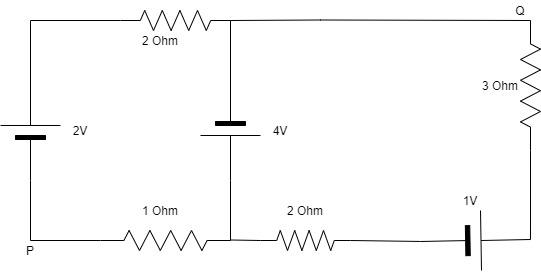
In the circuit shown, what is the potential difference ${V_{PQ}}$?
A) +3V
B) +2V
C) -2V
D) None of these
Answer
 Verified
264.9k+ views
Hint: Kirchhoff’s proposed two laws that help in solving complex electronics circuits one is KCL (Kirchhoff’s current Law) and another one is KVL (Kirchhoff’s voltage law). These two laws are used for finding the equivalent resistance.
Complete step by step solution:
We will be using KVL, Kirchhoff has defined the voltage loop law as: In any loop network that is closed the net total voltage in the entire loop is equivalent to the sum of all the voltage drops which is within the loop and is also equal to zero.
Here, consider two loops in the clockwise direction for the two areas. Here the current “I” flowing in the 4V and current ${I_1}$ is flowing in 2V and current $\left( {I - {I_1}} \right)$ is flowing in 1V. Apply KVL in the first loop:
$2 - 2{I_1} + 4 - {I_1} = 0$ ;
$ \Rightarrow 6 - 3{I_1} = 0$;
Do the needed calculation:
$ \Rightarrow {I_1} = \dfrac{6}{3}$;
$ \Rightarrow {I_1} = 2A$;
Now,
${V_{PQ}} = {V_p} - {V_Q}$;
Now, we know that:
V = IR;
Put the above relation in the above equation:
$\Rightarrow {V_{PQ}} = 2 - {I_1}R$;
$\Rightarrow {V_{PQ}} = 2 - \left( 2 \right)\left( 2 \right)$;
The value of ${V_{PQ}}$is:
$ \Rightarrow {V_{PQ}} = + 2V$;
Option (B) is the correct option. Therefore, the potential difference ${V_{PQ}}$ is +2V.
Note: Here, there is no electronic device between the midpoint in the circuit and the point Q, so there is no need to choose a long path in calculating the potential difference, instead choose the shortest path between the point P and Q but before that calculate the current in the circuit by using Kirchhoff’s voltage loop law.
Complete step by step solution:
We will be using KVL, Kirchhoff has defined the voltage loop law as: In any loop network that is closed the net total voltage in the entire loop is equivalent to the sum of all the voltage drops which is within the loop and is also equal to zero.
Here, consider two loops in the clockwise direction for the two areas. Here the current “I” flowing in the 4V and current ${I_1}$ is flowing in 2V and current $\left( {I - {I_1}} \right)$ is flowing in 1V. Apply KVL in the first loop:
$2 - 2{I_1} + 4 - {I_1} = 0$ ;
$ \Rightarrow 6 - 3{I_1} = 0$;
Do the needed calculation:
$ \Rightarrow {I_1} = \dfrac{6}{3}$;
$ \Rightarrow {I_1} = 2A$;
Now,
${V_{PQ}} = {V_p} - {V_Q}$;
Now, we know that:
V = IR;
Put the above relation in the above equation:
$\Rightarrow {V_{PQ}} = 2 - {I_1}R$;
$\Rightarrow {V_{PQ}} = 2 - \left( 2 \right)\left( 2 \right)$;
The value of ${V_{PQ}}$is:
$ \Rightarrow {V_{PQ}} = + 2V$;
Option (B) is the correct option. Therefore, the potential difference ${V_{PQ}}$ is +2V.
Note: Here, there is no electronic device between the midpoint in the circuit and the point Q, so there is no need to choose a long path in calculating the potential difference, instead choose the shortest path between the point P and Q but before that calculate the current in the circuit by using Kirchhoff’s voltage loop law.
Recently Updated Pages
JEE Main 2025-26 Experimental Skills Mock Test – Free Practice

JEE Main 2025-26 Electronic Devices Mock Test: Free Practice Online
JEE Main 2025-26 Mock Tests: Free Practice Papers & Solutions
JEE Main 2025-26: Magnetic Effects of Current & Magnetism Mock Test
JEE Main 2025-26 Atoms and Nuclei Mock Test – Free Practice Online
JEE Main Mock Test 2025-26: Experimental Skills Chapter Online Practice
Trending doubts
JEE Main 2026: Exam Dates, Session 2 Updates, City Slip, Admit Card & Latest News
JEE Main Participating Colleges 2026 - A Complete List of Top Colleges
Kinematics Mock Test for JEE Main 2025-26: Comprehensive Practice
Kinematics Mock Test for JEE Main 2025-26: Practice & Ace the Exam
Hybridisation in Chemistry – Concept, Types & Applications
Understanding the Electric Field of a Uniformly Charged Ring
Other Pages
CBSE Class 12 Physics Question Paper 2026: Download SET-wise PDF with Answer Key & Analysis
JEE Advanced 2026 Notification Out with Exam Date, Registration (Extended), Syllabus and More
JEE Advanced Percentile vs Marks 2026: JEE Main Cutoff, AIR & IIT Admission Guide
JEE Advanced Weightage Chapter Wise 2026 for Physics, Chemistry, and Mathematics
JEE Advanced Marks vs Rank 2025 - Predict Your IIT Rank Based on Score
Derivation of Equation of Trajectory Explained for Students