




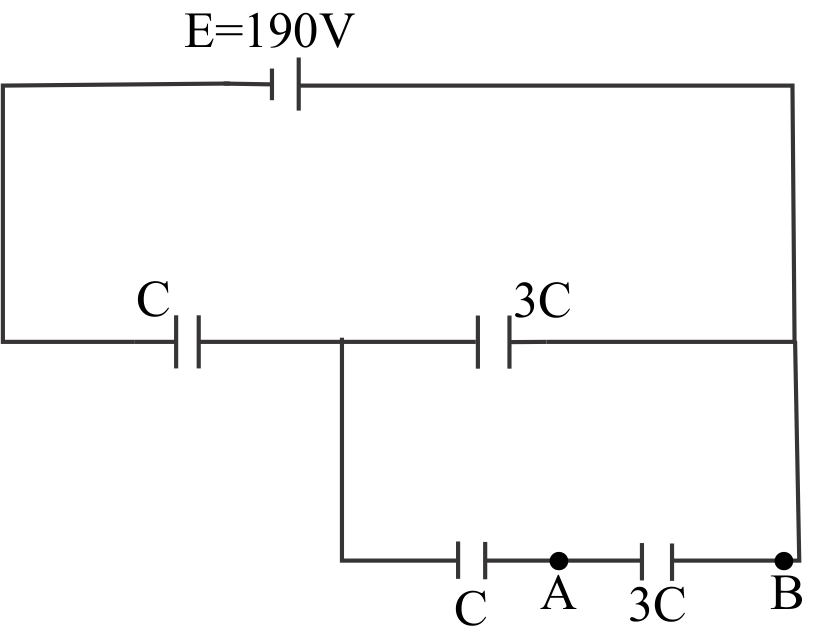
In the circuit shown in figure, potential difference between A and B is
A. $30V$
B. $60V$
C. $10V$
D. $90V$
Answer
 Verified
255.9k+ views
Hint First calculate the resultant capacitance of the circuit. Then using the appropriate formula, determine its charge. Considering the charge of two capacitors connected in series are the same, calculate the voltage difference across capacitors $C$ and $3C$.
Formula used
For series connection, ${C_{eq}} = \dfrac{{{C_1}{C_2}}}{{{C_1} + {C_2}}}$ and for parallel connection, ${C_{eq}} = {C_1} + {C_2}$
$q = CV$ where $q$ is the charge of the capacitor, $C$ is called the capacitance and $V$ is the potential difference across the capacitor.
Complete step by step answer
A capacitor is a system of conductors and dielectric that can store electric charge. It consists of two conductors containing equal and opposite charges and has a potential difference $V$ between them.
The potential difference between the conductors is proportional to the charge on the capacitor and is given by the relation $q = CV$ where $q$ is the charge on the positive conductor and $C$ is called the capacitance.
First let us calculate the equivalent capacitance of this circuit.
So,
$
3 + \left( {\dfrac{3}{4}} \right) \\
= \dfrac{{15}}{4} \\
$
This is the capacitance of the two branches in parallel to each other where $\dfrac{3}{4}$is the equivalent capacitance of capacitors $C$ and $3C$ connected in series.
This is in series connection with the capacitance $C$
So, equivalent capacitance of the circuit is
$\dfrac{{\dfrac{{15}}{4}}}{{1 + \dfrac{{15}}{4}}} = $ $\dfrac{{\dfrac{{15}}{4}}}{{\dfrac{{19}}{4}}} = \dfrac{{15}}{{19}}$
Using the formula $q = CV$we find,
$q = \dfrac{{15}}{{19}} \times 190 = 150C$
So, the charge of the resultant capacitance is $150C$
Now, as both capacitances $1$ and $\dfrac{{15}}{4}$ are in series, they must have the same charges.
Therefore, voltage across capacitance $\dfrac{{15}}{4}$ is
$V = \dfrac{q}{C} = \dfrac{{150}}{{\dfrac{{15}}{4}}} = 40V$
From the diagram we can show that the voltage across capacitances $C$ and $3C$ is $40V$.
Again since these two capacitors are in series so they must have the same charges.
Equivalent capacitance of $C$and $3C$is
${C_{eq}} = \dfrac{3}{4}$
$
q = {C_{eq}}V \\
\Rightarrow q = \dfrac{3}{4} \times 40 = 30C \\
$
Therefore the voltage across capacitance $3C$is $\dfrac{{30}}{3} = 10V$
Thus, the correct option is C.
Note It is important to note that two or more capacitors in series will always have the same charge across their plates. As the charge is equal and constant, the voltage drop across the capacitor is determined by the value of the capacitor only.
Formula used
For series connection, ${C_{eq}} = \dfrac{{{C_1}{C_2}}}{{{C_1} + {C_2}}}$ and for parallel connection, ${C_{eq}} = {C_1} + {C_2}$
$q = CV$ where $q$ is the charge of the capacitor, $C$ is called the capacitance and $V$ is the potential difference across the capacitor.
Complete step by step answer
A capacitor is a system of conductors and dielectric that can store electric charge. It consists of two conductors containing equal and opposite charges and has a potential difference $V$ between them.
The potential difference between the conductors is proportional to the charge on the capacitor and is given by the relation $q = CV$ where $q$ is the charge on the positive conductor and $C$ is called the capacitance.
First let us calculate the equivalent capacitance of this circuit.
So,
$
3 + \left( {\dfrac{3}{4}} \right) \\
= \dfrac{{15}}{4} \\
$
This is the capacitance of the two branches in parallel to each other where $\dfrac{3}{4}$is the equivalent capacitance of capacitors $C$ and $3C$ connected in series.
This is in series connection with the capacitance $C$
So, equivalent capacitance of the circuit is
$\dfrac{{\dfrac{{15}}{4}}}{{1 + \dfrac{{15}}{4}}} = $ $\dfrac{{\dfrac{{15}}{4}}}{{\dfrac{{19}}{4}}} = \dfrac{{15}}{{19}}$
Using the formula $q = CV$we find,
$q = \dfrac{{15}}{{19}} \times 190 = 150C$
So, the charge of the resultant capacitance is $150C$
Now, as both capacitances $1$ and $\dfrac{{15}}{4}$ are in series, they must have the same charges.
Therefore, voltage across capacitance $\dfrac{{15}}{4}$ is
$V = \dfrac{q}{C} = \dfrac{{150}}{{\dfrac{{15}}{4}}} = 40V$
From the diagram we can show that the voltage across capacitances $C$ and $3C$ is $40V$.
Again since these two capacitors are in series so they must have the same charges.
Equivalent capacitance of $C$and $3C$is
${C_{eq}} = \dfrac{3}{4}$
$
q = {C_{eq}}V \\
\Rightarrow q = \dfrac{3}{4} \times 40 = 30C \\
$
Therefore the voltage across capacitance $3C$is $\dfrac{{30}}{3} = 10V$
Thus, the correct option is C.
Note It is important to note that two or more capacitors in series will always have the same charge across their plates. As the charge is equal and constant, the voltage drop across the capacitor is determined by the value of the capacitor only.
Recently Updated Pages
Electricity and Magnetism Explained: Key Concepts & Applications

JEE Energetics Important Concepts and Tips for Exam Preparation
JEE Isolation, Preparation and Properties of Non-metals Important Concepts and Tips for Exam Preparation
JEE Main Mock Test 2025-26: Electromagnetic Induction & Alternating Currents
JEE Main 2023 (February 1st Shift 1) Maths Question Paper with Answer Key
JEE Main 2023 (February 1st Shift 2) Maths Question Paper with Answer Key
Trending doubts
JEE Main 2026: Exam Dates, Session 2 Updates, City Slip, Admit Card & Latest News
JEE Main Participating Colleges 2026 - A Complete List of Top Colleges
JEE Main 2026 Application Login: Direct Link, Registration, Form Fill, and Steps
JEE Main Colleges 2026: Complete List of Participating Institutes
JEE Main Marking Scheme 2026- Paper-Wise Marks Distribution and Negative Marking Details
Hybridisation in Chemistry – Concept, Types & Applications
Other Pages
CBSE Class 12 Physics Question Paper 2026: Download SET-wise PDF with Answer Key & Analysis
JEE Advanced 2026 - Exam Date (Released), Syllabus, Registration, Eligibility, Preparation, and More
JEE Advanced Marks vs Ranks 2025: Understanding Category-wise Qualifying Marks and Previous Year Cut-offs
JEE Advanced Weightage 2025 Chapter-Wise for Physics, Maths and Chemistry
Understanding the Electric Field of a Uniformly Charged Ring
Derivation of Equation of Trajectory Explained for Students