




In ${ BI }_{ 3 }$ molecule distance between two I atoms is found to be 3.54 $\overset { o }{ A } $. Also, ${ BI }_{ 3 }$ has ${ sp }^{ 2 }$-hybridised boron atom. If the radius of a covalently bonded I atom is 1.33, the covalent radius of boron will be X $\overset { o }{ A } $. Find the value of 100X.
Answer
 Verified
249.3k+ views
Hint: Here we need to determine the shape of the molecule using VSEPR theory and hybridization theory and then use trigonometric functions in order to arrive at the answer.
Complete step by step solution:
In order to solve this question, we will use the VSEPR and hybridisation theory. In order to determine the hybridization of an atom in a molecule we should follow the following steps:
-First, you have to determine the Lewis structure of the molecule.
-Now assign the regions of electron density around the atom using VSEPR theory for predicting the shape of the molecule (single bonds, multiple bonds, radicals, and lone pairs each will count as one region).
-Now we can determine the set of hybridized orbitals corresponding to the geometry determined using VSEPR theory.
The Lewis structure of ${ BI }_{ 3 }$ is given below:
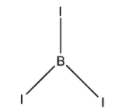
From the above structure, it is clear that the regions of electron density around the central atom are three. Therefore the geometry of the molecule is a Trigonal planar according to VSEPR theory. For a Trigonal planar molecule, the central atom must undergo $ { sp }^{ 2 }$ hybridization. The 2s and two 2p orbitals of Boron combine together in order to give three $ { sp }^{ 2 }$ hybrid orbitals.
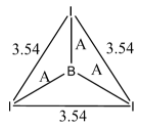
Now it is given that the radius of the I atom is 1.33 $\overset { o }{ A } $. Let the bond length of the B-I bond be A. The radius of the B atom is X $\overset { o }{ A } $. The distance between two I atoms in the structure is 3.54 $\overset { o }{ A } $. The diagram is shown below:
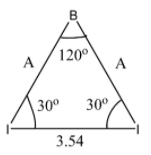
Taking one of the Isosceles triangles, we get:
Now, we will draw a perpendicular line from B to the line connecting the two I atoms.
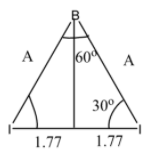
Let the length of the perpendicular be h, then
$\tan { { 30 }^{ o }=\dfrac { h }{ 1.77 } = } \dfrac { 1 }{ \sqrt { 3 } } $
$\Rightarrow h=1.02\overset { o }{ A } $
Now, applying Pythagoras theorem,
${ A }^{ 2 }=({ 1.02) }^{ 2 }+{ (1.77) }^{ 2 }$
${ \Rightarrow A=2.042 \overset { o }{ A } }$
This length is the sum of the radius of I and B, therefore
$2.42\overset { o }{ A } =1.33\overset { o }{ A } +X\overset { o }{ A } $
${ \Rightarrow X=0.712\overset { o }{ A } }$
So, ${ 100X=0.712\overset { o }{ A } \times 100=71.2 \overset { o }{ A } }$
Hence 100X is equal to $71.2\overset { o }{ A } $.
Note: Hybridization and VSEPR theory can only be applied when the molecules contain small central atoms. It cannot explain the structure of transition metal compounds since it does not concern itself with the inactive lone pairs and the sizes of the substituent groups.
Complete step by step solution:
In order to solve this question, we will use the VSEPR and hybridisation theory. In order to determine the hybridization of an atom in a molecule we should follow the following steps:
-First, you have to determine the Lewis structure of the molecule.
-Now assign the regions of electron density around the atom using VSEPR theory for predicting the shape of the molecule (single bonds, multiple bonds, radicals, and lone pairs each will count as one region).
-Now we can determine the set of hybridized orbitals corresponding to the geometry determined using VSEPR theory.
The Lewis structure of ${ BI }_{ 3 }$ is given below:
From the above structure, it is clear that the regions of electron density around the central atom are three. Therefore the geometry of the molecule is a Trigonal planar according to VSEPR theory. For a Trigonal planar molecule, the central atom must undergo $ { sp }^{ 2 }$ hybridization. The 2s and two 2p orbitals of Boron combine together in order to give three $ { sp }^{ 2 }$ hybrid orbitals.
Now it is given that the radius of the I atom is 1.33 $\overset { o }{ A } $. Let the bond length of the B-I bond be A. The radius of the B atom is X $\overset { o }{ A } $. The distance between two I atoms in the structure is 3.54 $\overset { o }{ A } $. The diagram is shown below:
Taking one of the Isosceles triangles, we get:
Now, we will draw a perpendicular line from B to the line connecting the two I atoms.
Let the length of the perpendicular be h, then
$\tan { { 30 }^{ o }=\dfrac { h }{ 1.77 } = } \dfrac { 1 }{ \sqrt { 3 } } $
$\Rightarrow h=1.02\overset { o }{ A } $
Now, applying Pythagoras theorem,
${ A }^{ 2 }=({ 1.02) }^{ 2 }+{ (1.77) }^{ 2 }$
${ \Rightarrow A=2.042 \overset { o }{ A } }$
This length is the sum of the radius of I and B, therefore
$2.42\overset { o }{ A } =1.33\overset { o }{ A } +X\overset { o }{ A } $
${ \Rightarrow X=0.712\overset { o }{ A } }$
So, ${ 100X=0.712\overset { o }{ A } \times 100=71.2 \overset { o }{ A } }$
Hence 100X is equal to $71.2\overset { o }{ A } $.
Note: Hybridization and VSEPR theory can only be applied when the molecules contain small central atoms. It cannot explain the structure of transition metal compounds since it does not concern itself with the inactive lone pairs and the sizes of the substituent groups.
Recently Updated Pages
JEE Isolation, Preparation and Properties of Non-metals Important Concepts and Tips for Exam Preparation

Isoelectronic Definition in Chemistry: Meaning, Examples & Trends
Ionisation Energy and Ionisation Potential Explained
Iodoform Reactions - Important Concepts and Tips for JEE
Introduction to Dimensions: Understanding the Basics
Instantaneous Velocity Explained: Formula, Examples & Graphs
Trending doubts
JEE Main 2026: Exam Dates, Session 2 Updates, City Slip, Admit Card & Latest News
Hybridisation in Chemistry – Concept, Types & Applications
Understanding the Electric Field of a Uniformly Charged Ring
JEE Main 2026 Application Login: Direct Link, Registration, Form Fill, and Steps
Derivation of Equation of Trajectory Explained for Students
JEE Main Marking Scheme 2026- Paper-Wise Marks Distribution and Negative Marking Details
Other Pages
JEE Advanced Marks vs Ranks 2025: Understanding Category-wise Qualifying Marks and Previous Year Cut-offs
JEE Advanced 2026 - Exam Date (Released), Syllabus, Registration, Eligibility, Preparation, and More
CBSE Notes Class 11 Chemistry Chapter 9 - Hydrocarbons - 2025-26
CBSE Notes Class 11 Chemistry Chapter 5 - Thermodynamics - 2025-26
CBSE Notes Class 11 Chemistry Chapter 8 - Organic Chemistry Some Basic Principles And Techniques - 2025-26
JEE Advanced Weightage 2025 Chapter-Wise for Physics, Maths and Chemistry