




In an office, every employee likes at least one of tea, coffee, and milk. The number of employees who like only tea, only coffee, only milk and all the three is all equal to x. The number of employees who like only tea and coffee, only coffee and milk, and only tea and milk is equal and each is equal to the number of employees who like all three is equal to x. Then the possible value of the number of employees on the office is
(A) 65
(B) 90
(C) 77
(D) 85
Answer
 Verified
232.8k+ views
Hint: The number of employees who like only Tea, Coffee, and Milk is equal to x. The number of employees who like only tea and coffee, only coffee and tea, and only tea and milk is equal to x. The number of employees who like all three is equal to x, \[\left( T\cap C\cap M \right)\] = x. Using these all pieces of information, draw a Venn diagram. Now, get the total number of employees who are included in the tea circle, coffee circle, and milk circle that is, \[n\left( T \right)\] , \[n\left( C \right)\] , and \[n\left( M \right)\] respectively. Then, get the total number of employees who are included in the tea and coffee circle, coffee and milk circle, and tea and milk circle that is, \[n\left( T\cap C \right)\] , \[n\left( C\cap M \right)\] , and \[n\left( T\cap M \right)\] respectively. We have to get the total number of employees that is \[\left( T\cap C\cap M \right)\] . Use the formula,
\[T\cup C\cup M=n\left( T \right)+n\left( C \right)+n\left( M \right)-n\left( T\cap C \right)-n\left( C\cap M \right)-n\left( T\cap M \right)+\left( T\cap C\cap M \right)\] and solve it further.
Complete step-by-step answer:
According to the question, it is given that, in an office, The number of employees who like only tea, only coffee, only milk and all the three is all equal to x. So,
The number of employees who like only Tea = x.
The number of employees who like only Coffee = x.
The number of employees who like only Milk = x.
It is also given that, the number of employees who like only tea and coffee, only coffee and milk and only tea and milk is equal and each is equal to the number of employees who like all the three is equal to x. So,
The number of employees who like only tea and coffee, \[n\left( T\cap C \right)\] = x …………………..(1)
The number of employees who like only coffee and milk, \[n\left( C\cap M \right)\] = x ……………………(2)
The number of employees who like only tea and milk, \[n\left( T\cap M \right)\] = x ………………………..(3)
The number of employees who like tea, coffee, and milk, \[\left( T\cap C\cap M \right)\] = x ………………….(4)
Now, drawing Venn diagram, we get
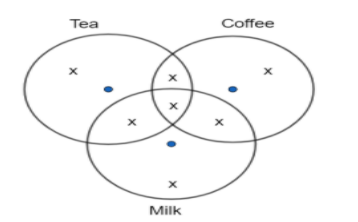
In the Venn diagram, we have,
The total number of employees who are included in the tea circle, \[n\left( T \right)\] = 4x ………………………..(5)
The total number of employees who are included in the coffee circle, \[n\left( C \right)\] = 4x ……………………..(6)
The total number of employees who are included in the milk circle, \[n\left( M \right)\] = 4x ……………………………(7)
The total number of employees who are included in tea and coffee circle, \[n\left( T\cap C \right)\] = 2x …………………..(8)
The total number of employees who are included in coffee and milk circle, \[n\left( C\cap M \right)\] = 2x ……………………(9)
The total number of employees who are included in tea and milk circle, \[n\left( T\cap M \right)\] = 2x
………………………..(10)
The total number of employees can be expressed as \[\left( T\cap C\cap M \right)\] .
We know the formula,
\[A\cup B\cup C=n\left( A \right)+n\left( B \right)+n\left( C \right)-n\left( A\cap B \right)-n\left( B\cap C \right)-n\left( A\cap C \right)+\left( A\cap B\cap C \right)\] ……………..(11)
Replacing A by T, B by C, and C by M in equation (8), we get
\[T\cup C\cup M=n\left( T \right)+n\left( C \right)+n\left( M \right)-n\left( T\cap C \right)-n\left( C\cap M \right)-n\left( T\cap M \right)+\left( T\cap C\cap M \right)\] ……………………..(12)
From equation (4), equation (5), equation (6), equation (7), equation (8), equation (9), equation (10), and equation (12), we get
\[\begin{align}
& T\cup C\cup M=n\left( T \right)+n\left( C \right)+n\left( M \right)-n\left( T\cap C \right)-n\left( C\cap M \right)-n\left( T\cap M \right)+\left( T\cap C\cap M \right) \\
& \Rightarrow T\cup C\cup M=4x+4x+4x-2x-2x-2x+x \\
\end{align}\]
\[\Rightarrow T\cup C\cup M=7x\] ……………………..(13)
In equation (13), we have the total number of employees equal to 7x. We can see that the total number of employees is multiple of 7.
Among all the options given, we have the only option (C) which is the multiple of 7.
So, the correct option is (C).
Note: In this question, one can take the total number of employees who like tea, coffee, and milk as x. This is wrong. ‘x’ is the number of employees who like only tea, only coffee, and only milk. The number of employees who like only tea, only coffee, and only milk cannot be equal to the total number of employees who like tea, coffee, and milk. To get the total number of employees who like tea, coffee, and milk, we have to draw the Venn diagram.
\[T\cup C\cup M=n\left( T \right)+n\left( C \right)+n\left( M \right)-n\left( T\cap C \right)-n\left( C\cap M \right)-n\left( T\cap M \right)+\left( T\cap C\cap M \right)\] and solve it further.
Complete step-by-step answer:
According to the question, it is given that, in an office, The number of employees who like only tea, only coffee, only milk and all the three is all equal to x. So,
The number of employees who like only Tea = x.
The number of employees who like only Coffee = x.
The number of employees who like only Milk = x.
It is also given that, the number of employees who like only tea and coffee, only coffee and milk and only tea and milk is equal and each is equal to the number of employees who like all the three is equal to x. So,
The number of employees who like only tea and coffee, \[n\left( T\cap C \right)\] = x …………………..(1)
The number of employees who like only coffee and milk, \[n\left( C\cap M \right)\] = x ……………………(2)
The number of employees who like only tea and milk, \[n\left( T\cap M \right)\] = x ………………………..(3)
The number of employees who like tea, coffee, and milk, \[\left( T\cap C\cap M \right)\] = x ………………….(4)
Now, drawing Venn diagram, we get
In the Venn diagram, we have,
The total number of employees who are included in the tea circle, \[n\left( T \right)\] = 4x ………………………..(5)
The total number of employees who are included in the coffee circle, \[n\left( C \right)\] = 4x ……………………..(6)
The total number of employees who are included in the milk circle, \[n\left( M \right)\] = 4x ……………………………(7)
The total number of employees who are included in tea and coffee circle, \[n\left( T\cap C \right)\] = 2x …………………..(8)
The total number of employees who are included in coffee and milk circle, \[n\left( C\cap M \right)\] = 2x ……………………(9)
The total number of employees who are included in tea and milk circle, \[n\left( T\cap M \right)\] = 2x
………………………..(10)
The total number of employees can be expressed as \[\left( T\cap C\cap M \right)\] .
We know the formula,
\[A\cup B\cup C=n\left( A \right)+n\left( B \right)+n\left( C \right)-n\left( A\cap B \right)-n\left( B\cap C \right)-n\left( A\cap C \right)+\left( A\cap B\cap C \right)\] ……………..(11)
Replacing A by T, B by C, and C by M in equation (8), we get
\[T\cup C\cup M=n\left( T \right)+n\left( C \right)+n\left( M \right)-n\left( T\cap C \right)-n\left( C\cap M \right)-n\left( T\cap M \right)+\left( T\cap C\cap M \right)\] ……………………..(12)
From equation (4), equation (5), equation (6), equation (7), equation (8), equation (9), equation (10), and equation (12), we get
\[\begin{align}
& T\cup C\cup M=n\left( T \right)+n\left( C \right)+n\left( M \right)-n\left( T\cap C \right)-n\left( C\cap M \right)-n\left( T\cap M \right)+\left( T\cap C\cap M \right) \\
& \Rightarrow T\cup C\cup M=4x+4x+4x-2x-2x-2x+x \\
\end{align}\]
\[\Rightarrow T\cup C\cup M=7x\] ……………………..(13)
In equation (13), we have the total number of employees equal to 7x. We can see that the total number of employees is multiple of 7.
Among all the options given, we have the only option (C) which is the multiple of 7.
So, the correct option is (C).
Note: In this question, one can take the total number of employees who like tea, coffee, and milk as x. This is wrong. ‘x’ is the number of employees who like only tea, only coffee, and only milk. The number of employees who like only tea, only coffee, and only milk cannot be equal to the total number of employees who like tea, coffee, and milk. To get the total number of employees who like tea, coffee, and milk, we have to draw the Venn diagram.
Recently Updated Pages
JEE Main 2023 April 6 Shift 1 Question Paper with Answer Key

JEE Main 2023 April 6 Shift 2 Question Paper with Answer Key
JEE Main 2023 (January 31 Evening Shift) Question Paper with Solutions [PDF]
JEE Main 2023 January 30 Shift 2 Question Paper with Answer Key
JEE Main 2023 January 25 Shift 1 Question Paper with Answer Key
JEE Main 2023 January 24 Shift 2 Question Paper with Answer Key
Trending doubts
JEE Main 2026: Session 2 Registration Open, City Intimation Slip, Exam Dates, Syllabus & Eligibility
JEE Main 2026 Application Login: Direct Link, Registration, Form Fill, and Steps
Understanding the Angle of Deviation in a Prism
Hybridisation in Chemistry – Concept, Types & Applications
How to Convert a Galvanometer into an Ammeter or Voltmeter
Understanding the Electric Field of a Uniformly Charged Ring
Other Pages
JEE Advanced Marks vs Ranks 2025: Understanding Category-wise Qualifying Marks and Previous Year Cut-offs
NCERT Solutions For Class 11 Maths Chapter 12 Limits and Derivatives (2025-26)
NCERT Solutions For Class 11 Maths Chapter 10 Conic Sections (2025-26)
JEE Advanced Weightage 2025 Chapter-Wise for Physics, Maths and Chemistry
Derivation of Equation of Trajectory Explained for Students
Understanding Electromagnetic Waves and Their Importance