




In a triangle, ABC right angled at C, the value of $\tan A+\tan B$ is [Pb. CET 1990; Karnataka CET 1999; MP PET 2001]
A. a+b
B. $\dfrac{{{a}^{2}}}{bc}$
C. $\dfrac{{{b}^{2}}}{ac}$
D. $\dfrac{{{c}^{2}}}{ab}$
Answer
 Verified
232.8k+ views
Hint:
In the question, we have given a right-angled triangle. In order to obtain the value of $\tan A+\tan B$, we have to find the value for $\tan A$ and $\tan B$ using the trigonometric ratio of the tangent of an angle. Then add up the values. Use the Pythagoras theorem for a right-angled triangle and make a possible substitution. Now compare the obtained result with the given options.
Formula Used:
When it comes to the angle of $90$ degrees, we are aware that it is a right-angled triangle with a base, a perpendicular, and a hypotenuse then,
$\tan A = \dfrac{Perpendicular}{Base}$.
Complete step-by-step solution:
We have given a triangle $ABC$ with right-angles at $C$;
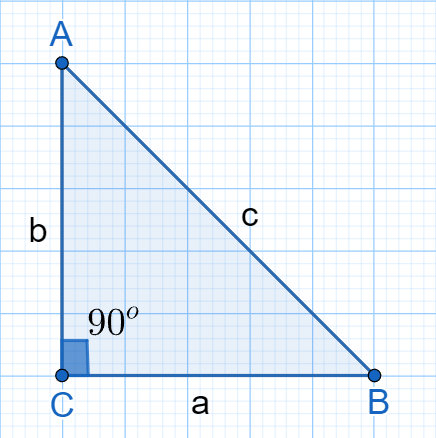
According to the Pythagoras theorem, we can write;
$c^2=a^2+b^2…(i)$
Therefore,
$\tan A=\dfrac{a}{b}\\
\tan B=\dfrac{b}{a}$
Now,
$\tan A+\tan B\\
=\dfrac{a}{b}+\dfrac{b}{a}\\
=\dfrac{a^2+b^2}{ab}$
Substitute eq (i)
$=\dfrac{c^2}{ab}$
Hence, $\tan A+\tan B=\dfrac{c^2}{ab}$
So, option D is correct.
Note:
Keep in mind that such type of question requires knowledge of the basic trigonometric ratios. The trigonometric ratios of a given acute angle are the ratios of the sides of a right-angled triangle concerning that angle. Therefore, the ratio of the angle's opposite and adjacent sides is referred to as the tan of the angle. Remember the base of the right triangle is located next to the opposite side, which is the perpendicular side. So carefully find the value of tan at $A$ and $B$.
In the question, we have given a right-angled triangle. In order to obtain the value of $\tan A+\tan B$, we have to find the value for $\tan A$ and $\tan B$ using the trigonometric ratio of the tangent of an angle. Then add up the values. Use the Pythagoras theorem for a right-angled triangle and make a possible substitution. Now compare the obtained result with the given options.
Formula Used:
When it comes to the angle of $90$ degrees, we are aware that it is a right-angled triangle with a base, a perpendicular, and a hypotenuse then,
$\tan A = \dfrac{Perpendicular}{Base}$.
Complete step-by-step solution:
We have given a triangle $ABC$ with right-angles at $C$;
According to the Pythagoras theorem, we can write;
$c^2=a^2+b^2…(i)$
Therefore,
$\tan A=\dfrac{a}{b}\\
\tan B=\dfrac{b}{a}$
Now,
$\tan A+\tan B\\
=\dfrac{a}{b}+\dfrac{b}{a}\\
=\dfrac{a^2+b^2}{ab}$
Substitute eq (i)
$=\dfrac{c^2}{ab}$
Hence, $\tan A+\tan B=\dfrac{c^2}{ab}$
So, option D is correct.
Note:
Keep in mind that such type of question requires knowledge of the basic trigonometric ratios. The trigonometric ratios of a given acute angle are the ratios of the sides of a right-angled triangle concerning that angle. Therefore, the ratio of the angle's opposite and adjacent sides is referred to as the tan of the angle. Remember the base of the right triangle is located next to the opposite side, which is the perpendicular side. So carefully find the value of tan at $A$ and $B$.
Recently Updated Pages
JEE Main 2023 April 6 Shift 1 Question Paper with Answer Key

JEE Main 2023 April 6 Shift 2 Question Paper with Answer Key
JEE Main 2023 (January 31 Evening Shift) Question Paper with Solutions [PDF]
JEE Main 2023 January 30 Shift 2 Question Paper with Answer Key
JEE Main 2023 January 25 Shift 1 Question Paper with Answer Key
JEE Main 2023 January 24 Shift 2 Question Paper with Answer Key
Trending doubts
JEE Main 2026: Session 2 Registration Open, City Intimation Slip, Exam Dates, Syllabus & Eligibility
JEE Main 2026 Application Login: Direct Link, Registration, Form Fill, and Steps
Understanding the Angle of Deviation in a Prism
Hybridisation in Chemistry – Concept, Types & Applications
How to Convert a Galvanometer into an Ammeter or Voltmeter
Understanding the Electric Field of a Uniformly Charged Ring
Other Pages
JEE Advanced Marks vs Ranks 2025: Understanding Category-wise Qualifying Marks and Previous Year Cut-offs
NCERT Solutions For Class 11 Maths Chapter 12 Limits and Derivatives (2025-26)
NCERT Solutions For Class 11 Maths Chapter 10 Conic Sections (2025-26)
JEE Advanced Weightage 2025 Chapter-Wise for Physics, Maths and Chemistry
Derivation of Equation of Trajectory Explained for Students
Understanding Electromagnetic Waves and Their Importance