




In a school, there are $3$ types of games to be played. Some of the students play $2$ types of games, but none play all $3$ games. Which Venn diagrams can justify the above statements?
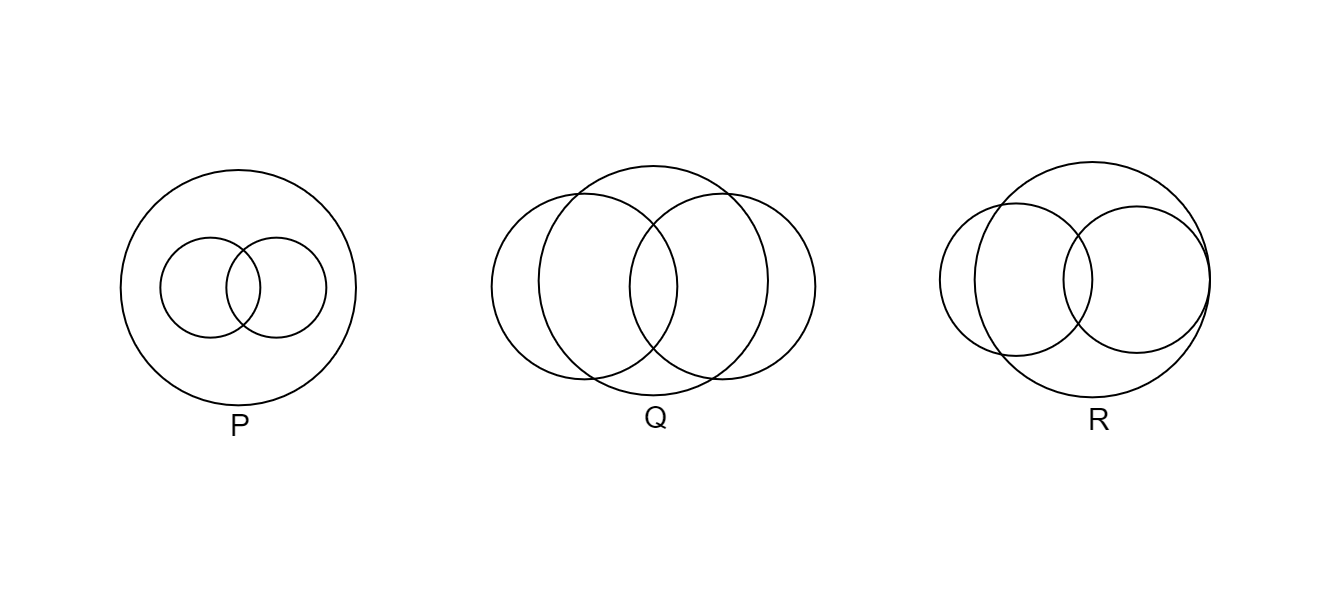
1. P and R
2. P and Q
3. None of these
4. Q and R
Answer
 Verified
249.9k+ views
Hint: Here, we are given three Venn diagrams P, Q, and R. We have to select which of the diagram justifies the statement that some students play two games, but none plays all three games. It means, we have to check which of the diagram is not of intersection.
Formula Used:
Given Venn diagram are of intersection i.e., $A \cap B \cap C$
Complete step by step Solution:
Let, A, B, and C be the first, second, and third games that are played by the student in school
Now, let the condition be some students play two games, but none play all three games.
It means, in the Venn diagram there should be no common part in all three games.
There should be a common part in any of the two games,
Case 1: A and B
Case 2: B and C
Case 3: A and C
A Venn diagram of the given statement is attached below,
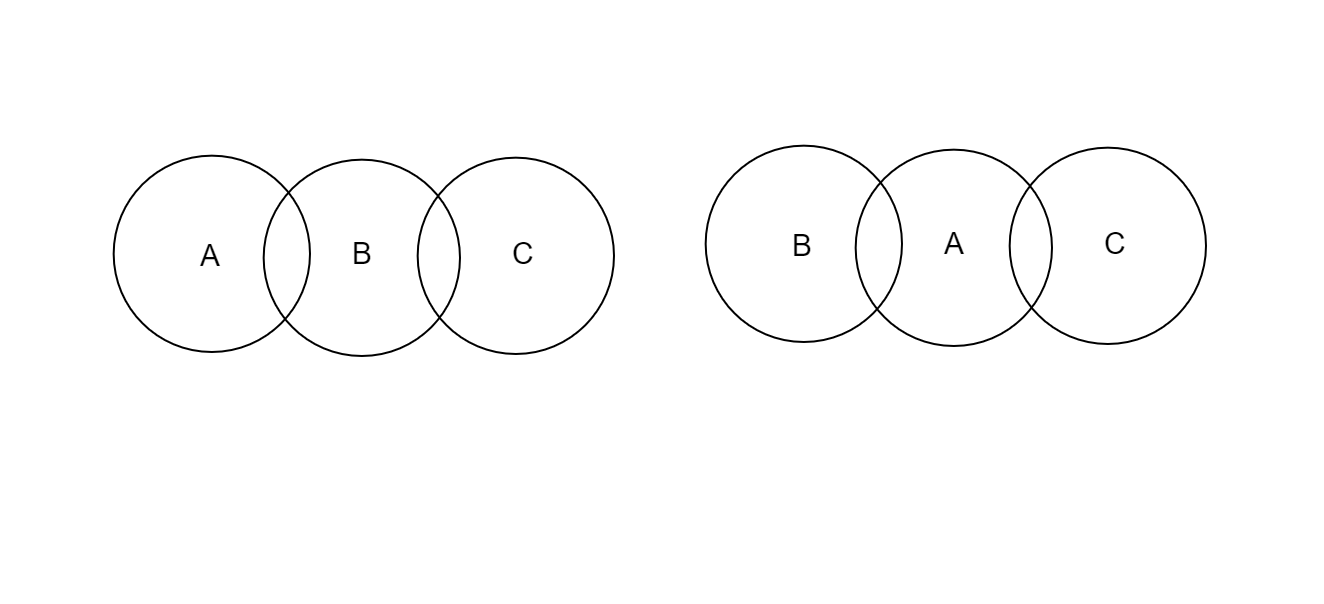 Now, in the given Venn diagram P, Q, and R, there are common parts in all three games. This implies that there are some students who play all three games which contradicts the statement that none of the students plays all three games.
Hence, the correct option is 3.
Note: The key concept involved in solving this problem is a good knowledge of Union and Intersection. Students must know that the union of two sets P and Q corresponds to the set of elements that are included in set P, set Q, or both sets P and Q. The intersection of two subsets of the universal set U, A, and B, is the set that contains all of the elements that are shared by both A and B.
Formula Used:
Given Venn diagram are of intersection i.e., $A \cap B \cap C$
Complete step by step Solution:
Let, A, B, and C be the first, second, and third games that are played by the student in school
Now, let the condition be some students play two games, but none play all three games.
It means, in the Venn diagram there should be no common part in all three games.
There should be a common part in any of the two games,
Case 1: A and B
Case 2: B and C
Case 3: A and C
A Venn diagram of the given statement is attached below,
Now, in the given Venn diagram P, Q, and R, there are common parts in all three games. This implies that there are some students who play all three games which contradicts the statement that none of the students plays all three games.Hence, the correct option is 3.
Note: The key concept involved in solving this problem is a good knowledge of Union and Intersection. Students must know that the union of two sets P and Q corresponds to the set of elements that are included in set P, set Q, or both sets P and Q. The intersection of two subsets of the universal set U, A, and B, is the set that contains all of the elements that are shared by both A and B.
Recently Updated Pages
JEE Isolation, Preparation and Properties of Non-metals Important Concepts and Tips for Exam Preparation

Isoelectronic Definition in Chemistry: Meaning, Examples & Trends
Ionisation Energy and Ionisation Potential Explained
Iodoform Reactions - Important Concepts and Tips for JEE
Introduction to Dimensions: Understanding the Basics
Instantaneous Velocity Explained: Formula, Examples & Graphs
Trending doubts
JEE Main 2026: Exam Dates, Session 2 Updates, City Slip, Admit Card & Latest News
Hybridisation in Chemistry – Concept, Types & Applications
JEE Main 2026 Application Login: Direct Link, Registration, Form Fill, and Steps
Understanding the Electric Field of a Uniformly Charged Ring
Derivation of Equation of Trajectory Explained for Students
JEE Main Marking Scheme 2026- Paper-Wise Marks Distribution and Negative Marking Details
Other Pages
JEE Advanced Marks vs Ranks 2025: Understanding Category-wise Qualifying Marks and Previous Year Cut-offs
JEE Advanced 2026 - Exam Date (Released), Syllabus, Registration, Eligibility, Preparation, and More
JEE Advanced Weightage 2025 Chapter-Wise for Physics, Maths and Chemistry
Understanding the Angle of Deviation in a Prism
Understanding Centrifugal Force in Physics
Ideal and Non-Ideal Solutions Explained for Class 12 Chemistry