




In a right triangle $AC=BC$ and $D$ is the midpoint of $AC$, then cotangent of angle $DBC$ is equal to
A. $2$
B. $3$
C. $\frac{1}{2}$
D. $\frac{1}{3}$
Answer
 Verified
292.8k+ views
Hint: To solve this question, we will consider the triangle $DBC$. In triangle $DBC$, we will calculate the cotangent of triangle $DBC$ that is $\cot B$ using trigonometric ratio formula and midpoint properties.
A midpoint divides the length into equal parts.
Formula used:
The trigonometric formula of cotangent is,
$\cot \theta =\frac{Base}{Perpendicular}$
Complete step-by-step solution:
We are given a right angled triangle in which two sides are equal that is $AC=BC$ and $D$ is the midpoint of side $AC$. We have to calculate the cotangent of angle $DBC$.
We will draw diagram for a triangle with the given data.
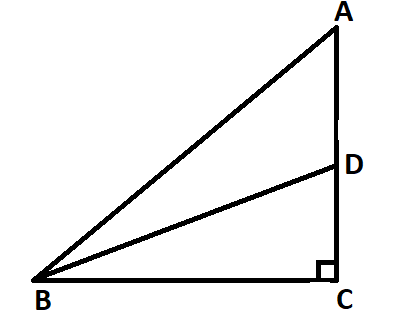
As $D$ is the midpoint of side$AC$, then$AD=DC$.
Now in triangle $DBC$,
$\cot B=\frac{BC}{DC}$
As $AC=BC$ and$AD=DC$, we can write $BC$ as $BC=2DC$.
$\begin{align}
& \cot B=\frac{2DC}{DC} \\
& \cot B=2 \\
\end{align}$
The cotangent of angle $DBC$is equal to $\cot B=2$ in a right angled triangle when$AC=BC$ and $D$ is the midpoint of $AC$.Hence the correct option is (A).
Note:
We could have also calculated the tangent of angle $DBC$ and then inversed the result derived because we know that cotangent is the inverse of tangent that is $\cot \theta =\frac{1}{\tan \theta }$.
A right angled triangle is a type of triangle in which one angle is always ${{90}^{0}}$. The three sides of a right angled triangle are termed as base, perpendicular or altitude and hypotenuse where hypotenuse is the longest side and it is the side opposite to the right angle that is ${{90}^{0}}$. The relationship between the sides of this triangle is depicted by the Pythagoras theorem which is ${{H}^{2}}={{P}^{2}}+{{B}^{2}}$.
A midpoint divides the length into equal parts.
Formula used:
The trigonometric formula of cotangent is,
$\cot \theta =\frac{Base}{Perpendicular}$
Complete step-by-step solution:
We are given a right angled triangle in which two sides are equal that is $AC=BC$ and $D$ is the midpoint of side $AC$. We have to calculate the cotangent of angle $DBC$.
We will draw diagram for a triangle with the given data.
As $D$ is the midpoint of side$AC$, then$AD=DC$.
Now in triangle $DBC$,
$\cot B=\frac{BC}{DC}$
As $AC=BC$ and$AD=DC$, we can write $BC$ as $BC=2DC$.
$\begin{align}
& \cot B=\frac{2DC}{DC} \\
& \cot B=2 \\
\end{align}$
The cotangent of angle $DBC$is equal to $\cot B=2$ in a right angled triangle when$AC=BC$ and $D$ is the midpoint of $AC$.Hence the correct option is (A).
Note:
We could have also calculated the tangent of angle $DBC$ and then inversed the result derived because we know that cotangent is the inverse of tangent that is $\cot \theta =\frac{1}{\tan \theta }$.
A right angled triangle is a type of triangle in which one angle is always ${{90}^{0}}$. The three sides of a right angled triangle are termed as base, perpendicular or altitude and hypotenuse where hypotenuse is the longest side and it is the side opposite to the right angle that is ${{90}^{0}}$. The relationship between the sides of this triangle is depicted by the Pythagoras theorem which is ${{H}^{2}}={{P}^{2}}+{{B}^{2}}$.
Recently Updated Pages
JEE Main 2023 (February 1st Shift 2) Physics Question Paper with Answer Key

JEE Main 2023 (February 1st Shift 1) Maths Question Paper with Answer Key
JEE Main 2023 (February 1st Shift 2) Chemistry Question Paper with Answer Key
Hydrogen and Its Type Important Concepts and Tips for JEE Exam Preparation
JEE Main 2023 (February 1st Shift 2) Maths Question Paper with Answer Key
JEE Main 2023 (February 1st Shift 1) Physics Question Paper with Answer Key
Trending doubts
JEE Main 2026: Exam Dates, Session 2 Updates, City Slip, Admit Card & Latest News
Understanding the Electric Field of a Uniformly Charged Ring
Understanding Atomic Structure for Beginners
Electron Gain Enthalpy and Electron Affinity Explained
Derivation of Equation of Trajectory Explained for Students
How to Convert a Galvanometer into an Ammeter or Voltmeter
Other Pages
JEE Advanced Percentile vs Marks 2026: JEE Main Cutoff, AIR & IIT Admission Guide
NCERT Solutions For Class 11 Maths Chapter 6 Permutations And Combinations - 2026-27 Free PDF Download (Login Required)
JEE Advanced 2026 Notification Out with Exam Date, Registration (Extended), Syllabus and More
NCERT Solutions For Class 11 Maths Chapter 4 Complex Numbers And Quadratic Equations - 2026-27 Free PDF Download (Login Required)
NCERT Solutions For Class 11 Maths Chapter 8 Sequences And Series - 2026-27 Free PDF Download (Login Required)
JEE Advanced Weightage Chapter Wise 2026 for Physics, Chemistry, and Mathematics