




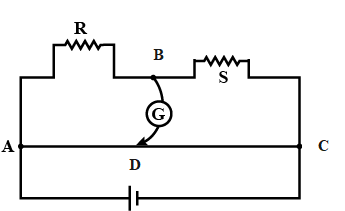
In a meter bridge, the null point is found at a distance of 60 cm from A, if now a resistance of is $5\Omega $ is connected in series with S and the null point occurs at 50 cm. Determine the values of R and S.
Answer
 Verified
263.1k+ views
Hint: We know that a meter bridge also called a slide wire bridge is an instrument that works on the principle of a Wheatstone bridge. A meter bridge is used in finding the unknown resistance of a conductor as that of in a Wheatstone bridge. The reason why this bridge is called the Meter Bridge is because of the fact that it works on the Wheatstone bridge's principle. So, people also popularly call it as Wheatstone's meter bridge. Another thing is that the wire length used in this circuit is of 1 meter, so it has got its name as a meter bridge.
Complete step by step answer
We know that the jockey is used to sliding on the bridge wire. It is a metal rod with one end as a knife edge. Now adjust the value of resistance in the resistance box and slide the jockey along the wire. This process is to be done until the galvanometer shows a zero or null deflection. In potentiometer experiment, null point is obtained at a particular point for a cell on potentiometer wire x cm long. If the length of the potentiometer wire is increased without changing the cell.
It can be said that Constantan is used for meter bridge wire because its temperature coefficient of resistance is almost negligible due to which the resistance of the wire does not change with increase in temperature of the wire due to flow of current. Sensitivity of metre bridge is the accuracy to measure the value of current. a bridge is most sensitive when all resistance is of the same order.
In first case, $\dfrac{R}{S}=\dfrac{60}{100-60}=\dfrac{3}{2}$
In second case, $\dfrac{R}{S}+5=\dfrac{50}{50}=1$ or $R=S+5$
From the first case, $S+\dfrac{5}{S}=\dfrac{3}{2}$ or $2 S+10=3 S$
or $S=10 \Omega$ and $R=10+5=15 \Omega$
Note We know that the Wheatstone bridge works on the principle of null deflection, i.e. the ratio of their resistances is equal and no current flows through the circuit. Under normal conditions, the bridge is in the unbalanced condition where current flows through the galvanometer. The Wheatstone Bridge circuit is nothing more than two simple series-parallel arrangements of resistances connected between a voltage supply terminal and ground producing zero voltage difference between the two parallel branches when balanced. The Wheatstone bridge is used for measuring the very low resistance values precisely. Wheatstone bridge along with an operational amplifier is used to measure the physical parameters like temperature, strain, light, etc.
Complete step by step answer
We know that the jockey is used to sliding on the bridge wire. It is a metal rod with one end as a knife edge. Now adjust the value of resistance in the resistance box and slide the jockey along the wire. This process is to be done until the galvanometer shows a zero or null deflection. In potentiometer experiment, null point is obtained at a particular point for a cell on potentiometer wire x cm long. If the length of the potentiometer wire is increased without changing the cell.
It can be said that Constantan is used for meter bridge wire because its temperature coefficient of resistance is almost negligible due to which the resistance of the wire does not change with increase in temperature of the wire due to flow of current. Sensitivity of metre bridge is the accuracy to measure the value of current. a bridge is most sensitive when all resistance is of the same order.
In first case, $\dfrac{R}{S}=\dfrac{60}{100-60}=\dfrac{3}{2}$
In second case, $\dfrac{R}{S}+5=\dfrac{50}{50}=1$ or $R=S+5$
From the first case, $S+\dfrac{5}{S}=\dfrac{3}{2}$ or $2 S+10=3 S$
or $S=10 \Omega$ and $R=10+5=15 \Omega$
Note We know that the Wheatstone bridge works on the principle of null deflection, i.e. the ratio of their resistances is equal and no current flows through the circuit. Under normal conditions, the bridge is in the unbalanced condition where current flows through the galvanometer. The Wheatstone Bridge circuit is nothing more than two simple series-parallel arrangements of resistances connected between a voltage supply terminal and ground producing zero voltage difference between the two parallel branches when balanced. The Wheatstone bridge is used for measuring the very low resistance values precisely. Wheatstone bridge along with an operational amplifier is used to measure the physical parameters like temperature, strain, light, etc.
Recently Updated Pages
Circuit Switching vs Packet Switching: Key Differences Explained

JEE Extractive Metallurgy Important Concepts and Tips for Exam Preparation
JEE Atomic Structure and Chemical Bonding important Concepts and Tips
JEE Amino Acids and Peptides Important Concepts and Tips for Exam Preparation
Electricity and Magnetism Explained: Key Concepts & Applications
JEE Energetics Important Concepts and Tips for Exam Preparation
Trending doubts
JEE Main 2026: Exam Dates, Session 2 Updates, City Slip, Admit Card & Latest News
JEE Main Participating Colleges 2026 - A Complete List of Top Colleges
Hybridisation in Chemistry – Concept, Types & Applications
Understanding the Electric Field of a Uniformly Charged Ring
Derivation of Equation of Trajectory Explained for Students
Understanding Atomic Structure for Beginners
Other Pages
CBSE Class 12 Physics Question Paper 2026: Download SET-wise PDF with Answer Key & Analysis
JEE Advanced 2026 Notification Out with Exam Date, Registration (Extended), Syllabus and More
JEE Advanced Marks vs Ranks 2025: Understanding Category-wise Qualifying Marks and Previous Year Cut-offs
JEE Advanced Weightage Chapter Wise 2026 for Physics, Chemistry, and Mathematics
JEE Advanced Marks vs Rank 2025 - Predict Your IIT Rank Based on Score
How to Convert a Galvanometer into an Ammeter or Voltmeter