




If the angle between the pass axis of the polariser and the analyser is $45^\circ $ , the ratio of intensities of the transmitted light and the original light after passing through the analyser is:
A) $\dfrac{1}{2}$
B) $\dfrac{1}{3}$
C) $1$
D) $\dfrac{1}{4}$
Answer
 Verified
233.1k+ views
Hint: As light passes through a polarising material, it gets polarised and as a result, its intensity changes. This change is dependent on the angle between the direction of polarisation and the axis of the material. It is also dependent on the original intensity of light. The intensity $I$ of polarised light after passing through polariser and subsequently passing through analyser is;
$I = \dfrac{{{I_o}}}{2}{\cos ^2}\theta $
Where ${I_o}$ was the original intensity of light and $\theta $ is the angle between the pass axis of the polariser and the analyser.
Formulae used:
$I = \dfrac{{{I_o}}}{2}{\cos ^2}\theta $
Where ${I_o}$ the original intensity of light, $I$ is the intensity of light after passing through the polariser and the analyser and $\theta $ is the angle between the pass axis of the polariser and the analyser
Complete step by step solution:
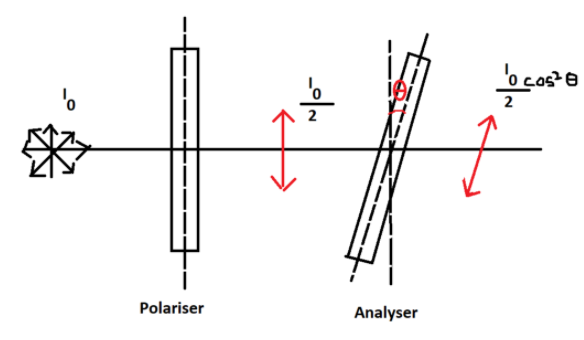
Polarisation of light is a phenomenon that occurs when unpolarised light passes through a polarising material and analyser and emerges with a particular fixed orientation in a singular plane. This leads to a change in the intensity of such a polarised light such that the new intensity is different from what the intensity of light had been before it got polarised.
In situations where unpolarised light enters a polariser and then an analyser, two separate processes occur. First the unpolarised light enters the polariser and the intensity of light changed to half of the initial value, that is,
${I_p} = \dfrac{{{I_o}}}{2}$ ,
where ${I_p}$ is the intensity of light after passing through the polariser
and ${I_o}$ is the original intensity of light.
This polarised light then enters the analyser before it gets transmitted and changes in accordance with the angle between the pass axis of polariser and the analyser, that is,
$I = {I_p}{\cos ^2}\theta $
$ \Rightarrow \,I = \dfrac{{{I_o}}}{2}{\cos ^2}\theta $
Where $I$ is the intensity of transmitted light.
In the given question, the angle between the pass axis of the polariser and the analyser is given as $\theta = {45^\circ }$.
Therefore, to find the intensity for the transmitted light, we use this angle in the above equation, that is,
\[I = \dfrac{{{I_o}}}{2}\cos 45^\circ \]
$ \Rightarrow I = \dfrac{{{I_o}}}{2}{(\dfrac{1}{{\sqrt 2 }})^2}$
$ \Rightarrow I = \dfrac{{{I_o}}}{2}(\dfrac{1}{2})$
$ \Rightarrow I = \dfrac{{{I_o}}}{4}$
Where $I$ is the final intensity of the transmitted light and ${I_o}$ the original intensity of light.
We have to find the ratio of final intensity of light to original intensity of light, that is,
$\dfrac{{{I_{transmitted}}}}{{{I_{original}}}} = \dfrac{I}{{{I_o}}}$
$ \Rightarrow \dfrac{I}{{{I_o}}} = \dfrac{{\dfrac{{{I_o}}}{4}}}{{{I_o}}}$
$ \Rightarrow \dfrac{I}{{{I_o}}} = \dfrac{1}{4}$
Therefore the correct answer option is (B), $\dfrac{1}{4}.$
Note: A common mistake students make is forgetting that the intensity of light gets reduced to half as it passes through the polariser. This leads to the wrong answer. To avoid such mistakes, draw the diagram given in solution to envision the polarisation of light and then proceed with the question.
$I = \dfrac{{{I_o}}}{2}{\cos ^2}\theta $
Where ${I_o}$ was the original intensity of light and $\theta $ is the angle between the pass axis of the polariser and the analyser.
Formulae used:
$I = \dfrac{{{I_o}}}{2}{\cos ^2}\theta $
Where ${I_o}$ the original intensity of light, $I$ is the intensity of light after passing through the polariser and the analyser and $\theta $ is the angle between the pass axis of the polariser and the analyser
Complete step by step solution:
Polarisation of light is a phenomenon that occurs when unpolarised light passes through a polarising material and analyser and emerges with a particular fixed orientation in a singular plane. This leads to a change in the intensity of such a polarised light such that the new intensity is different from what the intensity of light had been before it got polarised.
In situations where unpolarised light enters a polariser and then an analyser, two separate processes occur. First the unpolarised light enters the polariser and the intensity of light changed to half of the initial value, that is,
${I_p} = \dfrac{{{I_o}}}{2}$ ,
where ${I_p}$ is the intensity of light after passing through the polariser
and ${I_o}$ is the original intensity of light.
This polarised light then enters the analyser before it gets transmitted and changes in accordance with the angle between the pass axis of polariser and the analyser, that is,
$I = {I_p}{\cos ^2}\theta $
$ \Rightarrow \,I = \dfrac{{{I_o}}}{2}{\cos ^2}\theta $
Where $I$ is the intensity of transmitted light.
In the given question, the angle between the pass axis of the polariser and the analyser is given as $\theta = {45^\circ }$.
Therefore, to find the intensity for the transmitted light, we use this angle in the above equation, that is,
\[I = \dfrac{{{I_o}}}{2}\cos 45^\circ \]
$ \Rightarrow I = \dfrac{{{I_o}}}{2}{(\dfrac{1}{{\sqrt 2 }})^2}$
$ \Rightarrow I = \dfrac{{{I_o}}}{2}(\dfrac{1}{2})$
$ \Rightarrow I = \dfrac{{{I_o}}}{4}$
Where $I$ is the final intensity of the transmitted light and ${I_o}$ the original intensity of light.
We have to find the ratio of final intensity of light to original intensity of light, that is,
$\dfrac{{{I_{transmitted}}}}{{{I_{original}}}} = \dfrac{I}{{{I_o}}}$
$ \Rightarrow \dfrac{I}{{{I_o}}} = \dfrac{{\dfrac{{{I_o}}}{4}}}{{{I_o}}}$
$ \Rightarrow \dfrac{I}{{{I_o}}} = \dfrac{1}{4}$
Therefore the correct answer option is (B), $\dfrac{1}{4}.$
Note: A common mistake students make is forgetting that the intensity of light gets reduced to half as it passes through the polariser. This leads to the wrong answer. To avoid such mistakes, draw the diagram given in solution to envision the polarisation of light and then proceed with the question.
Recently Updated Pages
JEE Main 2023 April 6 Shift 1 Question Paper with Answer Key

JEE Main 2023 April 6 Shift 2 Question Paper with Answer Key
JEE Main 2023 (January 31 Evening Shift) Question Paper with Solutions [PDF]
JEE Main 2023 January 30 Shift 2 Question Paper with Answer Key
JEE Main 2023 January 25 Shift 1 Question Paper with Answer Key
JEE Main 2023 January 24 Shift 2 Question Paper with Answer Key
Trending doubts
JEE Main 2026: Session 2 Registration Open, City Intimation Slip, Exam Dates, Syllabus & Eligibility
JEE Main 2026 Application Login: Direct Link, Registration, Form Fill, and Steps
Understanding the Angle of Deviation in a Prism
Hybridisation in Chemistry – Concept, Types & Applications
How to Convert a Galvanometer into an Ammeter or Voltmeter
Understanding Uniform Acceleration in Physics
Other Pages
JEE Advanced Marks vs Ranks 2025: Understanding Category-wise Qualifying Marks and Previous Year Cut-offs
Dual Nature of Radiation and Matter Class 12 Physics Chapter 11 CBSE Notes - 2025-26
Understanding the Electric Field of a Uniformly Charged Ring
JEE Advanced Weightage 2025 Chapter-Wise for Physics, Maths and Chemistry
Derivation of Equation of Trajectory Explained for Students
Understanding Electromagnetic Waves and Their Importance