




If t is a parameter, then $x = a\left( {t + \dfrac{1}{t}} \right),y = b\left( {t - \dfrac{1}{t}} \right)$ represents which of the following?
(A). An ellipse
(B). A circle
(C). A pair of straight lines
(D). A hyperbola
Answer
 Verified
233.1k+ views
Hint- In such types of questions, we will approach the problem in such a way that we will just take the two coordinates into consideration and transpose the a and b part to the left-hand side of the equations respectively. After that we will just take the square of the L.H.S and the R.H.S and just expand the R.H.S using the identities like ${(a + b)^2} = {a^2} + {b^2} + 2ab$ and ${(a - b)^2} = {a^2} + {b^2} - 2ab$. Now, we will just arrange the two equations using the addition, subtraction rules to get to know they satisfy and match the equation of which conic.
Complete step-by-step answer:
We have been given that $x = a\left( {t + \dfrac{1}{t}} \right),y = b\left( {t - \dfrac{1}{t}} \right)$
Now, transpose the a and b to L.H.S in both the equations we get
$\dfrac{x}{a} = \left( {t + \dfrac{1}{t}} \right),\dfrac{y}{b} = \left( {t - \dfrac{1}{t}} \right)$
Take the square of L.H.S and R.H.S in both the equations.
${\left( {\dfrac{x}{a}} \right)^2} = {\left( {t + \dfrac{1}{t}} \right)^2},{\left( {\dfrac{y}{b}} \right)^2} = {\left( {t - \dfrac{1}{t}} \right)^2}$
We will just consider the first equation i.e. ${\left( {\dfrac{x}{a}} \right)^2} = {\left( {t + \dfrac{1}{t}} \right)^2}$
Using the identity ${(a + b)^2} = {a^2} + {b^2} + 2ab$ on R.H.S we get,
\[ \Rightarrow {\left( {\dfrac{x}{a}} \right)^2} = {(t)^2} + {\left( {\dfrac{1}{t}} \right)^2} + 2 \times t \times \dfrac{1}{t}\]
\[ \Rightarrow {\left( {\dfrac{x}{a}} \right)^2} = {(t)^2} + {\left( {\dfrac{1}{t}} \right)^2} + 2\] ----(1)
We will just consider the second equation i.e. ${\left( {\dfrac{y}{b}} \right)^2} = {\left( {t - \dfrac{1}{t}} \right)^2}$
Using the identity ${(a - b)^2} = {a^2} + {b^2} - 2ab$ on R.H.S we get,
\[ \Rightarrow {\left( {\dfrac{y}{b}} \right)^2} = {(t)^2} + {\left( {\dfrac{1}{t}} \right)^2} - 2 \times t \times \dfrac{1}{t}\]
\[ \Rightarrow {\left( {\dfrac{y}{b}} \right)^2} = {(t)^2} + {\left( {\dfrac{1}{t}} \right)^2} - 2\] ----(2)
Now, on subtracting (2) from (1) we get,
\[ \Rightarrow {\left( {\dfrac{x}{a}} \right)^2} - {\left( {\dfrac{y}{b}} \right)^2} = {(t)^2} + {\left( {\dfrac{1}{t}} \right)^2} + 2 - \left( {{{(t)}^2} + {{\left( {\dfrac{1}{t}} \right)}^2} - 2} \right)\]
\[ \Rightarrow {\left( {\dfrac{x}{a}} \right)^2} - {\left( {\dfrac{y}{b}} \right)^2} = {(t)^2} + {\left( {\dfrac{1}{t}} \right)^2} + 2 - {(t)^2} - {\left( {\dfrac{1}{t}} \right)^2} + 2\]
\[ \Rightarrow {\left( {\dfrac{x}{a}} \right)^2} - {\left( {\dfrac{y}{b}} \right)^2} = 4\]
\[ \Rightarrow {\left( {\dfrac{x}{a}} \right)^2} - {\left( {\dfrac{y}{b}} \right)^2} = {(2)^2}\]
Transposing \[{(2)^2}\] to L.H.S we get,
\[ \Rightarrow \dfrac{1}{{{{(2)}^2}}}{\left( {\dfrac{x}{a}} \right)^2} - \dfrac{1}{{{{(2)}^2}}}{\left( {\dfrac{y}{b}} \right)^2} = 1\]
\[ \Rightarrow \dfrac{{{x^2}}}{{4{a^2}}} - \dfrac{{{y^2}}}{{4{b^2}}} = 1\]
Now, we know that the standard form of the equation of a hyperbola with center $(0,0)$ and transverse axis on the x-axis is \[\dfrac{{{x^2}}}{{{a^2}}} - \dfrac{{{y^2}}}{{{b^2}}} = 1\]
Hence, we can say that the equation so formed in our question is of hyperbola. So, $x = a\left( {t + \dfrac{1}{t}} \right),y = b\left( {t - \dfrac{1}{t}} \right)$ represents a hyperbola.
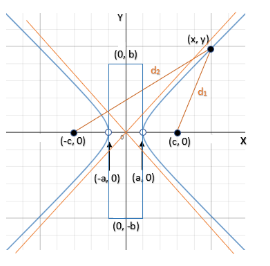
$\therefore $ Option. D A hyperbola is our correct answer.
Note- For such types of question we must be knowing the standard form of the equation of a hyperbola with center $(0,0)$ and transverse axis on the x-axis which is \[\dfrac{{{x^2}}}{{{a^2}}} - \dfrac{{{y^2}}}{{{b^2}}} = 1\] so as to compare the equations and also we should be knowing the basic algebraic identities like ${(a + b)^2} = {a^2} + {b^2} + 2ab$ and ${(a - b)^2} = {a^2} + {b^2} - 2ab$ . Moreover, we should be knowing the equations of all the conics to just check whether our answer is similar to which of the conics.
Complete step-by-step answer:
We have been given that $x = a\left( {t + \dfrac{1}{t}} \right),y = b\left( {t - \dfrac{1}{t}} \right)$
Now, transpose the a and b to L.H.S in both the equations we get
$\dfrac{x}{a} = \left( {t + \dfrac{1}{t}} \right),\dfrac{y}{b} = \left( {t - \dfrac{1}{t}} \right)$
Take the square of L.H.S and R.H.S in both the equations.
${\left( {\dfrac{x}{a}} \right)^2} = {\left( {t + \dfrac{1}{t}} \right)^2},{\left( {\dfrac{y}{b}} \right)^2} = {\left( {t - \dfrac{1}{t}} \right)^2}$
We will just consider the first equation i.e. ${\left( {\dfrac{x}{a}} \right)^2} = {\left( {t + \dfrac{1}{t}} \right)^2}$
Using the identity ${(a + b)^2} = {a^2} + {b^2} + 2ab$ on R.H.S we get,
\[ \Rightarrow {\left( {\dfrac{x}{a}} \right)^2} = {(t)^2} + {\left( {\dfrac{1}{t}} \right)^2} + 2 \times t \times \dfrac{1}{t}\]
\[ \Rightarrow {\left( {\dfrac{x}{a}} \right)^2} = {(t)^2} + {\left( {\dfrac{1}{t}} \right)^2} + 2\] ----(1)
We will just consider the second equation i.e. ${\left( {\dfrac{y}{b}} \right)^2} = {\left( {t - \dfrac{1}{t}} \right)^2}$
Using the identity ${(a - b)^2} = {a^2} + {b^2} - 2ab$ on R.H.S we get,
\[ \Rightarrow {\left( {\dfrac{y}{b}} \right)^2} = {(t)^2} + {\left( {\dfrac{1}{t}} \right)^2} - 2 \times t \times \dfrac{1}{t}\]
\[ \Rightarrow {\left( {\dfrac{y}{b}} \right)^2} = {(t)^2} + {\left( {\dfrac{1}{t}} \right)^2} - 2\] ----(2)
Now, on subtracting (2) from (1) we get,
\[ \Rightarrow {\left( {\dfrac{x}{a}} \right)^2} - {\left( {\dfrac{y}{b}} \right)^2} = {(t)^2} + {\left( {\dfrac{1}{t}} \right)^2} + 2 - \left( {{{(t)}^2} + {{\left( {\dfrac{1}{t}} \right)}^2} - 2} \right)\]
\[ \Rightarrow {\left( {\dfrac{x}{a}} \right)^2} - {\left( {\dfrac{y}{b}} \right)^2} = {(t)^2} + {\left( {\dfrac{1}{t}} \right)^2} + 2 - {(t)^2} - {\left( {\dfrac{1}{t}} \right)^2} + 2\]
\[ \Rightarrow {\left( {\dfrac{x}{a}} \right)^2} - {\left( {\dfrac{y}{b}} \right)^2} = 4\]
\[ \Rightarrow {\left( {\dfrac{x}{a}} \right)^2} - {\left( {\dfrac{y}{b}} \right)^2} = {(2)^2}\]
Transposing \[{(2)^2}\] to L.H.S we get,
\[ \Rightarrow \dfrac{1}{{{{(2)}^2}}}{\left( {\dfrac{x}{a}} \right)^2} - \dfrac{1}{{{{(2)}^2}}}{\left( {\dfrac{y}{b}} \right)^2} = 1\]
\[ \Rightarrow \dfrac{{{x^2}}}{{4{a^2}}} - \dfrac{{{y^2}}}{{4{b^2}}} = 1\]
Now, we know that the standard form of the equation of a hyperbola with center $(0,0)$ and transverse axis on the x-axis is \[\dfrac{{{x^2}}}{{{a^2}}} - \dfrac{{{y^2}}}{{{b^2}}} = 1\]
Hence, we can say that the equation so formed in our question is of hyperbola. So, $x = a\left( {t + \dfrac{1}{t}} \right),y = b\left( {t - \dfrac{1}{t}} \right)$ represents a hyperbola.
$\therefore $ Option. D A hyperbola is our correct answer.
Note- For such types of question we must be knowing the standard form of the equation of a hyperbola with center $(0,0)$ and transverse axis on the x-axis which is \[\dfrac{{{x^2}}}{{{a^2}}} - \dfrac{{{y^2}}}{{{b^2}}} = 1\] so as to compare the equations and also we should be knowing the basic algebraic identities like ${(a + b)^2} = {a^2} + {b^2} + 2ab$ and ${(a - b)^2} = {a^2} + {b^2} - 2ab$ . Moreover, we should be knowing the equations of all the conics to just check whether our answer is similar to which of the conics.
Recently Updated Pages
Geometry of Complex Numbers Explained

JEE General Topics in Chemistry Important Concepts and Tips
JEE Extractive Metallurgy Important Concepts and Tips for Exam Preparation
JEE Amino Acids and Peptides Important Concepts and Tips for Exam Preparation
JEE Atomic Structure and Chemical Bonding important Concepts and Tips
Electricity and Magnetism Explained: Key Concepts & Applications
Trending doubts
JEE Main 2026: Session 2 Registration Open, City Intimation Slip, Exam Dates, Syllabus & Eligibility
JEE Main 2026 Application Login: Direct Link, Registration, Form Fill, and Steps
JEE Main Marking Scheme 2026- Paper-Wise Marks Distribution and Negative Marking Details
Understanding the Angle of Deviation in a Prism
Hybridisation in Chemistry – Concept, Types & Applications
How to Convert a Galvanometer into an Ammeter or Voltmeter
Other Pages
JEE Advanced Marks vs Ranks 2025: Understanding Category-wise Qualifying Marks and Previous Year Cut-offs
Understanding the Electric Field of a Uniformly Charged Ring
JEE Advanced Weightage 2025 Chapter-Wise for Physics, Maths and Chemistry
Derivation of Equation of Trajectory Explained for Students
Understanding Electromagnetic Waves and Their Importance
Understanding How a Current Loop Acts as a Magnetic Dipole