




If $s$ is the size of source giving light of wavelength $\lambda $ , separation between the slits, $D$ its distance from the plane of slits, what should be the criterion for the interference fringes to be seen.
Answer
 Verified
233.1k+ views
Hint: The Young’s double slit experiment uses sources that are coherent in nature to understand the wave nature of the light. The light from the source is made to pass through two slits and made to fall on the screen. There indicates the formation of fringes.
Complete step by step solution:
It is given that the
size of source given light is $s$
wavelength of the light is $\lambda $
The distance between the slits is $D$
The interference fringes forms on the screen only when the certain criterion is established. In the young’s double slit experiment, the two slits act as the entrance of the light from the source of the light.
These two slits must be in equal size and at an equal distance from the centre to obtain the interference fringes on the screen. The size of the screen must be at $1\,mm$ wide. Hence the size of source given light is $s = 1\,mm$ . The source provides the light of the monochromatic and it must be nearly $10\,cm$ distance from the slit to obtain the formation of the fringes in the screen of the young’s double slit experiment.
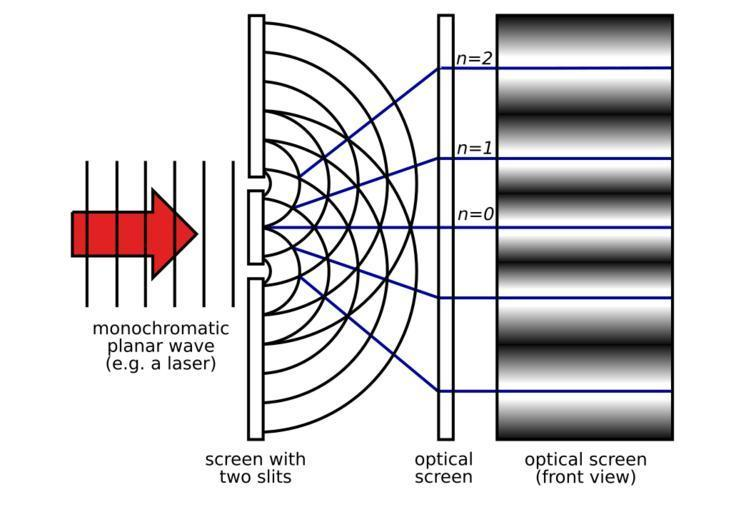
Note: The source of the light used is coherent, that means it allows the light that has the same frequency and the same phase difference between the waves. That way the slits are placed at the equal distance from the centre and also the same size.
Complete step by step solution:
It is given that the
size of source given light is $s$
wavelength of the light is $\lambda $
The distance between the slits is $D$
The interference fringes forms on the screen only when the certain criterion is established. In the young’s double slit experiment, the two slits act as the entrance of the light from the source of the light.
These two slits must be in equal size and at an equal distance from the centre to obtain the interference fringes on the screen. The size of the screen must be at $1\,mm$ wide. Hence the size of source given light is $s = 1\,mm$ . The source provides the light of the monochromatic and it must be nearly $10\,cm$ distance from the slit to obtain the formation of the fringes in the screen of the young’s double slit experiment.
Note: The source of the light used is coherent, that means it allows the light that has the same frequency and the same phase difference between the waves. That way the slits are placed at the equal distance from the centre and also the same size.
Recently Updated Pages
JEE Main 2023 April 6 Shift 1 Question Paper with Answer Key

JEE Main 2023 April 6 Shift 2 Question Paper with Answer Key
JEE Main 2023 (January 31 Evening Shift) Question Paper with Solutions [PDF]
JEE Main 2023 January 30 Shift 2 Question Paper with Answer Key
JEE Main 2023 January 25 Shift 1 Question Paper with Answer Key
JEE Main 2023 January 24 Shift 2 Question Paper with Answer Key
Trending doubts
JEE Main 2026: Session 2 Registration Open, City Intimation Slip, Exam Dates, Syllabus & Eligibility
JEE Main 2026 Application Login: Direct Link, Registration, Form Fill, and Steps
Understanding the Angle of Deviation in a Prism
Hybridisation in Chemistry – Concept, Types & Applications
How to Convert a Galvanometer into an Ammeter or Voltmeter
Understanding Uniform Acceleration in Physics
Other Pages
JEE Advanced Marks vs Ranks 2025: Understanding Category-wise Qualifying Marks and Previous Year Cut-offs
Dual Nature of Radiation and Matter Class 12 Physics Chapter 11 CBSE Notes - 2025-26
Understanding the Electric Field of a Uniformly Charged Ring
JEE Advanced Weightage 2025 Chapter-Wise for Physics, Maths and Chemistry
Derivation of Equation of Trajectory Explained for Students
Understanding Electromagnetic Waves and Their Importance