




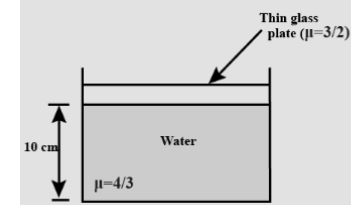
If an observer sees the bottom of the vessel shown in Fig. at 8 cm, find the refractive index of the medium in which the observer is present.
Answer
 Verified
284.1k+ views
Hint: Calculate the apparent depth using the formula \[\mu = \dfrac{{real}}{{apparent}}\] and now this becomes the real depth for the new case and 8 cm is the apparent depth and using the same formula now calculate required refractive index.
Complete step- by-step solution
When the light is travelling from medium 1 to 2 the refractive index can be written as,
\[_1{\mu _2} = \dfrac{{{\mu _2}}}{{{\mu _1}}}\]
If the object is placed in a different medium then due to refraction, object appears to be displaced from its real position so, when object is in denser medium and observer is in rarer medium,
\[\mu = \dfrac{{real}}{{apparent}}\]
It is given that real depth is 10 cm and μ can be written as \[{}_g{\mu _w} = \dfrac{{{\mu _w}}}{{{\mu _g}}}\] where, \[{\mu _g} = \dfrac{3}{2};{\mu _w} = \dfrac{4}{3}\]
Substitute in the formula and we get apparent depth.
\[
_g{\mu _w} = \dfrac{{real}}{{apparent}} \\
\dfrac{{{\mu _w}}}{{{\mu _g}}} = \dfrac{{real}}{{apparent}} \\
\dfrac{{\dfrac{4}{3}}}{{\dfrac{3}{2}}} = \dfrac{{10}}{{apparent}} \\
apparent = \dfrac{{45}}{4} \\
\]
Using the same format the refractive index at 8 cm (μr) which is the apparent depth now
$
\dfrac{{\dfrac{3}{2}}}{{{\mu _r}}} = \dfrac{{45}}{{4 \times 8}} \\
{\mu _r} = \dfrac{{16}}{{15}} \\
$
Hence the refractive index at 8 cm is$\dfrac{{16}}{{15}}$ .
Note In case of more immiscible liquids as layers present then refractive index of the combination is
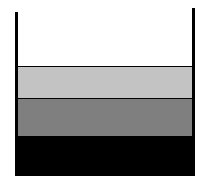
${\mu _c} = \dfrac{{real(d)}}{{app(d)}} = \dfrac{{{d_1} + {d_2}...}}{{\dfrac{{{d_1}}}{{{\mu _1}}} + \dfrac{{{d_2}}}{{{\mu _2}}}...}}$
Complete step- by-step solution
When the light is travelling from medium 1 to 2 the refractive index can be written as,
\[_1{\mu _2} = \dfrac{{{\mu _2}}}{{{\mu _1}}}\]
If the object is placed in a different medium then due to refraction, object appears to be displaced from its real position so, when object is in denser medium and observer is in rarer medium,
\[\mu = \dfrac{{real}}{{apparent}}\]
It is given that real depth is 10 cm and μ can be written as \[{}_g{\mu _w} = \dfrac{{{\mu _w}}}{{{\mu _g}}}\] where, \[{\mu _g} = \dfrac{3}{2};{\mu _w} = \dfrac{4}{3}\]
Substitute in the formula and we get apparent depth.
\[
_g{\mu _w} = \dfrac{{real}}{{apparent}} \\
\dfrac{{{\mu _w}}}{{{\mu _g}}} = \dfrac{{real}}{{apparent}} \\
\dfrac{{\dfrac{4}{3}}}{{\dfrac{3}{2}}} = \dfrac{{10}}{{apparent}} \\
apparent = \dfrac{{45}}{4} \\
\]
Using the same format the refractive index at 8 cm (μr) which is the apparent depth now
$
\dfrac{{\dfrac{3}{2}}}{{{\mu _r}}} = \dfrac{{45}}{{4 \times 8}} \\
{\mu _r} = \dfrac{{16}}{{15}} \\
$
Hence the refractive index at 8 cm is$\dfrac{{16}}{{15}}$ .
Note In case of more immiscible liquids as layers present then refractive index of the combination is
${\mu _c} = \dfrac{{real(d)}}{{app(d)}} = \dfrac{{{d_1} + {d_2}...}}{{\dfrac{{{d_1}}}{{{\mu _1}}} + \dfrac{{{d_2}}}{{{\mu _2}}}...}}$
Recently Updated Pages
Properties of Solids and Liquids Mock Test 2025

JEE Main Mock Test 2025-26: Dual Nature of Matter & Radiation
JEE Main 2025-26 Work, Energy and Power Mock Test – Free Practice Online
JEE Main Mock Test 2025-26: Experimental Skills Chapter Online Practice
JEE Main 2025-26 Mock Test: Properties of Solids and Liquids
JEE Main 2025 Kinetic Theory Of Gases Mock Test: Practice & Solutions
Trending doubts
Other Pages
JEE Advanced 2026 Notification Out with Exam Date, Registration (Extended), Syllabus and More
JEE Advanced Weightage Chapter Wise 2026 for Physics, Chemistry, and Mathematics
Class 12 Physics Formulas: Complete Chapter-wise PDF Guide
Degree of Dissociation: Meaning, Formula, Calculation & Uses
Understanding How a Current Loop Acts as a Magnetic Dipole
Valentine Week 2026 Complete List, Dates, Quotes & Wishes