




If ABC are angles of a triangle such that\[x = cisA\], \[y = cisB\], \[z = cisC\], then find value of $xyz$
(A). -1
(B). 1
(C). $ - i$
(D). $i$
Answer
 Verified
257.7k+ views
Hint: Use Euler’s complex formula to write the given values in exponential complex form. Then use the supplementary condition of the interior angles of a triangle to find the value of the desired expression.
Complete step-by-step solution -
A complex number is a number that can be expressed in the form $a + ib$, where $a$ and $b$ are real numbers.
The acronym $cis$ is a commonly used mathematical notation for complex numbers defined by:
$cis\left( x \right) = \cos \left( x \right) + i\sin \left( x \right)$
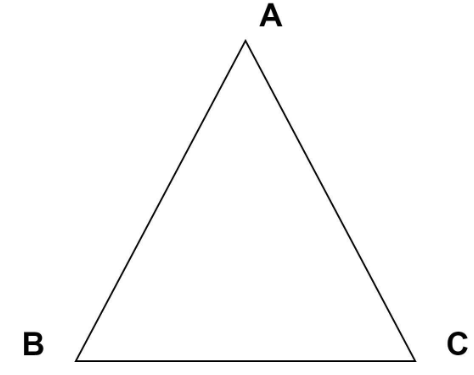
Given the problem, ABC is a triangle.
The angles of the triangle are given as:
$
x = cisA \\
y = cisB \\
z = cisC \\
$
We need to find the value of the expression $xyz$.
Euler’s formula on the complex numbers states that ${e^{i\theta }} = \left( {\cos \theta + i\sin \theta } \right)$.
Using the same in above given data, we get:
$\left(
x = cisA = \cos A + i\sin A = {e^{iA}} \\
y = cisB = \cos B + i\sin B = {e^{iB}} \\
z = cisC = \cos C + i\sin C = {e^{iC}} \\
\right){\text{ (1)}}$
Also, we know that for a triangle, the sum of all its interior angles is supplementary or ${180^0}$.
Using the same result for triangle ABC, we get
$A + B + C = {180^0}{\text{ (2)}}$
We need to find the value of the expression $xyz$.
Using equations (1) in expression$xyz$, we get
$
xyz = cisA.cisB.cisC \\
\Rightarrow xyz = \left( {\cos A + i\sin A} \right)\left( {\cos B + i\sin B} \right)\left( {\cos C + i\sin C} \right) \\
\Rightarrow xyz = {e^{iA}}.{e^{iB}}.{e^{iC}}{\text{ (3)}} \\
$
We know that the product of two exponentials with same base is given by
${a^b} \times {a^c} = {a^{b + c}}$
Using this result in equation (3), we get
$ \Rightarrow xyz = {e^{iA}}.{e^{iB}}.{e^{iC}} = {e^{i\left( {A + B + C} \right)}}$
Using equation (2) in above, we get
$ \Rightarrow xyz = {e^{i\left( {A + B + C} \right)}} = {e^{i\left( {{{180}^0}} \right)}}$
Transforming the above equation using Euler’s formula for complex number as stated in the above part of the solution, we get
\[ \Rightarrow xyz = {e^{i\left( {{{180}^0}} \right)}} = \cos {180^0} + i\sin {180^0}\]
Using $\cos {180^0} = - 1$and $\sin {180^0} = 0$in above equation, we get
\[
\Rightarrow xyz = \cos {180^0} + i\sin {180^0} = - 1 + i \times 0 = - 1 \\
\Rightarrow xyz = - 1 \\
\]
Hence the value of the expression $xyz$ is -1.
Therefore, option (A). -1 is the correct answer.
Note: The Euler’s formula for complex numbers and the cis notation should be kept in mind while solving problems like above. Euler’s complex formula establishes the fundamental relationship between the trigonometric functions and the complex exponential function. The above formula is used for a unit complex number, that is a complex number with magnitude unity.
Complete step-by-step solution -
A complex number is a number that can be expressed in the form $a + ib$, where $a$ and $b$ are real numbers.
The acronym $cis$ is a commonly used mathematical notation for complex numbers defined by:
$cis\left( x \right) = \cos \left( x \right) + i\sin \left( x \right)$
Given the problem, ABC is a triangle.
The angles of the triangle are given as:
$
x = cisA \\
y = cisB \\
z = cisC \\
$
We need to find the value of the expression $xyz$.
Euler’s formula on the complex numbers states that ${e^{i\theta }} = \left( {\cos \theta + i\sin \theta } \right)$.
Using the same in above given data, we get:
$\left(
x = cisA = \cos A + i\sin A = {e^{iA}} \\
y = cisB = \cos B + i\sin B = {e^{iB}} \\
z = cisC = \cos C + i\sin C = {e^{iC}} \\
\right){\text{ (1)}}$
Also, we know that for a triangle, the sum of all its interior angles is supplementary or ${180^0}$.
Using the same result for triangle ABC, we get
$A + B + C = {180^0}{\text{ (2)}}$
We need to find the value of the expression $xyz$.
Using equations (1) in expression$xyz$, we get
$
xyz = cisA.cisB.cisC \\
\Rightarrow xyz = \left( {\cos A + i\sin A} \right)\left( {\cos B + i\sin B} \right)\left( {\cos C + i\sin C} \right) \\
\Rightarrow xyz = {e^{iA}}.{e^{iB}}.{e^{iC}}{\text{ (3)}} \\
$
We know that the product of two exponentials with same base is given by
${a^b} \times {a^c} = {a^{b + c}}$
Using this result in equation (3), we get
$ \Rightarrow xyz = {e^{iA}}.{e^{iB}}.{e^{iC}} = {e^{i\left( {A + B + C} \right)}}$
Using equation (2) in above, we get
$ \Rightarrow xyz = {e^{i\left( {A + B + C} \right)}} = {e^{i\left( {{{180}^0}} \right)}}$
Transforming the above equation using Euler’s formula for complex number as stated in the above part of the solution, we get
\[ \Rightarrow xyz = {e^{i\left( {{{180}^0}} \right)}} = \cos {180^0} + i\sin {180^0}\]
Using $\cos {180^0} = - 1$and $\sin {180^0} = 0$in above equation, we get
\[
\Rightarrow xyz = \cos {180^0} + i\sin {180^0} = - 1 + i \times 0 = - 1 \\
\Rightarrow xyz = - 1 \\
\]
Hence the value of the expression $xyz$ is -1.
Therefore, option (A). -1 is the correct answer.
Note: The Euler’s formula for complex numbers and the cis notation should be kept in mind while solving problems like above. Euler’s complex formula establishes the fundamental relationship between the trigonometric functions and the complex exponential function. The above formula is used for a unit complex number, that is a complex number with magnitude unity.
Recently Updated Pages
Geometry of Complex Numbers Explained

JEE General Topics in Chemistry Important Concepts and Tips
JEE Extractive Metallurgy Important Concepts and Tips for Exam Preparation
JEE Atomic Structure and Chemical Bonding important Concepts and Tips
JEE Amino Acids and Peptides Important Concepts and Tips for Exam Preparation
Electricity and Magnetism Explained: Key Concepts & Applications
Trending doubts
JEE Main 2026: Exam Dates, Session 2 Updates, City Slip, Admit Card & Latest News
JEE Main Participating Colleges 2026 - A Complete List of Top Colleges
JEE Main 2026 Application Login: Direct Link, Registration, Form Fill, and Steps
JEE Main Colleges 2026: Complete List of Participating Institutes
JEE Main Marking Scheme 2026- Paper-Wise Marks Distribution and Negative Marking Details
Hybridisation in Chemistry – Concept, Types & Applications
Other Pages
JEE Advanced 2026 - Exam Date (Released), Syllabus, Registration, Eligibility, Preparation, and More
JEE Advanced Marks vs Ranks 2025: Understanding Category-wise Qualifying Marks and Previous Year Cut-offs
JEE Advanced Weightage 2025 Chapter-Wise for Physics, Maths and Chemistry
Understanding the Electric Field of a Uniformly Charged Ring
Derivation of Equation of Trajectory Explained for Students
Understanding Electromagnetic Waves and Their Importance