




If \[2.5 \times {10^{ - 6}}N\] average force is exerted by a light wave on a non-reflecting surface of \[30c{m^2}\] area during \[40\]minutes of time span, the energy flux of light just before it falls on the surface is _______ \[W/c{m^2}\].
(Round off to the nearest integer) (Assume complete absorption and normal incidence conditions are there)
Answer
 Verified
260.4k+ views
Hint: Whenever these forms of questions are given we have to understand that the concept here used is to solve the question for finding out the energy flux intensity of the light incident on the surface which is non-reflecting. Non-reflecting here means this the photons in the light energy are totally absorbed in the surface.
Formula used:
\[F = \dfrac{{IA}}{C}\]
Complete answer:
Given,
\[F = 2.5 \times {10^{ - 6}}~N\]
\[Area = A = 30~c{m^2}\],
\[time,T = 40~{minutes}\]
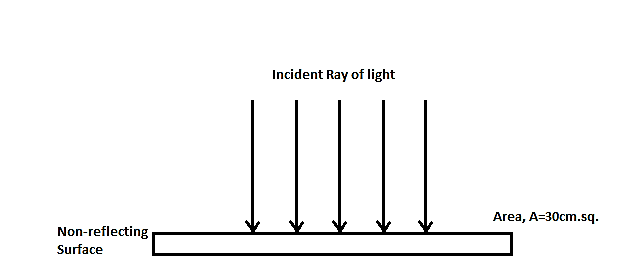
Here, we have to draw a diagram showing the phenomenon occurring according to the question.
Then let us use a formula for the force exerted on the surface by the light wave as below:
\[F = \dfrac{{IA}}{C}\]
\[ \ldots {\rm{ }}(I - {\rm{ }}intensity{\rm{ }}of{\rm{ }}light{\rm{ }}wave,C - {\rm{ }}speed{\rm{ }}of{\rm{ }}light)\]
Now, placing all the values in the equation above, we get
\[I = \dfrac{{FC}}{A}\]
\[I = \dfrac{{2.5 \times {{10}^6} \times 3 \times {{10}^8}}}{{30 \times {{10}^{ - 4}}}}\]
\[I = 2.5 \times {10^{ - 6}} \times {10^{11}}\]
\[I = 2.5 \times {10^5}\]
\[I = 25 \times {10^4}watt/{m^2}\]
But it has been asked in centimetre unit, so we have to convert meter to the centimetre, so that
\[I = 25 \times \dfrac{{{{10}^4}}}{{{{10}^4}}}watt/c{m^2}\]
\[I = 25W/c{m^2}\]
So, the intensity of the light wave is \[25W/c{m^2}\].
Note: Let us understand the concept used here, light is totally observed since, it is mentioned in the question that the surface is non-reflecting that means there will be no reflection considered. Hence, we just have to apply the formula and do the proper calculation. Must remember that give answer in the asked unit only.
Formula used:
\[F = \dfrac{{IA}}{C}\]
Complete answer:
Given,
\[F = 2.5 \times {10^{ - 6}}~N\]
\[Area = A = 30~c{m^2}\],
\[time,T = 40~{minutes}\]
Here, we have to draw a diagram showing the phenomenon occurring according to the question.
Then let us use a formula for the force exerted on the surface by the light wave as below:
\[F = \dfrac{{IA}}{C}\]
\[ \ldots {\rm{ }}(I - {\rm{ }}intensity{\rm{ }}of{\rm{ }}light{\rm{ }}wave,C - {\rm{ }}speed{\rm{ }}of{\rm{ }}light)\]
Now, placing all the values in the equation above, we get
\[I = \dfrac{{FC}}{A}\]
\[I = \dfrac{{2.5 \times {{10}^6} \times 3 \times {{10}^8}}}{{30 \times {{10}^{ - 4}}}}\]
\[I = 2.5 \times {10^{ - 6}} \times {10^{11}}\]
\[I = 2.5 \times {10^5}\]
\[I = 25 \times {10^4}watt/{m^2}\]
But it has been asked in centimetre unit, so we have to convert meter to the centimetre, so that
\[I = 25 \times \dfrac{{{{10}^4}}}{{{{10}^4}}}watt/c{m^2}\]
\[I = 25W/c{m^2}\]
So, the intensity of the light wave is \[25W/c{m^2}\].
Note: Let us understand the concept used here, light is totally observed since, it is mentioned in the question that the surface is non-reflecting that means there will be no reflection considered. Hence, we just have to apply the formula and do the proper calculation. Must remember that give answer in the asked unit only.
Recently Updated Pages
Algebra Made Easy: Step-by-Step Guide for Students

JEE Isolation, Preparation and Properties of Non-metals Important Concepts and Tips for Exam Preparation
JEE Energetics Important Concepts and Tips for Exam Preparation
Chemical Properties of Hydrogen - Important Concepts for JEE Exam Preparation
JEE General Topics in Chemistry Important Concepts and Tips
JEE Amino Acids and Peptides Important Concepts and Tips for Exam Preparation
Trending doubts
JEE Main 2026: Exam Dates, Session 2 Updates, City Slip, Admit Card & Latest News
JEE Main Participating Colleges 2026 - A Complete List of Top Colleges
Hybridisation in Chemistry – Concept, Types & Applications
Understanding the Electric Field of a Uniformly Charged Ring
Derivation of Equation of Trajectory Explained for Students
Understanding Atomic Structure for Beginners
Other Pages
CBSE Class 12 Physics Question Paper 2026: Download SET-wise PDF with Answer Key & Analysis
JEE Advanced 2026 Notification Out with Exam Date, Registration (Extended), Syllabus and More
JEE Advanced Marks vs Ranks 2025: Understanding Category-wise Qualifying Marks and Previous Year Cut-offs
JEE Advanced Weightage Chapter Wise 2026 for Physics, Chemistry, and Mathematics
How to Convert a Galvanometer into an Ammeter or Voltmeter
Electron Gain Enthalpy and Electron Affinity Explained