




Four point masses, each of mass M are placed at corner of square ABCD of side L. The moment of inertia of this system about an axis passing through A and parallel to BD is
(A) $3M{L^2}$
(B) \[M{L^2}\]
(C) $2M{L^2}$
(D) $\sqrt 3 M{L^2}$
Answer
 Verified
263.7k+ views
Hint: Since each corner of square ABCD has a mass and we need to find the inertia parallel to BD so we will be using the parallel axis theorem.
Formula Used:
\[I = {I_{cm}} + M{a^2}\]
Complete step by step answer
First, we will draw the diagram. Here, OP is the perpendicular drawn from O to AD. XX’ is drawn passing through A and parallel to BD. The length of AP and AD to be equal as $\dfrac{L}{2}$.
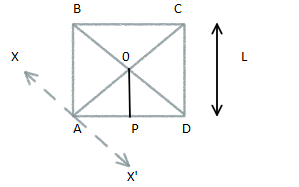
We know from properties of square that $\angle BAD = {90^0}$, so $\angle OAP = {45^0}$. To get OA, \[\cos {45^0} = \dfrac{{L/2}}{{AO}} \Rightarrow AO = \dfrac{L}{{2\cos {{45}^0}}} = \dfrac{L}{{2 \times 1/2}} = \dfrac{L}{{\sqrt 2 }}\].
To find moment of inertia at A, we will apply parallel axis theorem, \[I = {I_{cm}} + M{a^2}\]where
${I_{cm}}$is the moment of inertia at center of mass, M is the mass a be the distance between two axes.
\[{I_{XX'}} = {I_{cm}} + M{(AO)^2}\]
The moment of inertia at center will be because of all four points A, B, C, D.
So \[{I_{XX'}} = ({I_A} + {I_B} + {I_C} + {I_D}) + M{(AO)^2} = M{(\dfrac{L}{{\sqrt 2 }})^2} + 0 + M{(\dfrac{L}{{\sqrt 2 }})^2} + 0 + 4M{(\dfrac{L}{{\sqrt 2 }})^2}\]
\[ \Rightarrow {I_{XX'}} = \dfrac{{M{L^2}}}{2} + \dfrac{{M{L^2}}}{2} + \dfrac{{4M{L^2}}}{2} = 3M{L^2}\]
Correct answer is A. $3M{L^2}$
Additional information
There are basically two theorems used in calculating moment of inertia. They are –
Parallel Axis Theorem which states that a body’s moment of inertia about any axis is the sum of moment of inertia about a parallel axis which passes through the center of mass and the product of mass of body and perpendicular distance between axes square.
Perpendicular Axis Theorem which says that a body’s moment of inertia about a perpendicular to plane axis is the sum of moment of inertia of any two-perpendicular axis in the first axis intersecting plane.
Note
Moment of inertia at point B and D is zero as the perpendicular distance for both the points are zero.
Formula Used:
\[I = {I_{cm}} + M{a^2}\]
Complete step by step answer
First, we will draw the diagram. Here, OP is the perpendicular drawn from O to AD. XX’ is drawn passing through A and parallel to BD. The length of AP and AD to be equal as $\dfrac{L}{2}$.
We know from properties of square that $\angle BAD = {90^0}$, so $\angle OAP = {45^0}$. To get OA, \[\cos {45^0} = \dfrac{{L/2}}{{AO}} \Rightarrow AO = \dfrac{L}{{2\cos {{45}^0}}} = \dfrac{L}{{2 \times 1/2}} = \dfrac{L}{{\sqrt 2 }}\].
To find moment of inertia at A, we will apply parallel axis theorem, \[I = {I_{cm}} + M{a^2}\]where
${I_{cm}}$is the moment of inertia at center of mass, M is the mass a be the distance between two axes.
\[{I_{XX'}} = {I_{cm}} + M{(AO)^2}\]
The moment of inertia at center will be because of all four points A, B, C, D.
So \[{I_{XX'}} = ({I_A} + {I_B} + {I_C} + {I_D}) + M{(AO)^2} = M{(\dfrac{L}{{\sqrt 2 }})^2} + 0 + M{(\dfrac{L}{{\sqrt 2 }})^2} + 0 + 4M{(\dfrac{L}{{\sqrt 2 }})^2}\]
\[ \Rightarrow {I_{XX'}} = \dfrac{{M{L^2}}}{2} + \dfrac{{M{L^2}}}{2} + \dfrac{{4M{L^2}}}{2} = 3M{L^2}\]
Correct answer is A. $3M{L^2}$
Additional information
There are basically two theorems used in calculating moment of inertia. They are –
Parallel Axis Theorem which states that a body’s moment of inertia about any axis is the sum of moment of inertia about a parallel axis which passes through the center of mass and the product of mass of body and perpendicular distance between axes square.
Perpendicular Axis Theorem which says that a body’s moment of inertia about a perpendicular to plane axis is the sum of moment of inertia of any two-perpendicular axis in the first axis intersecting plane.
Note
Moment of inertia at point B and D is zero as the perpendicular distance for both the points are zero.
Recently Updated Pages
JEE Main Mock Test 2025-26: Principles Related To Practical

JEE Main 2025-26 Experimental Skills Mock Test – Free Practice
JEE Main 2025-26 Electronic Devices Mock Test: Free Practice Online
JEE Main 2025-26 Mock Tests: Free Practice Papers & Solutions
JEE Main 2025-26: Magnetic Effects of Current & Magnetism Mock Test
JEE Main Statistics and Probability Mock Test 2025-26
Trending doubts
JEE Main 2026: Exam Dates, Session 2 Updates, City Slip, Admit Card & Latest News
JEE Main Participating Colleges 2026 - A Complete List of Top Colleges
Hybridisation in Chemistry – Concept, Types & Applications
Understanding the Electric Field of a Uniformly Charged Ring
Derivation of Equation of Trajectory Explained for Students
Understanding Atomic Structure for Beginners
Other Pages
JEE Advanced 2026 Notification Out with Exam Date, Registration (Extended), Syllabus and More
JEE Advanced Marks vs Ranks 2025: Understanding Category-wise Qualifying Marks and Previous Year Cut-offs
CBSE Notes Class 11 Physics Chapter 1 - Units And Measurements - 2025-26
NCERT Solutions For Class 11 Physics Chapter 1 Units And Measurements - 2025-26
Important Questions For Class 11 Physics Chapter 1 Units and Measurement - 2025-26
JEE Advanced Weightage Chapter Wise 2026 for Physics, Chemistry, and Mathematics