




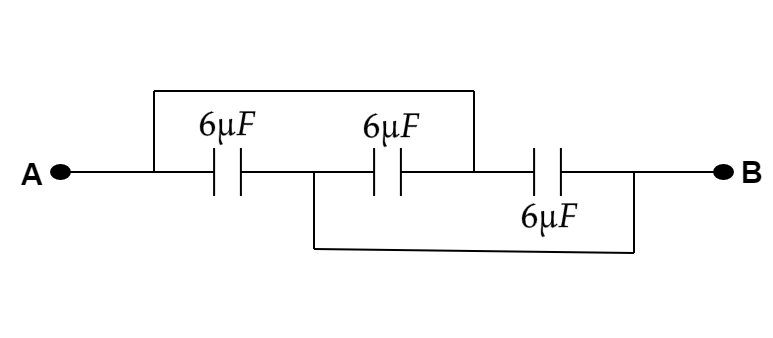
Find the equivalent resistance of the given circuit:
Answer
 Verified
242.1k+ views
Hint: - In this question, first the equivalent circuit needs to be drawn between the given terminal points to identify whether the given capacitors are in series or in parallel. Now apply the formula of the series combination or the parallel combination to determine the equivalent capacitance.
Complete step-by-step solution:
In this problem, the circuit of the capacitance is known which has three capacitors and we need to determine the equivalent capacitance of the circuit.
The given circuit is,
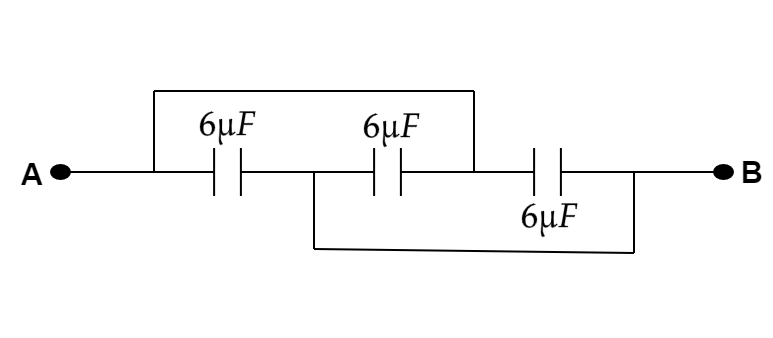
From the above diagram, we can see that the potential difference between each capacitor is the same, so all the capacitors between points A and B are in parallel. At this moment, we consider the equivalent circuit of the capacitor as,
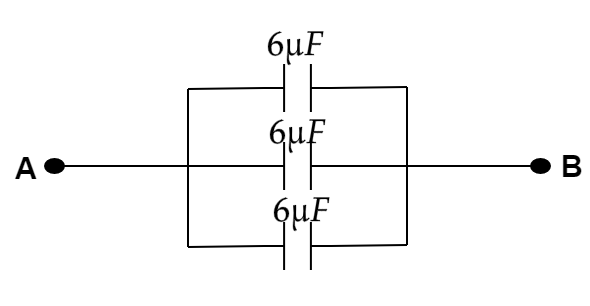
When capacitors are connected in parallel the equivalent capacitance, ${C_T}$ of the circuit is adequate to the sum of all individual capacitors connected.
By parallel connection of the capacitor equation, we will calculate the equivalent capacitance of the capacitor as,
${C_T} = 6 + 6 + 6$
After simplification, we get
$\therefore {C_T} = 18\mu F$
Thus, the equivalent capacitance of the capacitor between point A and B is $18\mu F$ .
Additional Information: We can define the capacitance as the ratio of the magnitude of the charge on either of the conductors to the magnitude of the potential difference between the two conductors. The unit of capacitance is Farad. There are two types of combinations possible in capacitor: parallel and series. The Series and parallel combination of capacitors have the opposite formula as that of resistance.
Note: We know that if the capacitors are in parallel then the equivalent capacitance of the capacitor is the sum of the individual capacitors but if the capacitors are in series then the capacitance of the capacitor is calculated by $\dfrac{1}{{{C_T}}} = \dfrac{1}{{{C_1}}} + \dfrac{1}{{{C_2}}} + \dfrac{1}{{{C_3}}}$ . Where ${C_1}$ , ${C_2}$ , ${C_3}$ are the individual capacitance.
Complete step-by-step solution:
In this problem, the circuit of the capacitance is known which has three capacitors and we need to determine the equivalent capacitance of the circuit.
The given circuit is,
From the above diagram, we can see that the potential difference between each capacitor is the same, so all the capacitors between points A and B are in parallel. At this moment, we consider the equivalent circuit of the capacitor as,
When capacitors are connected in parallel the equivalent capacitance, ${C_T}$ of the circuit is adequate to the sum of all individual capacitors connected.
By parallel connection of the capacitor equation, we will calculate the equivalent capacitance of the capacitor as,
${C_T} = 6 + 6 + 6$
After simplification, we get
$\therefore {C_T} = 18\mu F$
Thus, the equivalent capacitance of the capacitor between point A and B is $18\mu F$ .
Additional Information: We can define the capacitance as the ratio of the magnitude of the charge on either of the conductors to the magnitude of the potential difference between the two conductors. The unit of capacitance is Farad. There are two types of combinations possible in capacitor: parallel and series. The Series and parallel combination of capacitors have the opposite formula as that of resistance.
Note: We know that if the capacitors are in parallel then the equivalent capacitance of the capacitor is the sum of the individual capacitors but if the capacitors are in series then the capacitance of the capacitor is calculated by $\dfrac{1}{{{C_T}}} = \dfrac{1}{{{C_1}}} + \dfrac{1}{{{C_2}}} + \dfrac{1}{{{C_3}}}$ . Where ${C_1}$ , ${C_2}$ , ${C_3}$ are the individual capacitance.
Recently Updated Pages
JEE Main 2025-26 Mock Tests: Free Practice Papers & Solutions

JEE Main 2025-26 Experimental Skills Mock Test – Free Practice
JEE Main 2025-26 Electronic Devices Mock Test: Free Practice Online
JEE Main 2025-26 Atoms and Nuclei Mock Test – Free Practice Online
JEE Main 2025-26: Magnetic Effects of Current & Magnetism Mock Test
JEE Main Mock Test 2025: Properties of Solids and Liquids
Trending doubts
JEE Main 2026: Session 1 Results Out and Session 2 Registration Open, City Intimation Slip, Exam Dates, Syllabus & Eligibility
Ideal and Non-Ideal Solutions Explained for Class 12 Chemistry
JEE Main Participating Colleges 2026 - A Complete List of Top Colleges
Degree of Dissociation: Meaning, Formula, Calculation & Uses
Understanding the Angle of Deviation in a Prism
Hybridisation in Chemistry – Concept, Types & Applications
Other Pages
CBSE Class 12 Physics Question Paper 2026: Download SET-wise PDF with Answer Key & Analysis
JEE Advanced Marks vs Ranks 2025: Understanding Category-wise Qualifying Marks and Previous Year Cut-offs
Dual Nature of Radiation and Matter Class 12 Physics Chapter 11 CBSE Notes - 2025-26
CBSE Class 10 Sanskrit Set 4 52 Question Paper 2025 – PDF, Solutions & Analysis
JEE Advanced Weightage 2025 Chapter-Wise for Physics, Maths and Chemistry
Understanding the Electric Field of a Uniformly Charged Ring