




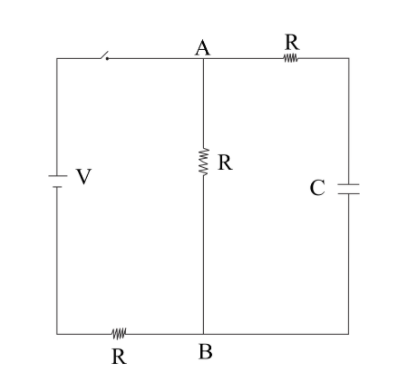
Find the charge $Q$ on the capacitor at time $t$ .
Answer
 Verified
267.3k+ views
Hint: We can use the formula of charge on a capacitor as product of capacitance and voltage across it, and then using the equation of potential balance across each element of circuit, we will get a differential equation, and by solving it, we can find charge as a function of time.
Complete step by step answer:
Equivalent resistance with series in capacitor is $\dfrac{{R \times R}}{{R + R}} + R$
On solving this, we can equivalent resistance $\operatorname{Re} $ as
${\text{Re = }}\dfrac{{\text{R}}}{2} + {\text{R}}$
On further simplification, we get,
$\operatorname{Re} = \dfrac{{3R}}{2}$
Now, equation of potential balance, across each element of circuit will be,
$V - {V_C} - {V_R} = 0$
Where,
${V_C}$ is voltage across capacitance, that is, $\dfrac{q}{C}$ ( $q$ is charge at time $t$ and $C$ is capacitance )
${V_R}$ is voltage across resistance, that is, $\operatorname{Re} I$ ( $\operatorname{Re} $ is equivalent resistance, $I$ is current at time $t$ )
On further simplification we get,
$V = \dfrac{q}{C} + \operatorname{Re} I$
Now current is rate of change of charge, that is, $\dfrac{{dq}}{{dt}}$, so we get,
$V = \dfrac{q}{C} + \operatorname{Re} \dfrac{{dq}}{{dt}}$
On further simplification, we get,
$\dfrac{{dt}}{{\operatorname{Re} C}} = \dfrac{{dq}}{{CV - q}}$
On integrating both sides and applying limits in time from $0$ to $t$ and on charge from $0$ to $q$, we get,
$\int_0^t {\dfrac{{dt}}{{\operatorname{Re} C}}} = \int_0^q {\dfrac{{dq}}{{CV - q}}} $
On integration we get,
$\left( {\dfrac{t}{{\operatorname{Re} C}}} \right)_0^t = \left( { - \ln (CV - q)} \right)_0^q$
On solving limits, we get,
\[\left( { - \dfrac{t}{{\operatorname{Re} C}}} \right) = \left( {\ln (CV - q) - \ln (CV)} \right)\]
So we get,
$\dfrac{{ - t}}{{\operatorname{Re} C}} = \ln \left( {\dfrac{{CV - q}}{{CV}}} \right)$
On further simplifications, we get,
$q = CV\left( {1 - {e^{\dfrac{{ - t}}{{\operatorname{Re} C}}}}} \right)$
Where $\operatorname{Re} = \dfrac{{3R}}{2}$, $CV$ is initial charge (if we denote it by ${q_0}$ ) then we get,
$q = {q_0}\left( {1 - {e^{\dfrac{{ - 2t}}{{3RC}}}}} \right)$
Note: We got $\operatorname{Re} C$ in the expression of charge, this is known as Time Constant of the RC Circuit. This time constant has a role of opposing the change in charge of the capacitor. This can be denoted as the inertia of the circuit. It means, greater the time constant, slower will be the charging rate of the capacitor.
Complete step by step answer:
Equivalent resistance with series in capacitor is $\dfrac{{R \times R}}{{R + R}} + R$
On solving this, we can equivalent resistance $\operatorname{Re} $ as
${\text{Re = }}\dfrac{{\text{R}}}{2} + {\text{R}}$
On further simplification, we get,
$\operatorname{Re} = \dfrac{{3R}}{2}$
Now, equation of potential balance, across each element of circuit will be,
$V - {V_C} - {V_R} = 0$
Where,
${V_C}$ is voltage across capacitance, that is, $\dfrac{q}{C}$ ( $q$ is charge at time $t$ and $C$ is capacitance )
${V_R}$ is voltage across resistance, that is, $\operatorname{Re} I$ ( $\operatorname{Re} $ is equivalent resistance, $I$ is current at time $t$ )
On further simplification we get,
$V = \dfrac{q}{C} + \operatorname{Re} I$
Now current is rate of change of charge, that is, $\dfrac{{dq}}{{dt}}$, so we get,
$V = \dfrac{q}{C} + \operatorname{Re} \dfrac{{dq}}{{dt}}$
On further simplification, we get,
$\dfrac{{dt}}{{\operatorname{Re} C}} = \dfrac{{dq}}{{CV - q}}$
On integrating both sides and applying limits in time from $0$ to $t$ and on charge from $0$ to $q$, we get,
$\int_0^t {\dfrac{{dt}}{{\operatorname{Re} C}}} = \int_0^q {\dfrac{{dq}}{{CV - q}}} $
On integration we get,
$\left( {\dfrac{t}{{\operatorname{Re} C}}} \right)_0^t = \left( { - \ln (CV - q)} \right)_0^q$
On solving limits, we get,
\[\left( { - \dfrac{t}{{\operatorname{Re} C}}} \right) = \left( {\ln (CV - q) - \ln (CV)} \right)\]
So we get,
$\dfrac{{ - t}}{{\operatorname{Re} C}} = \ln \left( {\dfrac{{CV - q}}{{CV}}} \right)$
On further simplifications, we get,
$q = CV\left( {1 - {e^{\dfrac{{ - t}}{{\operatorname{Re} C}}}}} \right)$
Where $\operatorname{Re} = \dfrac{{3R}}{2}$, $CV$ is initial charge (if we denote it by ${q_0}$ ) then we get,
$q = {q_0}\left( {1 - {e^{\dfrac{{ - 2t}}{{3RC}}}}} \right)$
Note: We got $\operatorname{Re} C$ in the expression of charge, this is known as Time Constant of the RC Circuit. This time constant has a role of opposing the change in charge of the capacitor. This can be denoted as the inertia of the circuit. It means, greater the time constant, slower will be the charging rate of the capacitor.
Recently Updated Pages
States of Matter Chapter For JEE Main Chemistry

Young’s Double Slit Experiment Derivation Explained
Wheatstone Bridge – Principle, Formula, Diagram & Applications
Circuit Switching vs Packet Switching: Key Differences Explained
Mass vs Weight: Key Differences Explained for Students
[Awaiting the three content sources: Ask AI Response, Competitor 1 Content, and Competitor 2 Content. Please provide those to continue with the analysis and optimization.]
Trending doubts
JEE Main 2026: Exam Dates, Session 2 Updates, City Slip, Admit Card & Latest News
JEE Main Participating Colleges 2026 - A Complete List of Top Colleges
Kinematics Mock Test for JEE Main 2025-26: Practice & Ace the Exam
Kinematics Mock Test for JEE Main 2025-26: Comprehensive Practice
Hybridisation in Chemistry – Concept, Types & Applications
Understanding the Electric Field of a Uniformly Charged Ring
Other Pages
CBSE Class 12 Physics Question Paper 2026: Download SET-wise PDF with Answer Key & Analysis
JEE Advanced 2026 Notification Out with Exam Date, Registration (Extended), Syllabus and More
JEE Advanced Percentile vs Marks 2026: JEE Main Cutoff, AIR & IIT Admission Guide
JEE Advanced 2026 Marks vs Rank: Estimate IIT Rank from Your Score
JEE Advanced Weightage Chapter Wise 2026 for Physics, Chemistry, and Mathematics
Derivation of Equation of Trajectory Explained for Students