




Find the area of region $\left\{ {\left( {x,y} \right) \in {R^2}:y \geqslant \sqrt {\left| {x + 3} \right|} ,5y \leqslant x + 9 \leqslant 15} \right\}$.
A) $\dfrac{1}{6}$
B) $\dfrac{4}{3}$
C) $\dfrac{3}{2}$
D) $\dfrac{5}{3}$
Answer
 Verified
233.1k+ views
Hint: Use the given equations to plot the curves on the coordinate plane. And use the inequality to find the region belonging to inequality. Plot $y \geqslant \sqrt {\left| {x + 3} \right|} $ , $5y \leqslant x + 9$ and $x \leqslant 6$ separately. In case of $y \geqslant \sqrt {\left| {x + 3} \right|} $, simplify it by squaring both sides and resolve the absolute value function for the interval $x \leqslant - 3{\text{ and }}x \geqslant - 3$. Now figure out the region and use the method of integration to find the area under the curve.
Complete step by step answer:
We are here given with three inequalities that represent three different regions on the Cartesian plane. The three inequalities are $y \geqslant \sqrt {\left| {x + 3} \right|} $ , $5y \leqslant x + 9$ and $x + 9 \leqslant 15$. We need to find the area of the region which is bounded by these curves.
Let us find these regions one by one. First, consider the inequality: $y \geqslant \sqrt {\left| {x + 3} \right|} $
We can transform this into a more useful form by squaring both sides:
$ \Rightarrow {y^2} \geqslant \left| {x + 3} \right|$
Now, we need to resolve this absolute function on the right-hand side. But first, we need to understand the concept of the absolute value function. The definition of this function is as follows:
$f\left( x \right) = \left| x \right| = \left\{ {\begin{array}{*{20}{c}}
{x,{\text{ if }}x \geqslant 0} \\
{ - x,{\text{ if }}x < 0}
\end{array}} \right.$
So, using this definition, we can write that:
$ \Rightarrow {y^2} \geqslant \left\{ {\begin{array}{*{20}{c}}
{x + 3,{\text{ when }}\left( {x + 3} \right) \geqslant 0 \Rightarrow x \geqslant - 3} \\
{ - 3 - x,{\text{ when }}\left( {x + 3} \right) \leqslant 0 \Rightarrow x \leqslant - 3{\text{ }}}
\end{array}} \right.$
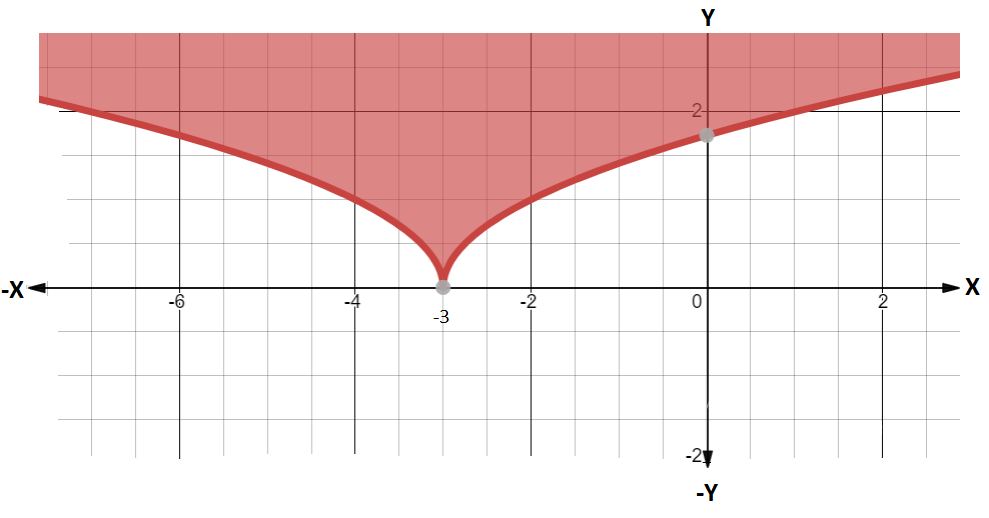
Thus, for $x \geqslant - 3$ the curve will be a parabola that opens towards the direction of the positive x-axis and for $x \leqslant - 3$ the curve will be a parabola that opens towards the negative x-axis. This is because of the sign of the variable $x$ in the equation.
Therefore, we can now draw our curve. But first, we need to consider some details from the parent equation. Since $y$ was greater than equal to a square root, therefore the value of $y$ can never be negative.
As we know, the curve will divide the x-y plane into two-part. So, for checking the region to be selected, we need to perform a test by assuming a point which is not on the curve.
Let’s take $\left( {x,y} \right) = \left( {0,0} \right)$ and put in the inequality and check if it holds.
$ \Rightarrow y \geqslant \sqrt {\left| {x + 3} \right|} \Rightarrow 0 \geqslant \sqrt {\left| {0 + 3} \right|} \Rightarrow 0 \geqslant \sqrt 3 $
So, this point does not satisfy the inequality. Thus we can say this point will not lie in the region represented by this inequality.
And as we know that the equation of the parabola is of the form ${y^2} = 4ax$ , therefore, this parabola can be represented by this following figure:
Similarly, let us now consider the inequality $5y \leqslant x + 9 \leqslant 15$
Or this inequality can be represented in a simpler form as: $5y \leqslant x + 9{\text{ and }}x + 9 \leqslant 15 \Rightarrow 5y - x - 9 \leqslant 0{\text{ and }}x \leqslant 6$
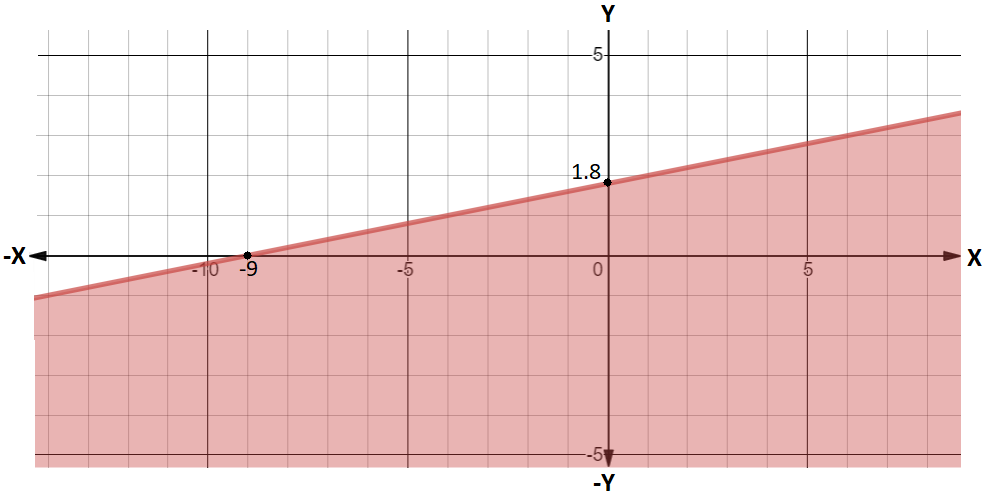
This gives us two equations of the line. Let’s consider $5y - x - 9 \leqslant 0$ first and try to find the intercept points on x-axis and y-axis. For x-intercept, we can put $y = 0$ and for y-intercept, we can put $x = 0$
$ \Rightarrow $ At $y = 0$ , $x + 9 = 0 \Rightarrow x = - 9$ and at $x = 0,{\text{ }}5y - 9 = 0 \Rightarrow y = \dfrac{9}{5}$
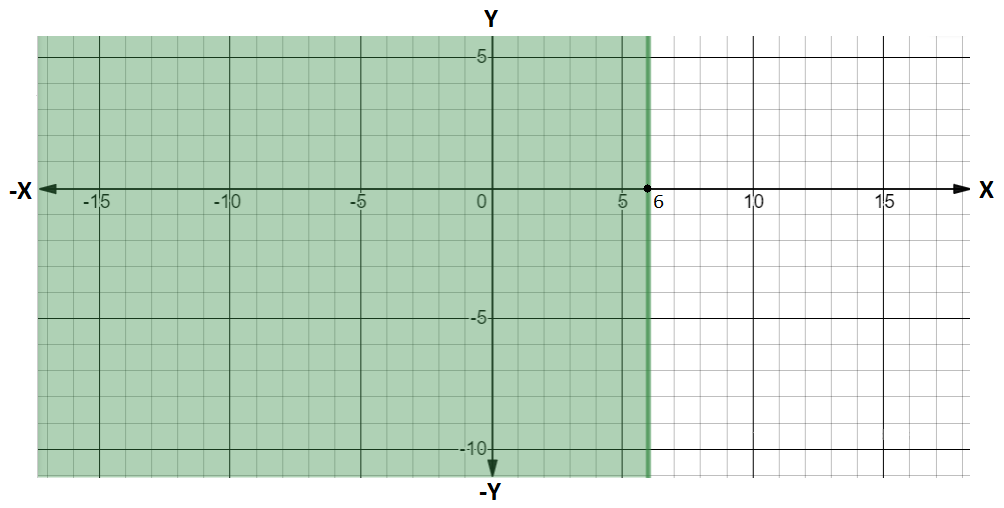
And the line $x \leqslant 6$ will be vertical and pass parallel to the y-axis through point $\left( {6,0} \right)$.
Now, for checking the region, we put $\left( {0,0} \right)$ in $5y - x - 9 \leqslant 0$: $ \Rightarrow 0 - 0 - 9 \leqslant 0 \Rightarrow - 9 \leqslant 0$
So, the coordinates of origin satisfy the equation and the origin will be inside the region.
So, now we can plot these lines easily as shown in the diagram:
Now, we can combine these three regions to find the bounded area and the coordinates for the intersection point. Thus the required region is shown in the following figure:
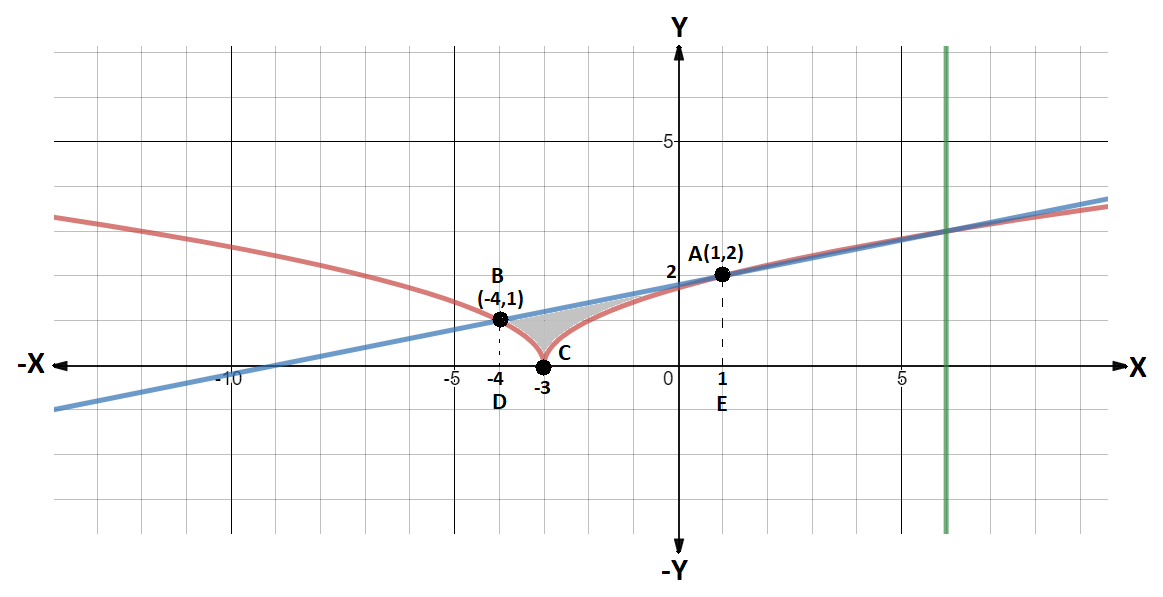
So, we got the region ABC as the required bounded area. The points of intersection of line \[5y - x - 9 = 0\] and parabola $y = \sqrt {\left| {x + 3} \right|} $ are A and B.
Let’s now try to figure out these points. For point A, $x > - 3$ therefore, the equation of parabola will be ${y^2} = x + 3$. So we have to find a common point of ${y^2} = x + 3$ and \[5y - x - 9 = 0\]. This can be done substituting the value of $x$ from first into the second equation.
$ \Rightarrow 5y - \left( {{y^2} - 3} \right) - 9 = 0 \Rightarrow {y^2} - 5y + 6 = 0 \Rightarrow \left( {y - 2} \right)\left( {y - 3} \right) = 0$
Therefore, $y = 2{\text{ or }}y = 3$
But for $y = 2 \Rightarrow x = {y^2} - 3 = 4 - 3 \Rightarrow x = 1$ and for $y = 3 \Rightarrow x = {3^2} - 3 = 6$
They intersect at $\left( {1,2} \right){\text{ and }}\left( {6,3} \right)$ but $\left( {1,2} \right)$lie before $\left( {6,3} \right)$. Thus coordinates of point A is $\left( {1,2} \right)$.
Now, for the second point B, the equation of parabola for $x < - 3$ will become ${y^2} = - 3 - x$ .
Similarly, we need to find the intersection point of ${y^2} = - 3 - x$ and \[5y - x - 9 = 0\]. We can do this by substituting the value of $x$ from first into the second equation.
$ \Rightarrow 5y - \left( { - {y^2} - 3} \right) - 9 = 0 \Rightarrow {y^2} + 5y - 6 = 0 \Rightarrow \left( {y - 1} \right)\left( {y + 6} \right) = 0$
Therefore, $y = 1{\text{ or }}y = - 6$
But for $y = 1 \Rightarrow x = - {y^2} - 3 = - 1 - 3 \Rightarrow x = - 4$ and for \[y = - 6 \Rightarrow x = - {y^2} - 3 = - 36 - 3 = - 39\]
They intersect at $\left( { - 4,1} \right){\text{ and }}\left( { - 39, - 4} \right)$ but the value of $y$ cannot be negative. So coordinates of point B is $\left( { - 4,1} \right)$.
If we notice the diagram carefully, we can see that if we drop a line perpendicular to points A and B on the x-axis we get a trapezium ABDE. And our bounded region ABC falls completely inside this trapezium.
$ \Rightarrow $ Area of trapezium ABDE $ = $ Area of the bounded region ABC $ + $ Area of the parabola in interval $\left( { - 4, - 3} \right)$ + Area of the parabola in the interval $\left( { - 3,1} \right)$
We know that the area of under the curve and x-axis can be found through integrating the equation with respect to $x$ in a definite interval.
Therefore, the area of the parabola in the interval $\left( { - 4, - 3} \right)$will be $\int\limits_{ - 4}^{ - 3} {\sqrt { - 3 - x} } dx$ and the area of the parabola in the interval $\left( { - 3,1} \right)$ will be represented by $\int\limits_{ - 3}^1 {\sqrt {x + 3} } dx$
From the above relation, we get that:
$ \Rightarrow $ Required Area$ = $ Area of trapezium ABDE$ - \int\limits_{ - 4}^{ - 3} {\sqrt { - 3 - x} } dx$$ - \int\limits_{ - 3}^1 {\sqrt {x + 3} } dx$
These both integrals can be solved using $\int {{x^n}dx = \dfrac{{{x^{n + 1}}}}{{n + 1}}} + C$ and the area of trapezium can be expressed as half times the sum of parallel sides times the distance between them.
Therefore, we get:
$ \Rightarrow $ Required Area$ = $ $\dfrac{1}{2} \times \left( {BD + AE} \right) \times DE$ $ - \left[ {\dfrac{{{{\left( { - 3 - x} \right)}^{\dfrac{3}{2}}}}}{{ - \dfrac{3}{2}}}} \right]_{ - 4}^{ - 3}$$ - \left[ {\dfrac{{{{\left( {x + 3} \right)}^{\dfrac{3}{2}}}}}{{\dfrac{3}{2}}}} \right]_{ - 3}^1$
Now let’s put the values of BD, AE and DE from the diagram. On solving further, we have:
$ \Rightarrow $ Required Area$ = $ $\dfrac{1}{2} \times \left( {1 + 2} \right) \times 5$ $ + \dfrac{2}{3}\left[ {{{\left( { - 3 + 3} \right)}^{\dfrac{3}{2}}} - {{\left( { - 3 + 4} \right)}^{\dfrac{3}{2}}}} \right]$$ - \dfrac{2}{3}\left[ {{{\left( {1 + 3} \right)}^{\dfrac{3}{2}}} - {{\left( { - 3 + 3} \right)}^{\dfrac{3}{2}}}} \right]$
This can be further simplified as:
$ \Rightarrow $ Required Area$ = $ $\dfrac{{15}}{2}$ $ + \dfrac{2}{3}\left[ {0 - 1} \right]$$ - \dfrac{2}{3}\left[ {8 - 0} \right]$$ = \dfrac{{15}}{2} - \dfrac{2}{3} - \dfrac{{16}}{3} = \dfrac{{15}}{2} - \dfrac{{18}}{3} = \dfrac{3}{2}sq.units$
Therefore, we got the area of the required region as $\dfrac{3}{2}sq.units.$
Hence, the option (C) is the correct answer.
Note: Always draw a diagram when you are asked to find the area of the bounded region using some equation of curves. Notice than while plotting the curve $y = \sqrt {\left| {x + 3} \right|} $ we made some transformations by squaring both sides and then resolving the absolute value function. This will always help in drawing the curve on the coordinate plane but never forget to check the range and domain with the parent equation, i.e. $y = \sqrt {\left| {x + 3} \right|} $.
Complete step by step answer:
We are here given with three inequalities that represent three different regions on the Cartesian plane. The three inequalities are $y \geqslant \sqrt {\left| {x + 3} \right|} $ , $5y \leqslant x + 9$ and $x + 9 \leqslant 15$. We need to find the area of the region which is bounded by these curves.
Let us find these regions one by one. First, consider the inequality: $y \geqslant \sqrt {\left| {x + 3} \right|} $
We can transform this into a more useful form by squaring both sides:
$ \Rightarrow {y^2} \geqslant \left| {x + 3} \right|$
Now, we need to resolve this absolute function on the right-hand side. But first, we need to understand the concept of the absolute value function. The definition of this function is as follows:
$f\left( x \right) = \left| x \right| = \left\{ {\begin{array}{*{20}{c}}
{x,{\text{ if }}x \geqslant 0} \\
{ - x,{\text{ if }}x < 0}
\end{array}} \right.$
So, using this definition, we can write that:
$ \Rightarrow {y^2} \geqslant \left\{ {\begin{array}{*{20}{c}}
{x + 3,{\text{ when }}\left( {x + 3} \right) \geqslant 0 \Rightarrow x \geqslant - 3} \\
{ - 3 - x,{\text{ when }}\left( {x + 3} \right) \leqslant 0 \Rightarrow x \leqslant - 3{\text{ }}}
\end{array}} \right.$
Thus, for $x \geqslant - 3$ the curve will be a parabola that opens towards the direction of the positive x-axis and for $x \leqslant - 3$ the curve will be a parabola that opens towards the negative x-axis. This is because of the sign of the variable $x$ in the equation.
Therefore, we can now draw our curve. But first, we need to consider some details from the parent equation. Since $y$ was greater than equal to a square root, therefore the value of $y$ can never be negative.
As we know, the curve will divide the x-y plane into two-part. So, for checking the region to be selected, we need to perform a test by assuming a point which is not on the curve.
Let’s take $\left( {x,y} \right) = \left( {0,0} \right)$ and put in the inequality and check if it holds.
$ \Rightarrow y \geqslant \sqrt {\left| {x + 3} \right|} \Rightarrow 0 \geqslant \sqrt {\left| {0 + 3} \right|} \Rightarrow 0 \geqslant \sqrt 3 $
So, this point does not satisfy the inequality. Thus we can say this point will not lie in the region represented by this inequality.
And as we know that the equation of the parabola is of the form ${y^2} = 4ax$ , therefore, this parabola can be represented by this following figure:
Similarly, let us now consider the inequality $5y \leqslant x + 9 \leqslant 15$
Or this inequality can be represented in a simpler form as: $5y \leqslant x + 9{\text{ and }}x + 9 \leqslant 15 \Rightarrow 5y - x - 9 \leqslant 0{\text{ and }}x \leqslant 6$
This gives us two equations of the line. Let’s consider $5y - x - 9 \leqslant 0$ first and try to find the intercept points on x-axis and y-axis. For x-intercept, we can put $y = 0$ and for y-intercept, we can put $x = 0$
$ \Rightarrow $ At $y = 0$ , $x + 9 = 0 \Rightarrow x = - 9$ and at $x = 0,{\text{ }}5y - 9 = 0 \Rightarrow y = \dfrac{9}{5}$
And the line $x \leqslant 6$ will be vertical and pass parallel to the y-axis through point $\left( {6,0} \right)$.
Now, for checking the region, we put $\left( {0,0} \right)$ in $5y - x - 9 \leqslant 0$: $ \Rightarrow 0 - 0 - 9 \leqslant 0 \Rightarrow - 9 \leqslant 0$
So, the coordinates of origin satisfy the equation and the origin will be inside the region.
So, now we can plot these lines easily as shown in the diagram:
Now, we can combine these three regions to find the bounded area and the coordinates for the intersection point. Thus the required region is shown in the following figure:
So, we got the region ABC as the required bounded area. The points of intersection of line \[5y - x - 9 = 0\] and parabola $y = \sqrt {\left| {x + 3} \right|} $ are A and B.
Let’s now try to figure out these points. For point A, $x > - 3$ therefore, the equation of parabola will be ${y^2} = x + 3$. So we have to find a common point of ${y^2} = x + 3$ and \[5y - x - 9 = 0\]. This can be done substituting the value of $x$ from first into the second equation.
$ \Rightarrow 5y - \left( {{y^2} - 3} \right) - 9 = 0 \Rightarrow {y^2} - 5y + 6 = 0 \Rightarrow \left( {y - 2} \right)\left( {y - 3} \right) = 0$
Therefore, $y = 2{\text{ or }}y = 3$
But for $y = 2 \Rightarrow x = {y^2} - 3 = 4 - 3 \Rightarrow x = 1$ and for $y = 3 \Rightarrow x = {3^2} - 3 = 6$
They intersect at $\left( {1,2} \right){\text{ and }}\left( {6,3} \right)$ but $\left( {1,2} \right)$lie before $\left( {6,3} \right)$. Thus coordinates of point A is $\left( {1,2} \right)$.
Now, for the second point B, the equation of parabola for $x < - 3$ will become ${y^2} = - 3 - x$ .
Similarly, we need to find the intersection point of ${y^2} = - 3 - x$ and \[5y - x - 9 = 0\]. We can do this by substituting the value of $x$ from first into the second equation.
$ \Rightarrow 5y - \left( { - {y^2} - 3} \right) - 9 = 0 \Rightarrow {y^2} + 5y - 6 = 0 \Rightarrow \left( {y - 1} \right)\left( {y + 6} \right) = 0$
Therefore, $y = 1{\text{ or }}y = - 6$
But for $y = 1 \Rightarrow x = - {y^2} - 3 = - 1 - 3 \Rightarrow x = - 4$ and for \[y = - 6 \Rightarrow x = - {y^2} - 3 = - 36 - 3 = - 39\]
They intersect at $\left( { - 4,1} \right){\text{ and }}\left( { - 39, - 4} \right)$ but the value of $y$ cannot be negative. So coordinates of point B is $\left( { - 4,1} \right)$.
If we notice the diagram carefully, we can see that if we drop a line perpendicular to points A and B on the x-axis we get a trapezium ABDE. And our bounded region ABC falls completely inside this trapezium.
$ \Rightarrow $ Area of trapezium ABDE $ = $ Area of the bounded region ABC $ + $ Area of the parabola in interval $\left( { - 4, - 3} \right)$ + Area of the parabola in the interval $\left( { - 3,1} \right)$
We know that the area of under the curve and x-axis can be found through integrating the equation with respect to $x$ in a definite interval.
Therefore, the area of the parabola in the interval $\left( { - 4, - 3} \right)$will be $\int\limits_{ - 4}^{ - 3} {\sqrt { - 3 - x} } dx$ and the area of the parabola in the interval $\left( { - 3,1} \right)$ will be represented by $\int\limits_{ - 3}^1 {\sqrt {x + 3} } dx$
From the above relation, we get that:
$ \Rightarrow $ Required Area$ = $ Area of trapezium ABDE$ - \int\limits_{ - 4}^{ - 3} {\sqrt { - 3 - x} } dx$$ - \int\limits_{ - 3}^1 {\sqrt {x + 3} } dx$
These both integrals can be solved using $\int {{x^n}dx = \dfrac{{{x^{n + 1}}}}{{n + 1}}} + C$ and the area of trapezium can be expressed as half times the sum of parallel sides times the distance between them.
Therefore, we get:
$ \Rightarrow $ Required Area$ = $ $\dfrac{1}{2} \times \left( {BD + AE} \right) \times DE$ $ - \left[ {\dfrac{{{{\left( { - 3 - x} \right)}^{\dfrac{3}{2}}}}}{{ - \dfrac{3}{2}}}} \right]_{ - 4}^{ - 3}$$ - \left[ {\dfrac{{{{\left( {x + 3} \right)}^{\dfrac{3}{2}}}}}{{\dfrac{3}{2}}}} \right]_{ - 3}^1$
Now let’s put the values of BD, AE and DE from the diagram. On solving further, we have:
$ \Rightarrow $ Required Area$ = $ $\dfrac{1}{2} \times \left( {1 + 2} \right) \times 5$ $ + \dfrac{2}{3}\left[ {{{\left( { - 3 + 3} \right)}^{\dfrac{3}{2}}} - {{\left( { - 3 + 4} \right)}^{\dfrac{3}{2}}}} \right]$$ - \dfrac{2}{3}\left[ {{{\left( {1 + 3} \right)}^{\dfrac{3}{2}}} - {{\left( { - 3 + 3} \right)}^{\dfrac{3}{2}}}} \right]$
This can be further simplified as:
$ \Rightarrow $ Required Area$ = $ $\dfrac{{15}}{2}$ $ + \dfrac{2}{3}\left[ {0 - 1} \right]$$ - \dfrac{2}{3}\left[ {8 - 0} \right]$$ = \dfrac{{15}}{2} - \dfrac{2}{3} - \dfrac{{16}}{3} = \dfrac{{15}}{2} - \dfrac{{18}}{3} = \dfrac{3}{2}sq.units$
Therefore, we got the area of the required region as $\dfrac{3}{2}sq.units.$
Hence, the option (C) is the correct answer.
Note: Always draw a diagram when you are asked to find the area of the bounded region using some equation of curves. Notice than while plotting the curve $y = \sqrt {\left| {x + 3} \right|} $ we made some transformations by squaring both sides and then resolving the absolute value function. This will always help in drawing the curve on the coordinate plane but never forget to check the range and domain with the parent equation, i.e. $y = \sqrt {\left| {x + 3} \right|} $.
Recently Updated Pages
JEE Main 2023 April 6 Shift 1 Question Paper with Answer Key

JEE Main 2023 April 6 Shift 2 Question Paper with Answer Key
JEE Main 2023 (January 31 Evening Shift) Question Paper with Solutions [PDF]
JEE Main 2023 January 30 Shift 2 Question Paper with Answer Key
JEE Main 2023 January 25 Shift 1 Question Paper with Answer Key
JEE Main 2023 January 24 Shift 2 Question Paper with Answer Key
Trending doubts
JEE Main 2026: Session 2 Registration Open, City Intimation Slip, Exam Dates, Syllabus & Eligibility
JEE Main 2026 Application Login: Direct Link, Registration, Form Fill, and Steps
Understanding the Angle of Deviation in a Prism
Hybridisation in Chemistry – Concept, Types & Applications
How to Convert a Galvanometer into an Ammeter or Voltmeter
Understanding the Electric Field of a Uniformly Charged Ring
Other Pages
JEE Advanced Marks vs Ranks 2025: Understanding Category-wise Qualifying Marks and Previous Year Cut-offs
JEE Advanced Weightage 2025 Chapter-Wise for Physics, Maths and Chemistry
Derivation of Equation of Trajectory Explained for Students
Understanding Electromagnetic Waves and Their Importance
Understanding How a Current Loop Acts as a Magnetic Dipole
Understanding Average and RMS Value in Electrical Circuits