




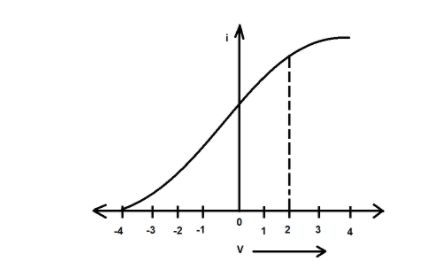
Figure represents the graph of photocurrent $I$ versus applied voltage ($V$). The maximum energy of the emitted photoelectron is-
(A) $2eV$
(B) $4eV$
(C) $0eV$
(D) $3eV$
Answer
 Verified
261k+ views
Hint: We are given with the graph of the photocurrent versus the applied voltage and are asked to find out the maximum kinetic energy of the emitted photoelectron. We will first find out the breakdown voltage of the given situation from the graph. Then we will calculate the kinetic energy with a suitable formula.
Formulae Used:
$K.E{._{Max}} = e{V_o}$
Where, $e$ is the charge on an electron and ${V_o}$ is the breakdown voltage.
Complete step by step solution:
From the graph, it is evident that the photocurrent starts rising from zero when the applied voltage is$ - 4V$.
Thus, by definition, ${V_o} = 4V$.
Now,
We can say,
Maximum Kinetic energy of the emitted photoelectron is
$K.E{._{Max}} = e{V_o} = 4eV$
Hence, the correct answer is (B).
Additional Information The process we discussed in this question is we can say a special type of photoelectric effect. Fundamentally it works on the principle of photoelectric effect but the catch is that the incident radiation is assisted by an external potential difference.
When a beam of light of certain wavelength is incident on a metal surface, the electrons in the valence shell of the outermost atoms of the surface attain the energy and are emitted out by the surface. The kinetic energy of the emitted electrons depends on the threshold frequency of the metal which is different for different metals. Now, when the external voltage is applied on the surface, the emitted electrons get some extra energy for its flow. The incidence of the light beam and the applied voltage goes simultaneously.
Note: The maximum kinetic energy of the emitted electron depends on the breakdown voltage of the system as it is evident from the formula of kinetic energy. If the breakdown voltage of the system changes, then the kinetic energy of the electrons also changes by a certain amount.
Formulae Used:
$K.E{._{Max}} = e{V_o}$
Where, $e$ is the charge on an electron and ${V_o}$ is the breakdown voltage.
Complete step by step solution:
From the graph, it is evident that the photocurrent starts rising from zero when the applied voltage is$ - 4V$.
Thus, by definition, ${V_o} = 4V$.
Now,
We can say,
Maximum Kinetic energy of the emitted photoelectron is
$K.E{._{Max}} = e{V_o} = 4eV$
Hence, the correct answer is (B).
Additional Information The process we discussed in this question is we can say a special type of photoelectric effect. Fundamentally it works on the principle of photoelectric effect but the catch is that the incident radiation is assisted by an external potential difference.
When a beam of light of certain wavelength is incident on a metal surface, the electrons in the valence shell of the outermost atoms of the surface attain the energy and are emitted out by the surface. The kinetic energy of the emitted electrons depends on the threshold frequency of the metal which is different for different metals. Now, when the external voltage is applied on the surface, the emitted electrons get some extra energy for its flow. The incidence of the light beam and the applied voltage goes simultaneously.
Note: The maximum kinetic energy of the emitted electron depends on the breakdown voltage of the system as it is evident from the formula of kinetic energy. If the breakdown voltage of the system changes, then the kinetic energy of the electrons also changes by a certain amount.
Recently Updated Pages
Algebra Made Easy: Step-by-Step Guide for Students

JEE Isolation, Preparation and Properties of Non-metals Important Concepts and Tips for Exam Preparation
JEE Energetics Important Concepts and Tips for Exam Preparation
Chemical Properties of Hydrogen - Important Concepts for JEE Exam Preparation
JEE General Topics in Chemistry Important Concepts and Tips
JEE Amino Acids and Peptides Important Concepts and Tips for Exam Preparation
Trending doubts
JEE Main 2026: Exam Dates, Session 2 Updates, City Slip, Admit Card & Latest News
JEE Main Participating Colleges 2026 - A Complete List of Top Colleges
Hybridisation in Chemistry – Concept, Types & Applications
Understanding the Electric Field of a Uniformly Charged Ring
Derivation of Equation of Trajectory Explained for Students
Understanding Atomic Structure for Beginners
Other Pages
CBSE Class 12 Physics Question Paper 2026: Download SET-wise PDF with Answer Key & Analysis
JEE Advanced 2026 Notification Out with Exam Date, Registration (Extended), Syllabus and More
JEE Advanced Marks vs Ranks 2025: Understanding Category-wise Qualifying Marks and Previous Year Cut-offs
JEE Advanced Weightage Chapter Wise 2026 for Physics, Chemistry, and Mathematics
How to Convert a Galvanometer into an Ammeter or Voltmeter
Understanding Uniform Acceleration in Physics