




Fig, shows a block and tackle system pulleys used to lift a load. What is the mechanical advantage of the system?
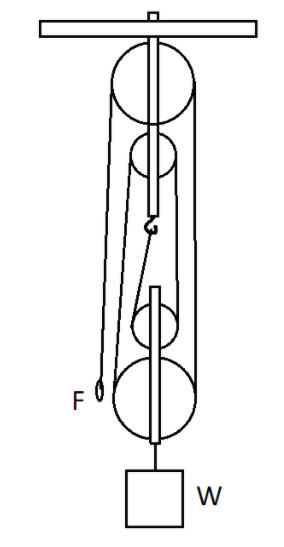
(A) 6
(B) 8
(C) 4
(D) 2
Answer
 Verified
283.8k+ views
Hint: This could be simply solved by breaking the diagrams into simple free body diagrams of both the blocks. Then apply Newton’s law of motion.
Formula used: Here, we will use the basic formula NLM-2:
${\text{F = ma}}$
Here, ${\text{F}}$ is the force exerted on the block
${\text{m}}$ is the mass of the block
${\text{a}}$ is acceleration of the block
Complete step by step answer:
We already know that the bodies are connected together by rope,
So, both the bodies will have the same acceleration.
As we know that the movable part is known as tackle in which load is always attached and fixed part is known as block, but in this diagram the pulley on which load is applied is connected to tackle pulley hence by observing the configuration we can say four tackle is required for it to support the load.
Then we need to match the correct option.
The correct option is C.
Additional Information: A pulley is a wheel on an axle or shaft that is designed to support movement and change of direction of a taut cable or belt, or transfer of power between the shaft and cable or belt. In the case of a pulley supported by a frame or shell that does not transfer power to a shaft, but is used to guide the cable or exert a force, the supporting shell is called a block, and the pulley may be called a sheave
Note: It should be always kept in mind that we should always draw the FBD of the body before solving any force questions. Also, never forget to assume tension force away from the body wherever there is rope in pulley or block questions. Similarly, spring forces also are a case of springs acting tensile (away) from the body. Also, if the bodies are connected together, they will have the same acceleration.
Formula used: Here, we will use the basic formula NLM-2:
${\text{F = ma}}$
Here, ${\text{F}}$ is the force exerted on the block
${\text{m}}$ is the mass of the block
${\text{a}}$ is acceleration of the block
Complete step by step answer:
We already know that the bodies are connected together by rope,
So, both the bodies will have the same acceleration.
As we know that the movable part is known as tackle in which load is always attached and fixed part is known as block, but in this diagram the pulley on which load is applied is connected to tackle pulley hence by observing the configuration we can say four tackle is required for it to support the load.
Then we need to match the correct option.
The correct option is C.
Additional Information: A pulley is a wheel on an axle or shaft that is designed to support movement and change of direction of a taut cable or belt, or transfer of power between the shaft and cable or belt. In the case of a pulley supported by a frame or shell that does not transfer power to a shaft, but is used to guide the cable or exert a force, the supporting shell is called a block, and the pulley may be called a sheave
Note: It should be always kept in mind that we should always draw the FBD of the body before solving any force questions. Also, never forget to assume tension force away from the body wherever there is rope in pulley or block questions. Similarly, spring forces also are a case of springs acting tensile (away) from the body. Also, if the bodies are connected together, they will have the same acceleration.
Recently Updated Pages
Properties of Solids and Liquids Mock Test 2025

JEE Main Mock Test 2025-26: Dual Nature of Matter & Radiation
JEE Main 2025-26 Work, Energy and Power Mock Test – Free Practice Online
JEE Main Mock Test 2025-26: Experimental Skills Chapter Online Practice
JEE Main 2025-26 Mock Test: Properties of Solids and Liquids
JEE Main 2025 Kinetic Theory Of Gases Mock Test: Practice & Solutions
Trending doubts
JEE Main 2026: Exam Dates, Session 2 Updates, City Slip, Admit Card & Latest News
Understanding the Electric Field of a Uniformly Charged Ring
Understanding Atomic Structure for Beginners
Derivation of Equation of Trajectory Explained for Students
Electron Gain Enthalpy and Electron Affinity Explained
How to Convert a Galvanometer into an Ammeter or Voltmeter
Other Pages
CBSE Class 12 Physics Question Paper 2026: Download SET-wise PDF with Answer Key & Analysis
JEE Advanced Percentile vs Marks 2026: JEE Main Cutoff, AIR & IIT Admission Guide
JEE Advanced 2026 Notification Out with Exam Date, Registration (Extended), Syllabus and More
Understanding Uniform Acceleration in Physics
Understanding Electromagnetic Waves and Their Importance
Understanding Instantaneous Velocity