




Explain Davisson -Germer’s experiment with the help of a diagram.
Answer
 Verified
267k+ views
Hint: Here, in the Davisson and Germer experiment, he showed that an electron beam can undergo diffraction when it is passed through the atomic crystals. This in turn shows that the wave nature of electrons as waves can exhibit interference and diffraction patterns.
Complete step by step solution:
Initially, the scientists could only explain the particle nature of electrons but failed to explain the properties related to their wave nature. C.J. Davisson and L.H. Germer conducted an experiment in the year 1927, popularly known as Davisson-Germer’s experiment in order to explain the wave nature of electrons through the electron diffraction process.
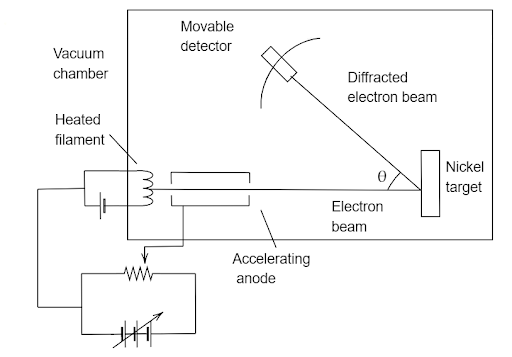
Image: Experimental setup of Davisson Germer experiment
The experimental arrangement and working of the Davisson Germer experiment are discussed below:
An electron gun consisting of a tungsten filament F was coated with barium oxide and heated through a low voltage power supply. While applying the suitable potential difference from a high voltage power supply, the electron gun emits electrons which are again accelerated to a particular velocity. The cylinder was perforated with fine holes along its axis, these emitted electrons were made to pass through it, thus producing a finely collimated beam.
This finely collimated beam produced from the cylinder is again made to fall on the surface of a nickel crystal. Due to this, the electrons will get scattered in various directions and the beam of electrons produced has a certain amount of intensity which is measured by the electron detector and then it is connected to a sensitive galvanometer (to record the current readings), it is then moved on a circular scale.
Then by moving the detector on the circular scale at different positions, that is changing the \[\theta \](angle between the incident beam and the scattered electron beams), the intensity of the scattered electron beam can be measured for different values of angle of scattering.
Let’s see the observations made by Davisson Germer’s experiment. Here we obtain the variation of the intensity (I) of the scattered electrons by changing the angle of scattering, \[\theta \]. The accelerated voltage varied from 44V to 68 V. when we start changing the accelerating potential difference
An accelerating voltage of 54V at a scattering angle \[\theta = {50^0}\], we could see a strong peak in the intensity and this strong peak was the result of constructive interference of the electrons. Using the data of electron diffraction, the wavelength of matter waves was calculated.
Thus, Davisson Germer’s experiment confirms the wave nature of electrons.
Note:Davisson and Germer’s experiments proves the De-Broglie Hypothesis that the electron exists in wave nature as well by this it is possible to understand the structure of particles at the nanoscale using electron diffraction.
Complete step by step solution:
Initially, the scientists could only explain the particle nature of electrons but failed to explain the properties related to their wave nature. C.J. Davisson and L.H. Germer conducted an experiment in the year 1927, popularly known as Davisson-Germer’s experiment in order to explain the wave nature of electrons through the electron diffraction process.
Image: Experimental setup of Davisson Germer experiment
The experimental arrangement and working of the Davisson Germer experiment are discussed below:
An electron gun consisting of a tungsten filament F was coated with barium oxide and heated through a low voltage power supply. While applying the suitable potential difference from a high voltage power supply, the electron gun emits electrons which are again accelerated to a particular velocity. The cylinder was perforated with fine holes along its axis, these emitted electrons were made to pass through it, thus producing a finely collimated beam.
This finely collimated beam produced from the cylinder is again made to fall on the surface of a nickel crystal. Due to this, the electrons will get scattered in various directions and the beam of electrons produced has a certain amount of intensity which is measured by the electron detector and then it is connected to a sensitive galvanometer (to record the current readings), it is then moved on a circular scale.
Then by moving the detector on the circular scale at different positions, that is changing the \[\theta \](angle between the incident beam and the scattered electron beams), the intensity of the scattered electron beam can be measured for different values of angle of scattering.
Let’s see the observations made by Davisson Germer’s experiment. Here we obtain the variation of the intensity (I) of the scattered electrons by changing the angle of scattering, \[\theta \]. The accelerated voltage varied from 44V to 68 V. when we start changing the accelerating potential difference
An accelerating voltage of 54V at a scattering angle \[\theta = {50^0}\], we could see a strong peak in the intensity and this strong peak was the result of constructive interference of the electrons. Using the data of electron diffraction, the wavelength of matter waves was calculated.
Thus, Davisson Germer’s experiment confirms the wave nature of electrons.
Note:Davisson and Germer’s experiments proves the De-Broglie Hypothesis that the electron exists in wave nature as well by this it is possible to understand the structure of particles at the nanoscale using electron diffraction.
Recently Updated Pages
States of Matter Chapter For JEE Main Chemistry

Young’s Double Slit Experiment Derivation Explained
Wheatstone Bridge – Principle, Formula, Diagram & Applications
Circuit Switching vs Packet Switching: Key Differences Explained
Mass vs Weight: Key Differences Explained for Students
[Awaiting the three content sources: Ask AI Response, Competitor 1 Content, and Competitor 2 Content. Please provide those to continue with the analysis and optimization.]
Trending doubts
JEE Main 2026: Exam Dates, Session 2 Updates, City Slip, Admit Card & Latest News
JEE Main Participating Colleges 2026 - A Complete List of Top Colleges
Kinematics Mock Test for JEE Main 2025-26: Comprehensive Practice
Kinematics Mock Test for JEE Main 2025-26: Practice & Ace the Exam
Hybridisation in Chemistry – Concept, Types & Applications
Understanding the Electric Field of a Uniformly Charged Ring
Other Pages
CBSE Class 12 Physics Question Paper 2026: Download SET-wise PDF with Answer Key & Analysis
JEE Advanced 2026 Notification Out with Exam Date, Registration (Extended), Syllabus and More
JEE Advanced Percentile vs Marks 2026: JEE Main Cutoff, AIR & IIT Admission Guide
JEE Advanced 2026 Marks vs Rank: Estimate IIT Rank from Your Score
JEE Advanced Weightage Chapter Wise 2026 for Physics, Chemistry, and Mathematics
Derivation of Equation of Trajectory Explained for Students