




Derive an expression for the time period of oscillation of a simple pendulum.
Answer
 Verified
274.2k+ views
Hint: A simple pendulum is a system in which a mass (a bob) connected to one end of an inextensible string hanging vertically and is connected to a fixed support.
If we apply an angular displacement from the mean position, the bob will complete a left swing and a right swing and come back to its mean position again. The time taken by the pendulum for this complete cycle is known as its time period of oscillation.
Complete step by step solution:
Let us first know about a simple pendulum. It is basically a system in which a mass (a bob) is connected to one end of an inextensible string hanging vertically and is connected to a fixed support.
If we apply an angular displacement from the mean position, the bob will complete a left swing and a right swing and come back to its mean position again. The time taken by the pendulum for this complete cycle is known as its time period of oscillation.
Let a bob of mass $m$ is suspended from the end of a light inextensible string whose upper end is connected to a fixed rigid support. Now, the bob is displaced from its mean position.
Now, Using the equation of motion,
$T' - mg\cos \theta = m{v^2}l$ where $T'$ is the tension in the string, $\theta $ is the angle made by the length from vertical at any moment and $v$ is its velocity at that moment.
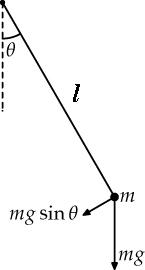
Now, the torque will tend to bring the mass to its equilibrium position,
$\tau = mgl \times \sin \theta = mg\sin \theta \times l$
As we know torque, $\tau = I\alpha $ where $I$ is the moment of inertia of the bob and $\alpha $ is its angular acceleration
So, $mg\sin \theta \times l = I \times \alpha $
For small angles of oscillations, $\sin \theta \approx \theta $
So, $I\alpha = - mgl\theta $ (Here –ve sign denotes that the torque is against the motion o bob)
As we know that the moment of inertia of the bob in this case $I = m{l^2}$
Therefore, $\alpha = - \dfrac{g}{l}\theta $
Also, $\alpha = - \omega _0^2\theta $ where ${\omega _0}$ is the angular velocity of the bob
So the equation becomes,
\[ - \omega _0^2\theta = - \dfrac{g}{l}\theta \]
On simplifying we have
${\omega _0} = \sqrt {\dfrac{g}{l}} $
As we know time period is given by $\dfrac{{2\pi }}{{{\omega _0}}}$
So, Time period of simple pendulum $T = 2\pi \sqrt {\dfrac{l}{g}}$.
Note: There are some assumptions in the derivation of time period of a simple pendulum
1. Gravity remains constant for the system
2. There is negligible air resistance on the system
3. The length of the pendulum does not bend or compress and has negligible mass
4. The pendulum swings in a perfect plane
If we apply an angular displacement from the mean position, the bob will complete a left swing and a right swing and come back to its mean position again. The time taken by the pendulum for this complete cycle is known as its time period of oscillation.
Complete step by step solution:
Let us first know about a simple pendulum. It is basically a system in which a mass (a bob) is connected to one end of an inextensible string hanging vertically and is connected to a fixed support.
If we apply an angular displacement from the mean position, the bob will complete a left swing and a right swing and come back to its mean position again. The time taken by the pendulum for this complete cycle is known as its time period of oscillation.
Let a bob of mass $m$ is suspended from the end of a light inextensible string whose upper end is connected to a fixed rigid support. Now, the bob is displaced from its mean position.
Now, Using the equation of motion,
$T' - mg\cos \theta = m{v^2}l$ where $T'$ is the tension in the string, $\theta $ is the angle made by the length from vertical at any moment and $v$ is its velocity at that moment.
Now, the torque will tend to bring the mass to its equilibrium position,
$\tau = mgl \times \sin \theta = mg\sin \theta \times l$
As we know torque, $\tau = I\alpha $ where $I$ is the moment of inertia of the bob and $\alpha $ is its angular acceleration
So, $mg\sin \theta \times l = I \times \alpha $
For small angles of oscillations, $\sin \theta \approx \theta $
So, $I\alpha = - mgl\theta $ (Here –ve sign denotes that the torque is against the motion o bob)
As we know that the moment of inertia of the bob in this case $I = m{l^2}$
Therefore, $\alpha = - \dfrac{g}{l}\theta $
Also, $\alpha = - \omega _0^2\theta $ where ${\omega _0}$ is the angular velocity of the bob
So the equation becomes,
\[ - \omega _0^2\theta = - \dfrac{g}{l}\theta \]
On simplifying we have
${\omega _0} = \sqrt {\dfrac{g}{l}} $
As we know time period is given by $\dfrac{{2\pi }}{{{\omega _0}}}$
So, Time period of simple pendulum $T = 2\pi \sqrt {\dfrac{l}{g}}$.
Note: There are some assumptions in the derivation of time period of a simple pendulum
1. Gravity remains constant for the system
2. There is negligible air resistance on the system
3. The length of the pendulum does not bend or compress and has negligible mass
4. The pendulum swings in a perfect plane
Recently Updated Pages
Mass vs Weight: Key Differences Explained for Students

Circuit Switching vs Packet Switching: Key Differences Explained
Uniform Acceleration Explained: Formula, Examples & Graphs
Wheatstone Bridge – Principle, Formula, Diagram & Applications
Classification of Drugs in Chemistry: Types, Examples & Exam Guide
Area vs Volume: Key Differences Explained for Students
Trending doubts
JEE Main 2026: Exam Dates, Session 2 Updates, City Slip, Admit Card & Latest News
Understanding the Electric Field of a Uniformly Charged Ring
Understanding Atomic Structure for Beginners
Derivation of Equation of Trajectory Explained for Students
Electron Gain Enthalpy and Electron Affinity Explained
How to Convert a Galvanometer into an Ammeter or Voltmeter
Other Pages
JEE Advanced 2026 Notification Out with Exam Date, Registration (Extended), Syllabus and More
JEE Advanced Percentile vs Marks 2026: JEE Main Cutoff, AIR & IIT Admission Guide
CBSE Notes Class 11 Physics Chapter 1 - Units And Measurements - 2026-27
NCERT Solutions For Class 11 Physics Chapter 1 Units And Measurements - 2025-26
Important Questions For Class 11 Physics Chapter 1 Units and Measurement - 2026-27
JEE Advanced Weightage Chapter Wise 2026 for Physics, Chemistry, and Mathematics