




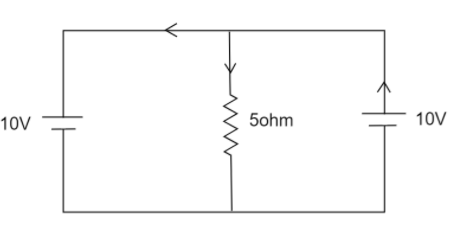
What is current through the $5\Omega $ resistor?
Answer
 Verified
299.4k+ views
Hint: Here we have a closed-loop of a conductor that we can divide into two elementary loops to simplify the problem. Also, we can use one of Kirchhoff’s laws to figure out our desired answer. Once we learn physics here, then it is a fundamental problem of algebra.
Complete step by step solution:
We take the closed-loop of current and part them into two sections $A$ and $B$ as shown in the figure below-
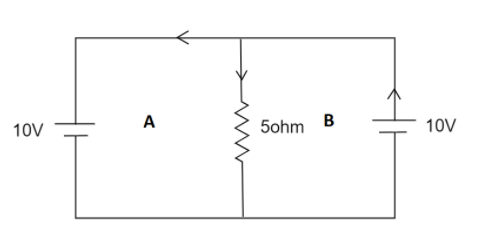
In both the current-carrying loop, the current is flowing counter-clockwise. So here we use Kirchhoff’s Voltage Law (KVL) to find out the current through the $5\Omega $ resistor.
Kirchhoff’s Second Law or Kirchhoff’s Voltage Law states that the algebraic sum of all the voltages around any closed loop in that circuit equals zero for a series of the closed-loop path.
We assume that the current through the $5\Omega $ resistor is $i$ (ampere).
According to Kirchhoff’s Voltage Law in the loop $A$-
$\Rightarrow 10 - 5i = 0$ ………$(1)$
Since the voltage difference across the resistor $10V$ and $i$ current is flowing through the resistor.
According to Kirchhoff’s Voltage Law in the loop $B$-
$\Rightarrow 10 - 5i = 0$ ………$(2)$
Since here also the voltage difference across the resistor $10V$ and $i$ current is flowing through the resistor.
So from both the above two equations, we can find out the value of $i$-
Hence,
$\Rightarrow 5i = 10$
$ \Rightarrow i = \dfrac{{10}}{5}$
$ \Rightarrow i = 2A$
Therefore, the current through the $5\Omega $ resistor is $2A$.
Note: We can use Kirchhoff’s Second Law, i.e., Kirchhoff’s Current Law, to determine the current at a junction in a closed current-carrying loop. A point of caution, we can only use these laws in a closed loop. These laws are advantageous in complex electric circuits.
Complete step by step solution:
We take the closed-loop of current and part them into two sections $A$ and $B$ as shown in the figure below-
In both the current-carrying loop, the current is flowing counter-clockwise. So here we use Kirchhoff’s Voltage Law (KVL) to find out the current through the $5\Omega $ resistor.
Kirchhoff’s Second Law or Kirchhoff’s Voltage Law states that the algebraic sum of all the voltages around any closed loop in that circuit equals zero for a series of the closed-loop path.
We assume that the current through the $5\Omega $ resistor is $i$ (ampere).
According to Kirchhoff’s Voltage Law in the loop $A$-
$\Rightarrow 10 - 5i = 0$ ………$(1)$
Since the voltage difference across the resistor $10V$ and $i$ current is flowing through the resistor.
According to Kirchhoff’s Voltage Law in the loop $B$-
$\Rightarrow 10 - 5i = 0$ ………$(2)$
Since here also the voltage difference across the resistor $10V$ and $i$ current is flowing through the resistor.
So from both the above two equations, we can find out the value of $i$-
Hence,
$\Rightarrow 5i = 10$
$ \Rightarrow i = \dfrac{{10}}{5}$
$ \Rightarrow i = 2A$
Therefore, the current through the $5\Omega $ resistor is $2A$.
Note: We can use Kirchhoff’s Second Law, i.e., Kirchhoff’s Current Law, to determine the current at a junction in a closed current-carrying loop. A point of caution, we can only use these laws in a closed loop. These laws are advantageous in complex electric circuits.
Recently Updated Pages
If the magnetizing field on a ferromagnetic material class 12 physics JEE_Main

A point charge is placed at the corner of a cube The class 12 physics JEE_Main
What changes occur if the monochromatic light used class 12 physics JEE_Main
The unit of specific conductance is A Ohm B Ohmmetre class 12 physics JEE_Main
Which lens is used in magnifying glass A Concave lens class 12 physics JEE_Main
Sir C V Raman won the Nobel Prize in which year A 1928 class 12 physics JEE_Main
Trending doubts
JEE Main 2026: Exam Dates, Session 2 Updates, City Slip, Admit Card & Latest News
Understanding the Electric Field of a Uniformly Charged Ring
Understanding Atomic Structure for Beginners
Electron Gain Enthalpy and Electron Affinity Explained
Derivation of Equation of Trajectory Explained for Students
How to Convert a Galvanometer into an Ammeter or Voltmeter
Other Pages
CBSE Class 12 Physics Question Paper 2026: Download SET-wise PDF with Answer Key & Analysis
JEE Advanced Percentile vs Marks 2026: JEE Main Cutoff, AIR & IIT Admission Guide
What Are Current and Potential Difference in Electricity?
Understanding Uniform Acceleration in Physics
Hybridisation in Chemistry – Concept, Types & Applications
Understanding Geostationary and Geosynchronous Satellites