




Conversion of phenol to salicylic acid and to salicyaldehyde are known as? (respectively)
(A) Reimer-Tiemann reaction and Kolbe’s reaction
(B) Williamson’s synthesis and Hydroboration-oxidation
(C) Kolbe’s reaction and Williamson’s synthesis
(D) Kolbe’s reaction and Reimer-Tiemann reaction
Answer
 Verified
584.8k+ views
Hint:The conversion of phenol to salicylic acid takes place through a base, and hydrolysis. If we talk about the conversion of phenol of salicylaldehyde takes place through the action of chloroform. So, we identify the naming reactions in which these conversions take place.
Complete step by step solution:
First, we will discuss the conversion of phenol to salicylic acid.
The phenol will be deprotonated by strong base i.e. hydroxide ion. There will be addition of phenoxide ions formed to the carbon-dioxide.
So, we can say that the addition further leads to the carboxylate formation. Then, it will further lead to the formation of carboxylic acid, i.e. salicylic acid.
The chemical reaction is
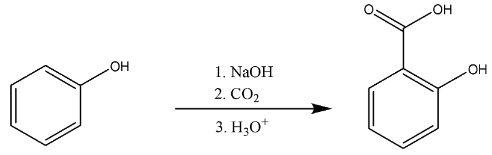
Thus, we know this whole mechanism takes place in Kolbe’s reaction, it is used for the synthesis of aspirin also known as salicylic acid in the industries.
Now, the next we have conversion of phenol to salicylaldehyde. It was proposed by Karl Riemer, mainly used for the ortho- phenols.
In this reaction too like Kolbe’s reaction, there is deprotonation of chloroform by strong base like KOH.
This reaction takes place through the nucleophilic attack, and the basic hydrolysis is done, leading to the formation of salicylaldehyde.
The chemical reaction is
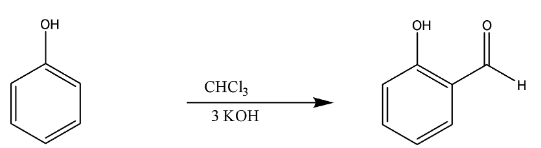
Thus, we can say this whole mechanism takes place in the Riemer –Tiemann reaction.
In the last, we can conclude that conversion of phenol to salicylic acid and to salicylaldehyde are known as Kolbe’ reaction, and Riemer-Tiemann reaction.
Hence, the correct option is (D).
Note: Don’t get confused between both these reactions. These both takes place through deprotonation by a strong base, as we discussed; but the product formation will be different. In case 1 there is addition of carbon-dioxide, and in case 2 there is nucleophilic attack.
Complete step by step solution:
First, we will discuss the conversion of phenol to salicylic acid.
The phenol will be deprotonated by strong base i.e. hydroxide ion. There will be addition of phenoxide ions formed to the carbon-dioxide.
So, we can say that the addition further leads to the carboxylate formation. Then, it will further lead to the formation of carboxylic acid, i.e. salicylic acid.
The chemical reaction is
Thus, we know this whole mechanism takes place in Kolbe’s reaction, it is used for the synthesis of aspirin also known as salicylic acid in the industries.
Now, the next we have conversion of phenol to salicylaldehyde. It was proposed by Karl Riemer, mainly used for the ortho- phenols.
In this reaction too like Kolbe’s reaction, there is deprotonation of chloroform by strong base like KOH.
This reaction takes place through the nucleophilic attack, and the basic hydrolysis is done, leading to the formation of salicylaldehyde.
The chemical reaction is
Thus, we can say this whole mechanism takes place in the Riemer –Tiemann reaction.
In the last, we can conclude that conversion of phenol to salicylic acid and to salicylaldehyde are known as Kolbe’ reaction, and Riemer-Tiemann reaction.
Hence, the correct option is (D).
Note: Don’t get confused between both these reactions. These both takes place through deprotonation by a strong base, as we discussed; but the product formation will be different. In case 1 there is addition of carbon-dioxide, and in case 2 there is nucleophilic attack.
Recently Updated Pages
Electricity and Magnetism Explained: Key Concepts & Applications

Balancing a Chemical Equation by Oxidation Number Method for JEE
JEE Main 2022 (July 28th Shift 1) Maths Question Paper with Answer Key
JEE Main 2023 (February 1st Shift 1) Maths Question Paper with Answer Key
Centripetal Force Explained: Definition, Formula & Examples
Effect of Temperature on Electrical Resistance
Trending doubts
JEE Main 2026: Exam Dates, Session 2 Updates, City Slip, Admit Card & Latest News
Understanding the Electric Field of a Uniformly Charged Ring
Understanding Atomic Structure for Beginners
Derivation of Equation of Trajectory Explained for Students
Understanding the Different Types of Solutions in Chemistry
Electron Gain Enthalpy and Electron Affinity Explained
Other Pages
NCERT Solutions For Class 12 Chemistry Chapter 2 Electrochemistry - 2026-27 Free PDF Download (Sign-in Required)
NCERT Solutions For Class 12 Chemistry Chapter 1 Solutions - 2026-27 Free PDF Download (Sign-in Required)
NCERT Solutions For Class 12 Chemistry Chapter 3 Chemical Kinetics - 2026-27 Free PDF Download (Login Required)
CBSE Notes Class 12 Chemistry Chapter 1 - Solutions - 2026-27 PDF Download (Login Required)
NCERT Solutions for Class 12 Chemistry Chapter 6 Haloalkanes and Haloarenes - 2026-27 Free PDF Download (Sign-In Required)
NCERT Solutions For Class 12 Chemistry Chapter 7 Alcohol Phenol And Ether - 2026-27 Free PDF Download (Login Required)
NCERT Solutions For Class 12 Chemistry Chapter 2 Electrochemistry - 2026-27 Free PDF Download (Sign-in Required)
NCERT Solutions For Class 12 Chemistry Chapter 1 Solutions - 2026-27 Free PDF Download (Sign-in Required)
NCERT Solutions For Class 12 Chemistry Chapter 3 Chemical Kinetics - 2026-27 Free PDF Download (Login Required)