




- Consider the situation shown. The switch S is open for a long time and then closed Then :
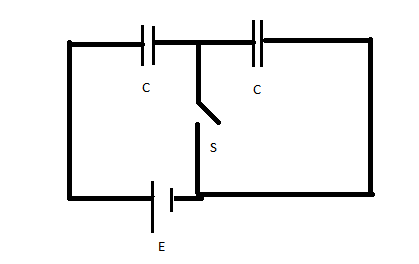
Column I Column II (A) Charge flown through battery when S is closed (p) \[\dfrac{{C{E^2}}}{2}\] (B) Work done by battery (q) \[\dfrac{{CE}}{2}\] (C) Change in energy stored in capacitor (r) \[\dfrac{{C{E^2}}}{4}\] (D) Heat developed in the system
| Column I | Column II | ||
| (A) | Charge flown through battery when S is closed | (p) | \[\dfrac{{C{E^2}}}{2}\] |
| (B) | Work done by battery | (q) | \[\dfrac{{CE}}{2}\] |
| (C) | Change in energy stored in capacitor | (r) | \[\dfrac{{C{E^2}}}{4}\] |
| (D) | Heat developed in the system |
Answer
 Verified
264.6k+ views
Hint: If the switch is closed then one capacitor becomes in series combination and other is short-circuited means no charge is stored as both the terminals are connected to the same side of the battery. And also heat developed in the system is equal to the change in energy.
Complete step by step solution:
Initially, both the capacitors are in series combination \[{C_{eq}} = \dfrac{{C \times C}}{{2C}}\]
\[ \Rightarrow {C_{eq}} = \dfrac{{C \times C}}{{2C}}\]
Simplifying the equation we get ,
\[ \Rightarrow {C_{eq}} = \dfrac{C}{2}\].
If the switch is closed then one capacitor becomes in series combination and other is short-circuited means no charge is stored as both the terminals are connected to the same side of the battery.
In that case \[{C_{final}} = C + 0\]
\[ \Rightarrow {C_{final}} = C + 0\]
\[ \Rightarrow {C_{final}} = C\]
Initial capacitance was \[{C_{initial}} = \dfrac{C}{2}\] & Final capacitance is \[{C_{final}} = C\].
Initially the switch is open and \[{C_{initial}} = \dfrac{C}{2}\], if the switch is closed then first capacitor discharges
Charge flown through battery when switch ( S ) is closed is
\[ \Rightarrow Q = ({C_{initial}} - {C_{disch\arg ing}}) \times E\]
Putting the values we get ;
\[ \Rightarrow Q = \left( {\dfrac{C}{2} - 0} \right) \times E\]
Simplifying it we get,
\[ \Rightarrow Q = \dfrac{{CE}}{2}\].
Work done by battery ( W )
\[ \Rightarrow W = \dfrac{C}{2}{E^2}\]
\[ \Rightarrow W = \dfrac{{C{E^2}}}{2}\].
Change in energy stored in capacitor
\[ \Rightarrow {C_{initial}} = \dfrac{C}{2}\]
\[ \Rightarrow {C_{final}} = C\]
Now, we have to find the energy stored initially, so for this
\[ \Rightarrow {E_{initial}} = \dfrac{1}{2} \times \dfrac{C}{2} \times {E^2}\]
Simplifying the equation we get ,
\[ \Rightarrow {E_{initial}} = \dfrac{{C{E^2}}}{4}\]
Now, we have to find the energy stored finally, so for this
\[ \Rightarrow {E_{final}} = \dfrac{1}{2} \times C \times {E^2}\]
\[ \Rightarrow {E_{final}} = \dfrac{{C{E^2}}}{2}\].
Change in energy stored in the capacitor is \[{E_{final}} - {E_{initial}}\].
Putting the values we get with ,
\[ \Rightarrow {E_{final}} - {E_{initial}} = \dfrac{{C{E^2}}}{2} - \dfrac{{C{E^2}}}{4}\]
Simplifying the equation we get,
\[ \Rightarrow {E_{final}} - {E_{initial}} = \dfrac{{C{E^2}}}{4}\]……… eq (1)
Heat developed in the system \[H = \Delta E\].
\[ \Rightarrow H = {E_{final}} - {E_{initial}}\]
Using the result obtained from eq (1)
\[ \Rightarrow H = {E_{final}} - {E_{initial}} = \dfrac{{C{E^2}}}{4}\]
\[ \Rightarrow H = \dfrac{{C{E^2}}}{4}\].
Hence the correct matches are A-q, B-p, C-r and D-r.
Note:The energy of an uncharged capacitor is zero. When a capacitor is charged by battery, both the plates received charge equal in magnitude, no matter the size of plates are identical or not because the charge distribution on the plates of a capacitor is in accordance with charge conservation principle.
Complete step by step solution:
Initially, both the capacitors are in series combination \[{C_{eq}} = \dfrac{{C \times C}}{{2C}}\]
\[ \Rightarrow {C_{eq}} = \dfrac{{C \times C}}{{2C}}\]
Simplifying the equation we get ,
\[ \Rightarrow {C_{eq}} = \dfrac{C}{2}\].
If the switch is closed then one capacitor becomes in series combination and other is short-circuited means no charge is stored as both the terminals are connected to the same side of the battery.
In that case \[{C_{final}} = C + 0\]
\[ \Rightarrow {C_{final}} = C + 0\]
\[ \Rightarrow {C_{final}} = C\]
Initial capacitance was \[{C_{initial}} = \dfrac{C}{2}\] & Final capacitance is \[{C_{final}} = C\].
Initially the switch is open and \[{C_{initial}} = \dfrac{C}{2}\], if the switch is closed then first capacitor discharges
Charge flown through battery when switch ( S ) is closed is
\[ \Rightarrow Q = ({C_{initial}} - {C_{disch\arg ing}}) \times E\]
Putting the values we get ;
\[ \Rightarrow Q = \left( {\dfrac{C}{2} - 0} \right) \times E\]
Simplifying it we get,
\[ \Rightarrow Q = \dfrac{{CE}}{2}\].
Work done by battery ( W )
\[ \Rightarrow W = \dfrac{C}{2}{E^2}\]
\[ \Rightarrow W = \dfrac{{C{E^2}}}{2}\].
Change in energy stored in capacitor
\[ \Rightarrow {C_{initial}} = \dfrac{C}{2}\]
\[ \Rightarrow {C_{final}} = C\]
Now, we have to find the energy stored initially, so for this
\[ \Rightarrow {E_{initial}} = \dfrac{1}{2} \times \dfrac{C}{2} \times {E^2}\]
Simplifying the equation we get ,
\[ \Rightarrow {E_{initial}} = \dfrac{{C{E^2}}}{4}\]
Now, we have to find the energy stored finally, so for this
\[ \Rightarrow {E_{final}} = \dfrac{1}{2} \times C \times {E^2}\]
\[ \Rightarrow {E_{final}} = \dfrac{{C{E^2}}}{2}\].
Change in energy stored in the capacitor is \[{E_{final}} - {E_{initial}}\].
Putting the values we get with ,
\[ \Rightarrow {E_{final}} - {E_{initial}} = \dfrac{{C{E^2}}}{2} - \dfrac{{C{E^2}}}{4}\]
Simplifying the equation we get,
\[ \Rightarrow {E_{final}} - {E_{initial}} = \dfrac{{C{E^2}}}{4}\]……… eq (1)
Heat developed in the system \[H = \Delta E\].
\[ \Rightarrow H = {E_{final}} - {E_{initial}}\]
Using the result obtained from eq (1)
\[ \Rightarrow H = {E_{final}} - {E_{initial}} = \dfrac{{C{E^2}}}{4}\]
\[ \Rightarrow H = \dfrac{{C{E^2}}}{4}\].
Hence the correct matches are A-q, B-p, C-r and D-r.
Note:The energy of an uncharged capacitor is zero. When a capacitor is charged by battery, both the plates received charge equal in magnitude, no matter the size of plates are identical or not because the charge distribution on the plates of a capacitor is in accordance with charge conservation principle.
Recently Updated Pages
JEE Main 2025-26 Experimental Skills Mock Test – Free Practice

JEE Main 2025-26 Electronic Devices Mock Test: Free Practice Online
JEE Main 2025-26 Mock Tests: Free Practice Papers & Solutions
JEE Main 2025-26: Magnetic Effects of Current & Magnetism Mock Test
JEE Main 2025-26 Atoms and Nuclei Mock Test – Free Practice Online
JEE Main Mock Test 2025-26: Experimental Skills Chapter Online Practice
Trending doubts
JEE Main 2026: Exam Dates, Session 2 Updates, City Slip, Admit Card & Latest News
JEE Main Participating Colleges 2026 - A Complete List of Top Colleges
Kinematics Mock Test for JEE Main 2025-26: Comprehensive Practice
Kinematics Mock Test for JEE Main 2025-26: Practice & Ace the Exam
Hybridisation in Chemistry – Concept, Types & Applications
Understanding the Electric Field of a Uniformly Charged Ring
Other Pages
CBSE Class 12 Physics Question Paper 2026: Download SET-wise PDF with Answer Key & Analysis
JEE Advanced 2026 Notification Out with Exam Date, Registration (Extended), Syllabus and More
JEE Advanced Percentile vs Marks 2026: JEE Main Cutoff, AIR & IIT Admission Guide
JEE Advanced Weightage Chapter Wise 2026 for Physics, Chemistry, and Mathematics
JEE Advanced Marks vs Rank 2025 - Predict Your IIT Rank Based on Score
Derivation of Equation of Trajectory Explained for Students