




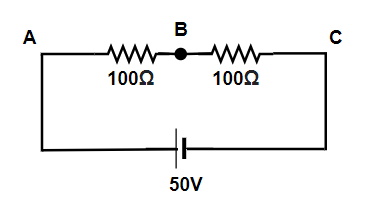
Consider the diagram shown below.
A voltmeter of resistance \[150\Omega \] is connected across \[A\] and \[B\] . The potential drop across \[B\] and \[C\] measured by voltmeter is
$\left( a \right)\,\,29V$
$\left( b \right)\,\,27V$
$\left( c \right)\,\,31V$
$\left( d \right)\,\,30V$
Answer
 Verified
274.8k+ views
Hint: A voltmeter is a device which is used for the measuring electric potential difference between any two points in an electrical circuit. Simple voltmeters move a pointer over a scale in relation to the voltage of the circuit; advanced voltmeters give a mathematical showcase of voltage by utilization of a simple to digital converter. The sum of voltage across resistors in series is equal to the voltage applied by the source connected.
Complete step by step solution:
When a voltmeter of the resistance \[150\Omega \] is connected across the point \[A\] and \[B\] , the two resistance will be in parallel and the resistance across the point \[A\] and \[B\] will be
\[ \Rightarrow {R_{ab}} = \dfrac{{150 \times 100}}{{150 + 100}}\]
After solving the above equation, we get
\[ \Rightarrow {R_{ab}} = 60\Omega \]
Now the equivalent resistance of the circuit will be
\[ \Rightarrow {R_{ac}} = {R_{ab}} + R{}_{bc}\]
After substituting the values of \[{R_{ab}}\] and \[R{}_{bc}\] the equation becomes
\[ \Rightarrow {R_{ac}} = 60 + 100\]
And on solving it, we get
\[ \Rightarrow {R_{ac}} = 160\Omega \]
The current in the circuit will be taken as
\[ \Rightarrow I = \dfrac{{50}}{{160}}\]
After calculating we get
$ \Rightarrow I = 0.31A$
In this way, Potential drop across B and C
\[ \Rightarrow {V_{bc}} = I{R_{bc}}\]
After substituting the values in the above equation
\[ \Rightarrow {V_{bc}} = 0.31 \times 100\]
Now we have to calculate the above equation we get
\[ \Rightarrow {V_{bc}} = 31V\]
Hence the correct option is $\left( c \right)$ .
Note: Resistance is a measure of the opposition to current flow in an electrical circuit. Resistance is measured in ohms. Voltmeter uses the concept of potential gradient which is the fall in potential per unit length. So, when current passes through a wire which is of uniform area then the potential difference across any part is directly proportional to length of that path. If the potential gradient is small, then the sensitivity of voltmeter will be higher.
Complete step by step solution:
When a voltmeter of the resistance \[150\Omega \] is connected across the point \[A\] and \[B\] , the two resistance will be in parallel and the resistance across the point \[A\] and \[B\] will be
\[ \Rightarrow {R_{ab}} = \dfrac{{150 \times 100}}{{150 + 100}}\]
After solving the above equation, we get
\[ \Rightarrow {R_{ab}} = 60\Omega \]
Now the equivalent resistance of the circuit will be
\[ \Rightarrow {R_{ac}} = {R_{ab}} + R{}_{bc}\]
After substituting the values of \[{R_{ab}}\] and \[R{}_{bc}\] the equation becomes
\[ \Rightarrow {R_{ac}} = 60 + 100\]
And on solving it, we get
\[ \Rightarrow {R_{ac}} = 160\Omega \]
The current in the circuit will be taken as
\[ \Rightarrow I = \dfrac{{50}}{{160}}\]
After calculating we get
$ \Rightarrow I = 0.31A$
In this way, Potential drop across B and C
\[ \Rightarrow {V_{bc}} = I{R_{bc}}\]
After substituting the values in the above equation
\[ \Rightarrow {V_{bc}} = 0.31 \times 100\]
Now we have to calculate the above equation we get
\[ \Rightarrow {V_{bc}} = 31V\]
Hence the correct option is $\left( c \right)$ .
Note: Resistance is a measure of the opposition to current flow in an electrical circuit. Resistance is measured in ohms. Voltmeter uses the concept of potential gradient which is the fall in potential per unit length. So, when current passes through a wire which is of uniform area then the potential difference across any part is directly proportional to length of that path. If the potential gradient is small, then the sensitivity of voltmeter will be higher.
Recently Updated Pages
Wheatstone Bridge – Principle, Formula, Diagram & Applications

Mass vs Weight: Key Differences Explained for Students
Circuit Switching vs Packet Switching: Key Differences Explained
Uniform Acceleration Explained: Formula, Examples & Graphs
Young’s Double Slit Experiment Derivation Explained
Length vs. Height: Key Differences Explained for Students
Trending doubts
JEE Main 2026: Exam Dates, Session 2 Updates, City Slip, Admit Card & Latest News
Understanding the Electric Field of a Uniformly Charged Ring
Understanding Atomic Structure for Beginners
Derivation of Equation of Trajectory Explained for Students
Electron Gain Enthalpy and Electron Affinity Explained
How to Convert a Galvanometer into an Ammeter or Voltmeter
Other Pages
CBSE Class 12 Physics Question Paper 2026: Download SET-wise PDF with Answer Key & Analysis
JEE Advanced 2026 Notification Out with Exam Date, Registration (Extended), Syllabus and More
JEE Advanced Percentile vs Marks 2026: JEE Main Cutoff, AIR & IIT Admission Guide
JEE Advanced Weightage Chapter Wise 2026 for Physics, Chemistry, and Mathematics
Understanding Electromagnetic Waves and Their Importance
Understanding Combined Translation and Rotational Motion