




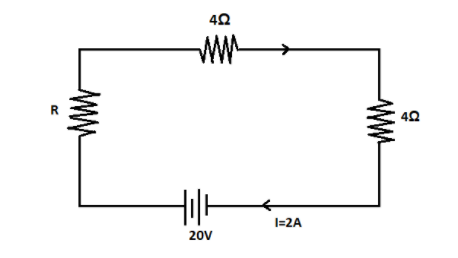
Calculate the unknown resistance $R$ of the circuit as shown in the figure, all resistance is connected in series. The current flowing through the circuit is $2A$ and the battery is of $20V$ voltage.
(A) $1\Omega $
(B) $2\Omega $
(C) $4\Omega $
(D) $6\Omega $
(E) $12\Omega $
Answer
 Verified
254.1k+ views
Hint: Resistors can be connected in two different ways. One is the parallel connection and the other is a series connection. Here we have a circuit where the three resistors are connected in series. We are given the values of the two resistors, the voltage of the circuit and the total current flowing through the circuit. Now with all these values, we have to find the value of the third resistor$R$.
Formula used
$V = IR$(Where $V$stands for the voltage of the circuit, $I$stands for the current flowing through the circuit, and $R$stands for the total resistance of the circuit)
Complete step by step solution:
In the question, it is given that
The voltage is \[V = 20Volts\]
The current flowing through the circuit is given by,
$I = 2A$
Since the resistors are connected in series the total equivalent resistance of the circuit will be the sum of individual resistances of the circuit. It is given that the other two resistors of the circuit have a resistance of $4\Omega $ each. Hence we can write the equivalent resistance of the circuit as,
${R_{eq}} = R + 4\Omega + 4\Omega $
$ \Rightarrow {R_{eq}} = R + 8\Omega $
According to Ohm’s law, the voltage is given by,
$V = IR$
Here we have to put the equivalent resistance of the circuit in the above equation,
$V = I{R_{eq}}$
We know that the voltage $V = 20V$, current,$I = 2A$and The equivalent resistance${R_{eq}} = R + 8$
Substituting these values in the equation for voltage we get,
$20 = 2\left( {R + 8} \right)$
Opening the bracket, we get
$20 = 2R + 16$
Solving the equation, we get
$20 - 16 = 2R$
$ \Rightarrow 2R = 4$
From this, we get the value of the resistor $R$as,
$R = \dfrac{4}{2} = 2\Omega $
The answer is: Option (B): $2\Omega $
Note:
If the resistors in a circuit have an end to end connection, they are said to be in a series connection. If all the resistors in a circuit are connected to two common points then they are said to be in a parallel connection. In a series connection, the current flowing through all the resistors will be the same. In a parallel connection, the potential difference between all the resistors will be the same.
Formula used
$V = IR$(Where $V$stands for the voltage of the circuit, $I$stands for the current flowing through the circuit, and $R$stands for the total resistance of the circuit)
Complete step by step solution:
In the question, it is given that
The voltage is \[V = 20Volts\]
The current flowing through the circuit is given by,
$I = 2A$
Since the resistors are connected in series the total equivalent resistance of the circuit will be the sum of individual resistances of the circuit. It is given that the other two resistors of the circuit have a resistance of $4\Omega $ each. Hence we can write the equivalent resistance of the circuit as,
${R_{eq}} = R + 4\Omega + 4\Omega $
$ \Rightarrow {R_{eq}} = R + 8\Omega $
According to Ohm’s law, the voltage is given by,
$V = IR$
Here we have to put the equivalent resistance of the circuit in the above equation,
$V = I{R_{eq}}$
We know that the voltage $V = 20V$, current,$I = 2A$and The equivalent resistance${R_{eq}} = R + 8$
Substituting these values in the equation for voltage we get,
$20 = 2\left( {R + 8} \right)$
Opening the bracket, we get
$20 = 2R + 16$
Solving the equation, we get
$20 - 16 = 2R$
$ \Rightarrow 2R = 4$
From this, we get the value of the resistor $R$as,
$R = \dfrac{4}{2} = 2\Omega $
The answer is: Option (B): $2\Omega $
Note:
If the resistors in a circuit have an end to end connection, they are said to be in a series connection. If all the resistors in a circuit are connected to two common points then they are said to be in a parallel connection. In a series connection, the current flowing through all the resistors will be the same. In a parallel connection, the potential difference between all the resistors will be the same.
Recently Updated Pages
Mass vs Weight: Key Differences Explained for Students

Uniform Acceleration Explained: Formula, Examples & Graphs
JEE Main 2022 (June 25th Shift 2) Chemistry Question Paper with Answer Key
Average Atomic Mass - Important Concepts and Tips for JEE
JEE Main 2023 (April 15th Shift 1) Physics Question Paper with Answer Key
JEE Main 2022 (June 27th Shift 2) Chemistry Question Paper with Answer Key
Trending doubts
JEE Main 2026: Exam Dates, Session 2 Updates, City Slip, Admit Card & Latest News
JEE Main Marking Scheme 2026- Paper-Wise Marks Distribution and Negative Marking Details
JEE Main 2026 Application Login: Direct Link, Registration, Form Fill, and Steps
Hybridisation in Chemistry – Concept, Types & Applications
Understanding the Electric Field of a Uniformly Charged Ring
Derivation of Equation of Trajectory Explained for Students
Other Pages
CBSE Class 12 Physics Question Paper 2026: Download SET-wise PDF with Answer Key & Analysis
JEE Advanced 2026 - Exam Date (Released), Syllabus, Registration, Eligibility, Preparation, and More
JEE Advanced Marks vs Ranks 2025: Understanding Category-wise Qualifying Marks and Previous Year Cut-offs
JEE Advanced Weightage 2025 Chapter-Wise for Physics, Maths and Chemistry
Understanding Atomic Structure for Beginners
Ideal and Non-Ideal Solutions Explained for Class 12 Chemistry