




How are things visible to us $?$
(A) Light gets reflected from our eyes and makes the object visible
(B) Light from the object get reflected and makes the object visible
(C) Both can occur according to the light condition
(D) The reason is still not known
Answer
 Verified
284.1k+ views
Hint If a smooth polished surface is approached by a ray of light and the light ray bounces back, it is also the reflection of light. We know that It is said that the incident light ray that falls on the surface will be reflected off the surface. It would be considered natural if a perpendicular had to be drawn on the reflective surface.
Useful formula:
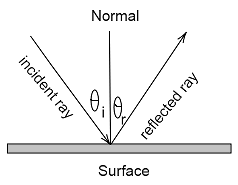
Law of reflection is ${\theta _i} = {\theta _r}$
Where,
${\theta _i}$ incident ray,
${\theta _r}$ reflected ray.
Complete step by step answer
Given by,
Reflected ray:
We are capable of seeing because light can travel across space from an object to enter our eyes. Once light enters our eyes, signals are transmitted to our brain, and the information is deciphered by our brain to detect the presence, position, and motion of the objects we see. If it were not for the presence of light, the entire operation, as complicated as it is, wouldn't be possible. There would be no sight without light
For example:
If for a moment you were to turn off the room lights and then cover all the windows with black building paper to prevent any light from entering the room, then you would find that nothing in the room would be visible. There will be objects which are worthy of being seen. There will be eyes that would be able to detect light from such objects. There will be a brain present that is able to decipher the information sent to it.
Yet there's no light here! The room and everything in it will be black in color. The presence of black is merely an indicator of the lack of light. If the sky appears dark in a room full of objects, then the objects do not produce or reflect light through your eyes. And there would be no vision without light.
Hence,
Due to reflection, objects are apparent. Light from the object is reflected and makes it visible.
Thus, option A is the correct answer.
Note In particular, reflective surfaces other than mirrors have a very rough finish. This may be due to wear and tear on the floor, such as scratches and dents, or dirt. Sometimes even the substance that makes up the surface matters. All of this causes both the light and the accuracy of the reflection to be lost.
Useful formula:
Law of reflection is ${\theta _i} = {\theta _r}$
Where,
${\theta _i}$ incident ray,
${\theta _r}$ reflected ray.
Complete step by step answer
Given by,
Reflected ray:
We are capable of seeing because light can travel across space from an object to enter our eyes. Once light enters our eyes, signals are transmitted to our brain, and the information is deciphered by our brain to detect the presence, position, and motion of the objects we see. If it were not for the presence of light, the entire operation, as complicated as it is, wouldn't be possible. There would be no sight without light
For example:
If for a moment you were to turn off the room lights and then cover all the windows with black building paper to prevent any light from entering the room, then you would find that nothing in the room would be visible. There will be objects which are worthy of being seen. There will be eyes that would be able to detect light from such objects. There will be a brain present that is able to decipher the information sent to it.
Yet there's no light here! The room and everything in it will be black in color. The presence of black is merely an indicator of the lack of light. If the sky appears dark in a room full of objects, then the objects do not produce or reflect light through your eyes. And there would be no vision without light.
Hence,
Due to reflection, objects are apparent. Light from the object is reflected and makes it visible.
Thus, option A is the correct answer.
Note In particular, reflective surfaces other than mirrors have a very rough finish. This may be due to wear and tear on the floor, such as scratches and dents, or dirt. Sometimes even the substance that makes up the surface matters. All of this causes both the light and the accuracy of the reflection to be lost.
Recently Updated Pages
Properties of Solids and Liquids Mock Test 2025

JEE Main Mock Test 2025-26: Dual Nature of Matter & Radiation
JEE Main 2025-26 Work, Energy and Power Mock Test – Free Practice Online
JEE Main Mock Test 2025-26: Experimental Skills Chapter Online Practice
JEE Main 2025-26 Mock Test: Properties of Solids and Liquids
JEE Main 2025 Kinetic Theory Of Gases Mock Test: Practice & Solutions
Trending doubts
JEE Main 2026: Exam Dates, Session 2 Updates, City Slip, Admit Card & Latest News
Understanding the Electric Field of a Uniformly Charged Ring
Understanding Atomic Structure for Beginners
Derivation of Equation of Trajectory Explained for Students
Electron Gain Enthalpy and Electron Affinity Explained
How to Convert a Galvanometer into an Ammeter or Voltmeter
Other Pages
CBSE Class 12 Physics Question Paper 2026: Download SET-wise PDF with Answer Key & Analysis
JEE Advanced Percentile vs Marks 2026: JEE Main Cutoff, AIR & IIT Admission Guide
JEE Advanced 2026 Notification Out with Exam Date, Registration (Extended), Syllabus and More
Understanding Uniform Acceleration in Physics
Understanding Electromagnetic Waves and Their Importance
Understanding Instantaneous Velocity