




What are the basic electrical principles?
Answer
 Verified
269.7k+ views
Hint: Electrical principles includes the concepts of charge, electric current, voltage,electric power, conductors and insulators.
Complete step by step solution:
Some of the electrical principles are as follows:
Charge: While some electrons are bound in an atom, they are all similarly attached to protons. The atom's electrons that are farthest from the nucleus can be extracted. Because there are fewer electrons in the atom when some electrons are taken out, there are more protons than electrons.
The electrically neutral body becomes positively charged after the elimination of electrons. The body can also get electrons from an outside source, which is the opposite of the first scenario. In this instance, the body's electron count rises and it acquires a negative charge. An electric charge is a difference between an excess or shortage of electrons in a body. In coulombs, the electric charge is expressed.
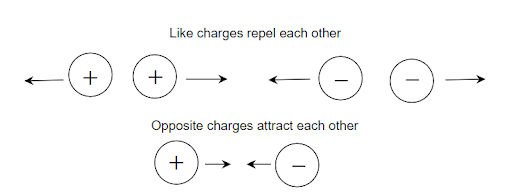
Image: Basic electrical principles
Conductors and insulators: Materials with weakly bonded valence or outside electrons are referred to as conductors. Aluminium, copper, gold, and silver are all effective conductors. Materials with securely bonded valence electrons are known as insulators. Insulators include things like glass, air, and stone.
Electric current: Electric current is defined as the number of charges per unit time passing through a boundary. In metals, because electrons are free to move around, the movement of electrons constitutes the electric current.
Voltage: As a measure of potential energy, the voltage between two locations or points is frequently arbitrary. It is frequently known as a "drop" voltage. When a voltage source is linked to a circuit, the voltage can induce a regular flow of charge carriers through the circuit, known as a current.
Electric power: In physics, electric power measures the rate of electrical energy transfer by an electric circuit per unit of time.
Note: The relationship between current, voltage, and resistance is expressed by Ohm's Law. This states that if the temperature stays stable, the current flowing in a circuit is exactly proportional to the voltage applied and inversely proportional to the circuit resistance.
Complete step by step solution:
Some of the electrical principles are as follows:
Charge: While some electrons are bound in an atom, they are all similarly attached to protons. The atom's electrons that are farthest from the nucleus can be extracted. Because there are fewer electrons in the atom when some electrons are taken out, there are more protons than electrons.
The electrically neutral body becomes positively charged after the elimination of electrons. The body can also get electrons from an outside source, which is the opposite of the first scenario. In this instance, the body's electron count rises and it acquires a negative charge. An electric charge is a difference between an excess or shortage of electrons in a body. In coulombs, the electric charge is expressed.
Image: Basic electrical principles
Conductors and insulators: Materials with weakly bonded valence or outside electrons are referred to as conductors. Aluminium, copper, gold, and silver are all effective conductors. Materials with securely bonded valence electrons are known as insulators. Insulators include things like glass, air, and stone.
Electric current: Electric current is defined as the number of charges per unit time passing through a boundary. In metals, because electrons are free to move around, the movement of electrons constitutes the electric current.
Voltage: As a measure of potential energy, the voltage between two locations or points is frequently arbitrary. It is frequently known as a "drop" voltage. When a voltage source is linked to a circuit, the voltage can induce a regular flow of charge carriers through the circuit, known as a current.
Electric power: In physics, electric power measures the rate of electrical energy transfer by an electric circuit per unit of time.
Note: The relationship between current, voltage, and resistance is expressed by Ohm's Law. This states that if the temperature stays stable, the current flowing in a circuit is exactly proportional to the voltage applied and inversely proportional to the circuit resistance.
Recently Updated Pages
Circuit Switching vs Packet Switching: Key Differences Explained

JEE General Topics in Chemistry Important Concepts and Tips
JEE Extractive Metallurgy Important Concepts and Tips for Exam Preparation
JEE Atomic Structure and Chemical Bonding important Concepts and Tips
JEE Amino Acids and Peptides Important Concepts and Tips for Exam Preparation
Electricity and Magnetism Explained: Key Concepts & Applications
Trending doubts
JEE Main 2026: Exam Dates, Session 2 Updates, City Slip, Admit Card & Latest News
JEE Main Participating Colleges 2026 - A Complete List of Top Colleges
Kinematics Mock Test for JEE Main 2025-26: Comprehensive Practice
Understanding the Electric Field of a Uniformly Charged Ring
Derivation of Equation of Trajectory Explained for Students
Understanding Atomic Structure for Beginners
Other Pages
CBSE Class 12 Physics Question Paper 2026: Download SET-wise PDF with Answer Key & Analysis
JEE Advanced 2026 Notification Out with Exam Date, Registration (Extended), Syllabus and More
JEE Advanced Percentile vs Marks 2026: JEE Main Cutoff, AIR & IIT Admission Guide
JEE Advanced 2026 Marks vs Rank: Estimate IIT Rank from Your Score
JEE Advanced Weightage Chapter Wise 2026 for Physics, Chemistry, and Mathematics
JEE Main Marking Scheme 2026- Paper-Wise Marks Distribution and Negative Marking Details