




An object A is placed at a distance d in front of a plane mirror. If one stand s directly behind the object at distance S from the mirror, then the distance of the image of A from the individual is:
A) $2S$
B) $2d$
C) $S + d$
D) $S + 2d$
Answer
 Verified
273.9k+ views
Hint: A plane mirror is theoretically a part of a lens on infinite radius or we can say that the radius of curvature of a plane mirror is infinite.
The image formed in a pain mirror is of the same height as the object and is at the equal distance from the mirror as the object is.
a pain mirror just act as the midpoint about which on the other side we see a flipped image of the object
Complete step by step solution:
As plain mirror has an infinite radius of curvature so the image formed by it will not be enlarged or diminished as in the case of other mirror but here in this case the image will be of same height the and will be at the same distance from the mirror as the object
Refer to the ray diagram:
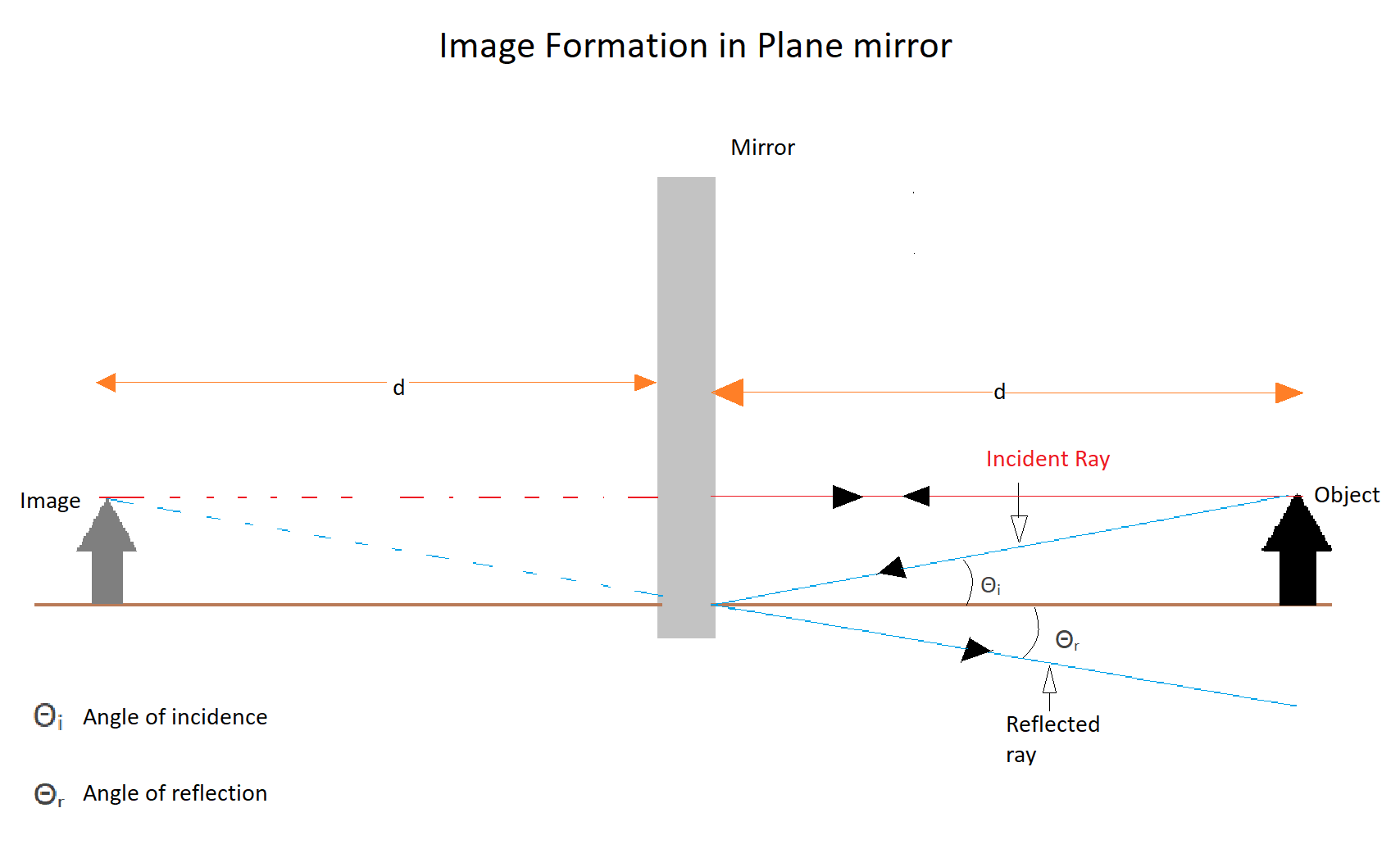 Here black arrow is the object and the grey arrow is the image now as we can see that
The incident and the reflected ray both lie in the same Plane and the angle between them is also equal so we can say that laws of reflection are satisfied.
Here it should be noted that every ray diagram need so satisfy laws of reflection
Now coming to the diagram we can say that the incident ray from the top of the object falls directly on the mirror at the right angle and gets reflected by the same angle another incident ray (blue) falls on the mirror at an angle $\theta $ is also reflected by the same angle the brown line is the reference line.
Now if we extend these rays inside the mirror we can see that the red ray and the blue ray meets at a particular point which is at a distance equal to the distance between the mirror and the object.
The point where the two rays intersect each other is the point where the image is formed Now in our question it is given that, object A is placed at a distance d in front of a plane mirror and the person stands right behind the object and the total distance between the person and the mirror is $S$. This is inclusive of the distance of the object from the mirror. Refer image
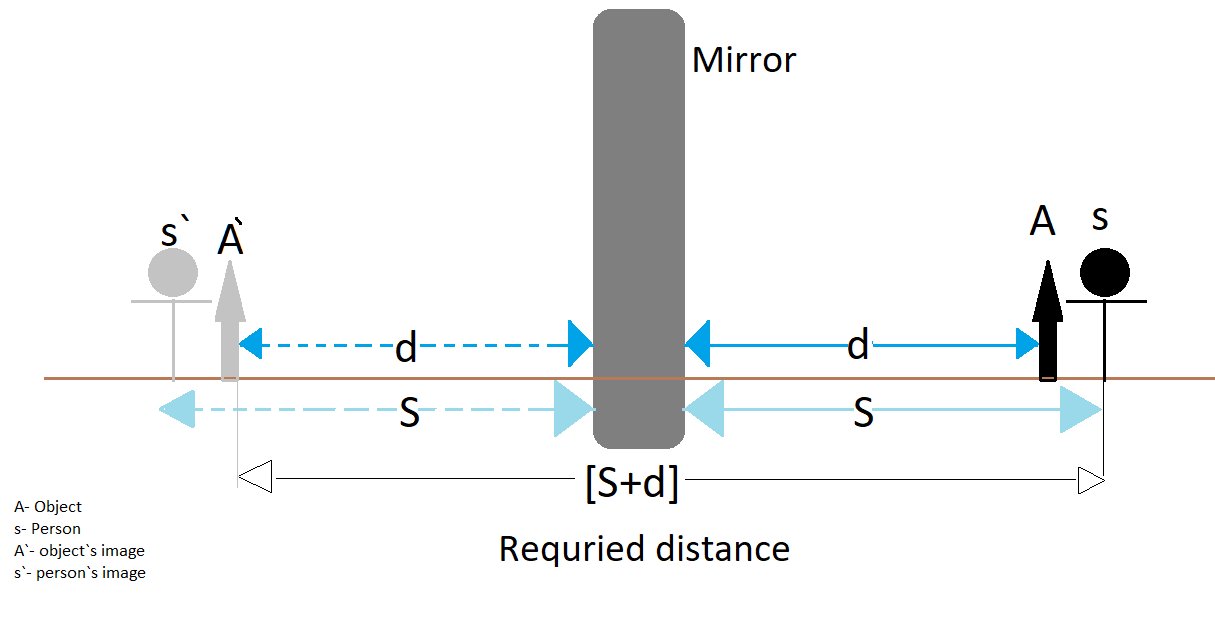
We need to find the distance between the person and the image of the object.
As we know as the distance between the object and the mirror is d so the distance between the mirror and its image will also be $d$
Now, as the distance between the mirror and person is $S$
So the required distance between the image of object A and the real person will be $S + d$.
Therefore, the distance of the image from the individual to the image that is formed at a distance d on the other side is given as $S + d$.
Note: 1. The ray diagram always needs to satisfy the laws of reflections.
2. When a ray of light strikes a plane mirror, the light ray gets reflected off the mirror. Reflection involves a change in direction of the ray.
3.The angle of incidence should be equal to the angle of reflection.
The image formed in a pain mirror is of the same height as the object and is at the equal distance from the mirror as the object is.
a pain mirror just act as the midpoint about which on the other side we see a flipped image of the object
Complete step by step solution:
As plain mirror has an infinite radius of curvature so the image formed by it will not be enlarged or diminished as in the case of other mirror but here in this case the image will be of same height the and will be at the same distance from the mirror as the object
Refer to the ray diagram:
Here black arrow is the object and the grey arrow is the image now as we can see that The incident and the reflected ray both lie in the same Plane and the angle between them is also equal so we can say that laws of reflection are satisfied.
Here it should be noted that every ray diagram need so satisfy laws of reflection
Now coming to the diagram we can say that the incident ray from the top of the object falls directly on the mirror at the right angle and gets reflected by the same angle another incident ray (blue) falls on the mirror at an angle $\theta $ is also reflected by the same angle the brown line is the reference line.
Now if we extend these rays inside the mirror we can see that the red ray and the blue ray meets at a particular point which is at a distance equal to the distance between the mirror and the object.
The point where the two rays intersect each other is the point where the image is formed Now in our question it is given that, object A is placed at a distance d in front of a plane mirror and the person stands right behind the object and the total distance between the person and the mirror is $S$. This is inclusive of the distance of the object from the mirror. Refer image
We need to find the distance between the person and the image of the object.
As we know as the distance between the object and the mirror is d so the distance between the mirror and its image will also be $d$
Now, as the distance between the mirror and person is $S$
So the required distance between the image of object A and the real person will be $S + d$.
Therefore, the distance of the image from the individual to the image that is formed at a distance d on the other side is given as $S + d$.
Note: 1. The ray diagram always needs to satisfy the laws of reflections.
2. When a ray of light strikes a plane mirror, the light ray gets reflected off the mirror. Reflection involves a change in direction of the ray.
3.The angle of incidence should be equal to the angle of reflection.
Recently Updated Pages
Wheatstone Bridge – Principle, Formula, Diagram & Applications

Mass vs Weight: Key Differences Explained for Students
Circuit Switching vs Packet Switching: Key Differences Explained
Uniform Acceleration Explained: Formula, Examples & Graphs
Young’s Double Slit Experiment Derivation Explained
Classification of Drugs in Chemistry: Types, Examples & Exam Guide
Trending doubts
JEE Main 2026: Exam Dates, Session 2 Updates, City Slip, Admit Card & Latest News
JEE Main Participating Colleges 2026 - A Complete List of Top Colleges
Kinematics Mock Test for JEE Main 2025-26: Comprehensive Practice
Understanding the Electric Field of a Uniformly Charged Ring
Understanding Atomic Structure for Beginners
Derivation of Equation of Trajectory Explained for Students
Other Pages
CBSE Class 12 Physics Question Paper 2026: Download SET-wise PDF with Answer Key & Analysis
JEE Advanced 2026 Notification Out with Exam Date, Registration (Extended), Syllabus and More
JEE Advanced Percentile vs Marks 2026: JEE Main Cutoff, AIR & IIT Admission Guide
JEE Advanced Weightage Chapter Wise 2026 for Physics, Chemistry, and Mathematics
How to Convert a Galvanometer into an Ammeter or Voltmeter
Electron Gain Enthalpy and Electron Affinity Explained