




An inclined plane making an angle of 30° with the horizontal is placed in a uniform electric field E = 100V/m. A particle of mass 1 kg and charge 0.01 c is allowed to slide down from rest from a height of 1m. If the coefficient of friction is 0.2 the time taken by the particle to reach the bottom is 330x, then find the value of x.
Answer
 Verified
261.3k+ views
Hint: The particle is charged, so it will experience the electric force. But due to being inclined, we will have to resolve the force. Also, because of the friction when the particle comes down, frictional force acts on the body and it always opposes the motion of the body. Also, the weight of the body will have to be resolved.
Complete step by step solution:
We draw the diagram representing all the forces.
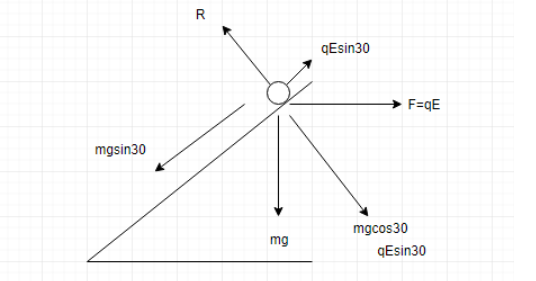
The net forces act down the plane.
For forces in the horizontal:
\[F\text{ }=\text{ }mg\text{ }sin\text{ }30\text{ }\text{ }\mu R\text{ }\text{ }qE\text{ }cos\text{ }30\]--(1)
There is no motion in the vertical direction, so, \[R=mg\cos 30+qE\sin 30\]
Putting the value of R in equation (1) we get,
\[F\text{ }=\text{ }mg\text{ }sin\text{ }30\text{ }\text{ }\mu (mg\cos 30+qE\sin 30)\text{ }\text{ }qE\text{ }cos\text{ }30\]
But from Newton’s second law,$F=ma$
\[\Rightarrow \text{a }=\text{ }g\text{ }sin\text{ }30\text{ }\text{ }\mu g\cos 30+\dfrac{qE}{m}\sin 30\text{ }\dfrac{\text{ }qE}{m}\text{ }cos\text{ }30\]
Substituting the value, we get,
\[\Rightarrow \text{a }=\text{ 10}\times \dfrac{1}{2}\text{ }\text{ 0}\text{.2}\times 10\times \dfrac{\sqrt{3}}{2}+\dfrac{0.01\times 100}{1}\times \dfrac{1}{2}\text{ }\dfrac{\text{ 0}\text{.01}\times 100}{1}\text{ }\times \dfrac{\sqrt{3}}{2}\]\
\[\therefore a=2.24m/{{s}^{2}}\]--(2)
Now it was given that the height of the plane 1m.
Using trigonometry,
$\Rightarrow \sin 30=\dfrac{P}{H} \\
\Rightarrow \dfrac{1}{2}=\dfrac{1}{H} \\
\therefore H=2m \\$
So, the distance covered is$2m$, now to find the time we can make use of equation of motion. Initially it was at rest, thus,
$\Rightarrow s=\dfrac{a{{t}^{2}}}{2} \\
\Rightarrow 4=2.24{{t}^{2}} \\
\Rightarrow {{t}^{2}}=1.75 \\
\therefore t=1.33s \\$
But the time given was $330x$,
\[\therefore 330x=1.33\]
So, $x=0.004$
Note: While solving such problems we need to find first all the forces acting. We then have to see in which direction the body is moving. Here the body was moving along the plane but there was no motion in the vertical direction. So, we just have to balance all the forces in a particular direction. On an incline the weight is always balanced by the normal reaction.
Complete step by step solution:
We draw the diagram representing all the forces.
The net forces act down the plane.
For forces in the horizontal:
\[F\text{ }=\text{ }mg\text{ }sin\text{ }30\text{ }\text{ }\mu R\text{ }\text{ }qE\text{ }cos\text{ }30\]--(1)
There is no motion in the vertical direction, so, \[R=mg\cos 30+qE\sin 30\]
Putting the value of R in equation (1) we get,
\[F\text{ }=\text{ }mg\text{ }sin\text{ }30\text{ }\text{ }\mu (mg\cos 30+qE\sin 30)\text{ }\text{ }qE\text{ }cos\text{ }30\]
But from Newton’s second law,$F=ma$
\[\Rightarrow \text{a }=\text{ }g\text{ }sin\text{ }30\text{ }\text{ }\mu g\cos 30+\dfrac{qE}{m}\sin 30\text{ }\dfrac{\text{ }qE}{m}\text{ }cos\text{ }30\]
Substituting the value, we get,
\[\Rightarrow \text{a }=\text{ 10}\times \dfrac{1}{2}\text{ }\text{ 0}\text{.2}\times 10\times \dfrac{\sqrt{3}}{2}+\dfrac{0.01\times 100}{1}\times \dfrac{1}{2}\text{ }\dfrac{\text{ 0}\text{.01}\times 100}{1}\text{ }\times \dfrac{\sqrt{3}}{2}\]\
\[\therefore a=2.24m/{{s}^{2}}\]--(2)
Now it was given that the height of the plane 1m.
Using trigonometry,
$\Rightarrow \sin 30=\dfrac{P}{H} \\
\Rightarrow \dfrac{1}{2}=\dfrac{1}{H} \\
\therefore H=2m \\$
So, the distance covered is$2m$, now to find the time we can make use of equation of motion. Initially it was at rest, thus,
$\Rightarrow s=\dfrac{a{{t}^{2}}}{2} \\
\Rightarrow 4=2.24{{t}^{2}} \\
\Rightarrow {{t}^{2}}=1.75 \\
\therefore t=1.33s \\$
But the time given was $330x$,
\[\therefore 330x=1.33\]
So, $x=0.004$
Note: While solving such problems we need to find first all the forces acting. We then have to see in which direction the body is moving. Here the body was moving along the plane but there was no motion in the vertical direction. So, we just have to balance all the forces in a particular direction. On an incline the weight is always balanced by the normal reaction.
Recently Updated Pages
Circuit Switching vs Packet Switching: Key Differences Explained

JEE Extractive Metallurgy Important Concepts and Tips for Exam Preparation
JEE Atomic Structure and Chemical Bonding important Concepts and Tips
JEE Amino Acids and Peptides Important Concepts and Tips for Exam Preparation
Electricity and Magnetism Explained: Key Concepts & Applications
JEE Energetics Important Concepts and Tips for Exam Preparation
Trending doubts
JEE Main 2026: Exam Dates, Session 2 Updates, City Slip, Admit Card & Latest News
JEE Main Participating Colleges 2026 - A Complete List of Top Colleges
Hybridisation in Chemistry – Concept, Types & Applications
Understanding the Electric Field of a Uniformly Charged Ring
Derivation of Equation of Trajectory Explained for Students
Understanding Atomic Structure for Beginners
Other Pages
CBSE Class 12 Physics Question Paper 2026: Download SET-wise PDF with Answer Key & Analysis
JEE Advanced 2026 Notification Out with Exam Date, Registration (Extended), Syllabus and More
JEE Advanced Marks vs Ranks 2025: Understanding Category-wise Qualifying Marks and Previous Year Cut-offs
JEE Advanced Weightage Chapter Wise 2026 for Physics, Chemistry, and Mathematics
How to Convert a Galvanometer into an Ammeter or Voltmeter
Ideal and Non-Ideal Solutions Explained for Class 12 Chemistry