




Acetonitrile is:
(a) \[{C_2}{H_5}CN\]
(b) \[C{H_3}CN\]
(c) \[C{H_3}COCN\]
(d) \[{C_6}{H_5}C{H_2}CN\]
Answer
 Verified
257.1k+ views
Hint: 2-propenenitrile (\[C{H_2} = CH - CN\]) is an organic compound, in which the alkene group is directly attached to the carbon atom of the cyanide group (\[ - CN\]). Similarly, acetonitrile, the simplest organic nitriles also have a carbon-nitrogen triple bond. In acetonitrile, a methyl group is directly connected to the cyanide functional group.
Complete Step by Step Solution:
The nitriles are the class of organic compounds that contains the cyanide functional group (\[ - CN\]), in which a triple bond is present between carbon and nitrogen atom Image 1).
The nitriles are generally represented by the \[RCN\] chemical formula.

Image: A general structure of nitriles.
The nitriles are much less toxic than their inorganic analogues such as \[NaCN\] and \[KCN\].
Some compounds such as malonic malononitrile (\[NC{H_2}COOH\]), potassium ferricyanide (\[{K_3}[Fe{(CN)_6}]\]) and potassium ferrocyanide (\[{K_4}[Fe{(CN)_6}\]) are known as less toxic because these compounds do not have the tendency to liberate the cyanide group.
For the IUPAC nomenclature, the word nitrile is used after the name of the parent carbon chain. The carbon atom of the nitrile group is also counted as a part of the parent chain. For example, the IUPAC name of \[C{H_3}CN\] can be written as ethanenitrile and the carbon atom is also counted with the parent chain. The old name of \[C{H_3}CN\]is methyl cyanide and acetonitrile.
When the cyanide (\[ - CN\]) functional is group attached to the cycloalkane, The numbering starts from the carbon atom of cycloalkane which is directly attached to the cyanide group. The name of the cycloalkane is followed by the suffix -carbonitrile. The carbon atom of \[ - CN\]group is not involved in numbering.
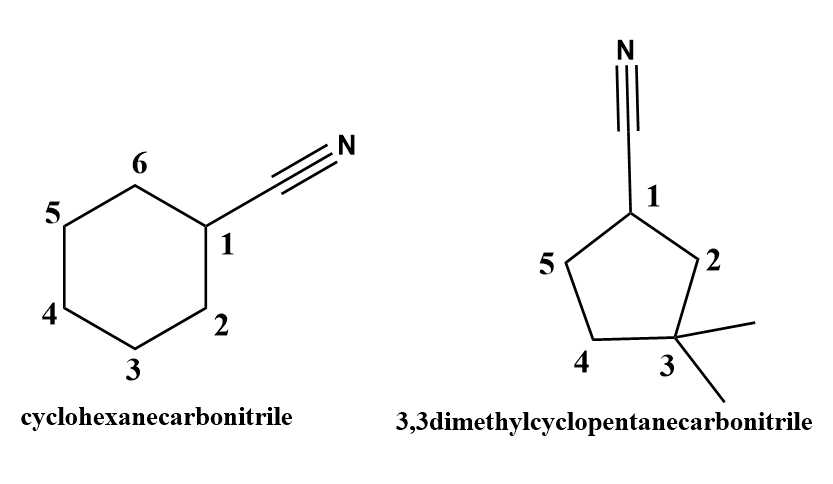
Image: Structure of cycloalkane containing \[ - CN\] functional group.
When a molecule contains a carboxyl group and nitrile functional group then the nitrile group is pronounced as the cyano group. The carbon atom of the cyano group is not counted as a part of the main chain. For example, 3-cyanopropanoic acid.
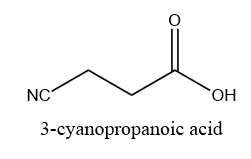
Image: Structure of a molecule having both cyano group and carboxylic group.
The above points indicate that the structure of acetonitrile will be \[C{H_3}CN\]. Therefore, option (b) will be the correct answer.
Note: Grignard reagent is one of the important compounds in organic chemistry. It is beneficial for the preparation of various organic compounds such as acetals, amides, amino compounds, etc. It is used for the manufacture of many compounds that are useful in the pharmaceutical field.
Complete Step by Step Solution:
The nitriles are the class of organic compounds that contains the cyanide functional group (\[ - CN\]), in which a triple bond is present between carbon and nitrogen atom Image 1).
The nitriles are generally represented by the \[RCN\] chemical formula.
Image: A general structure of nitriles.
The nitriles are much less toxic than their inorganic analogues such as \[NaCN\] and \[KCN\].
Some compounds such as malonic malononitrile (\[NC{H_2}COOH\]), potassium ferricyanide (\[{K_3}[Fe{(CN)_6}]\]) and potassium ferrocyanide (\[{K_4}[Fe{(CN)_6}\]) are known as less toxic because these compounds do not have the tendency to liberate the cyanide group.
For the IUPAC nomenclature, the word nitrile is used after the name of the parent carbon chain. The carbon atom of the nitrile group is also counted as a part of the parent chain. For example, the IUPAC name of \[C{H_3}CN\] can be written as ethanenitrile and the carbon atom is also counted with the parent chain. The old name of \[C{H_3}CN\]is methyl cyanide and acetonitrile.
When the cyanide (\[ - CN\]) functional is group attached to the cycloalkane, The numbering starts from the carbon atom of cycloalkane which is directly attached to the cyanide group. The name of the cycloalkane is followed by the suffix -carbonitrile. The carbon atom of \[ - CN\]group is not involved in numbering.
Image: Structure of cycloalkane containing \[ - CN\] functional group.
When a molecule contains a carboxyl group and nitrile functional group then the nitrile group is pronounced as the cyano group. The carbon atom of the cyano group is not counted as a part of the main chain. For example, 3-cyanopropanoic acid.
Image: Structure of a molecule having both cyano group and carboxylic group.
The above points indicate that the structure of acetonitrile will be \[C{H_3}CN\]. Therefore, option (b) will be the correct answer.
Note: Grignard reagent is one of the important compounds in organic chemistry. It is beneficial for the preparation of various organic compounds such as acetals, amides, amino compounds, etc. It is used for the manufacture of many compounds that are useful in the pharmaceutical field.
Recently Updated Pages
Electricity and Magnetism Explained: Key Concepts & Applications

JEE Energetics Important Concepts and Tips for Exam Preparation
JEE Isolation, Preparation and Properties of Non-metals Important Concepts and Tips for Exam Preparation
JEE Main 2023 (February 1st Shift 1) Maths Question Paper with Answer Key
JEE Main 2023 (February 1st Shift 2) Maths Question Paper with Answer Key
JEE Main 2023 (February 1st Shift 2) Chemistry Question Paper with Answer Key
Trending doubts
JEE Main 2026: Exam Dates, Session 2 Updates, City Slip, Admit Card & Latest News
JEE Main Participating Colleges 2026 - A Complete List of Top Colleges
JEE Main 2026 Application Login: Direct Link, Registration, Form Fill, and Steps
JEE Main Colleges 2026: Complete List of Participating Institutes
JEE Main Marking Scheme 2026- Paper-Wise Marks Distribution and Negative Marking Details
Hybridisation in Chemistry – Concept, Types & Applications
Other Pages
JEE Advanced 2026 - Exam Date (Released), Syllabus, Registration, Eligibility, Preparation, and More
CBSE Class 12 Chemistry Question Paper 2026 PDF Download (All Sets) with Answer Key
NCERT Solutions For Class 12 Chemistry Chapter 10 Biomolecules - 2025-26
JEE Advanced Marks vs Ranks 2025: Understanding Category-wise Qualifying Marks and Previous Year Cut-offs
NCERT Solutions For Class 12 Chemistry Chapter 2 Electrochemistry - 2025-26
NCERT Solutions For Class 12 Chemistry Chapter 1 Solutions - 2025-26