




What is a virtual image?
(A) The image that cannot be caught on screen
(B) The image that can be caught on a screen
(C) The image that cannot be converged on a screen
(D) None
Answer
 Verified
250.5k+ views
Hint: To understand what a virtual image is,first draw the ray diagram of an object placed in front of a concave mirror and find the nature of the image formed. Virtual images are generally represented by dotted lines.
Complete step by step solution:
When an object is placed in front of a concave lens, the light ray emitted by the source passes through the lens axis and gets deflected away. The rays don't meet at a point on the other side of the concave lens, rather it meets virtually on the same side of the, which is erect and highly diminished.
The diagram below shows the case of the formation of virtual and erect but highly diminished images when an object is placed between Focus and pole.
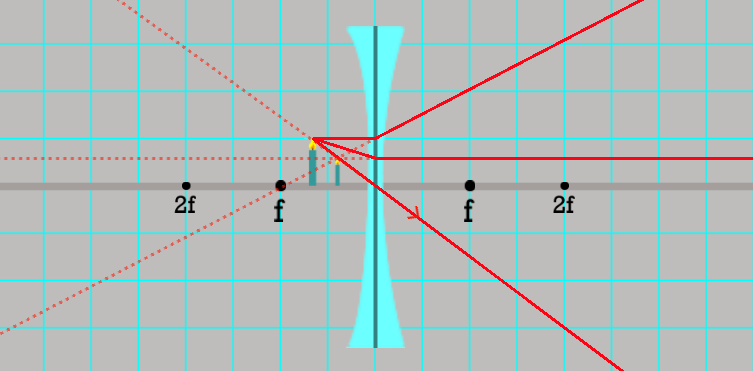
Virtual images can’t be caught on a screen, but are visible to naked human eye. It is formed when a ray of light slightly appears to meet at a point, but not on the other side of the lens but on the same side of the aperture.
The nature of virtual images are erect and highly diminished, which makes it suitable for many applications. Hence by definition, it is understood that virtual images are images that do not actually meet on the screen, but rather meet virtually and form the image on the same side. Therefore, these images can’t be caught on screen.
Hence, Option (A) is the right answer for the given question.
Note:
Virtual images are formed in many day to day applications. The rear mirrors used in cars and bikes are made of concave mirrors, which forms virtual, erect and highly magnified images, which helps the driver to get to know what’s behind the vehicle in advance.
Complete step by step solution:
When an object is placed in front of a concave lens, the light ray emitted by the source passes through the lens axis and gets deflected away. The rays don't meet at a point on the other side of the concave lens, rather it meets virtually on the same side of the, which is erect and highly diminished.
The diagram below shows the case of the formation of virtual and erect but highly diminished images when an object is placed between Focus and pole.
Virtual images can’t be caught on a screen, but are visible to naked human eye. It is formed when a ray of light slightly appears to meet at a point, but not on the other side of the lens but on the same side of the aperture.
The nature of virtual images are erect and highly diminished, which makes it suitable for many applications. Hence by definition, it is understood that virtual images are images that do not actually meet on the screen, but rather meet virtually and form the image on the same side. Therefore, these images can’t be caught on screen.
Hence, Option (A) is the right answer for the given question.
Note:
Virtual images are formed in many day to day applications. The rear mirrors used in cars and bikes are made of concave mirrors, which forms virtual, erect and highly magnified images, which helps the driver to get to know what’s behind the vehicle in advance.
Recently Updated Pages
JEE Isolation, Preparation and Properties of Non-metals Important Concepts and Tips for Exam Preparation

Isoelectronic Definition in Chemistry: Meaning, Examples & Trends
Ionisation Energy and Ionisation Potential Explained
Iodoform Reactions - Important Concepts and Tips for JEE
Introduction to Dimensions: Understanding the Basics
Instantaneous Velocity Explained: Formula, Examples & Graphs
Trending doubts
JEE Main 2026: Exam Dates, Session 2 Updates, City Slip, Admit Card & Latest News
JEE Main Marking Scheme 2026- Paper-Wise Marks Distribution and Negative Marking Details
Hybridisation in Chemistry – Concept, Types & Applications
JEE Main 2026 Application Login: Direct Link, Registration, Form Fill, and Steps
Understanding the Electric Field of a Uniformly Charged Ring
Derivation of Equation of Trajectory Explained for Students
Other Pages
CBSE Class 12 Physics Question Paper 2026: Download SET-wise PDF with Answer Key & Analysis
JEE Advanced Marks vs Ranks 2025: Understanding Category-wise Qualifying Marks and Previous Year Cut-offs
JEE Advanced 2026 - Exam Date (Released), Syllabus, Registration, Eligibility, Preparation, and More
JEE Advanced Weightage 2025 Chapter-Wise for Physics, Maths and Chemistry
Understanding the Angle of Deviation in a Prism
Understanding Electromagnetic Waves and Their Importance