




A vertical wire carrying a current in the upward direction is placed in a horizontal magnetic field directed towards north. The wire will experience a force directed towards
A. North
B. South
C. East
D. west
Answer
 Verified
233.1k+ views
Hint:According to Fleming’s left-hand rule, we express the directions of various parameters with the thumb, index finger, or the forefinger and middle finger. It provides a relationship between the magnetic field that the conductor is put in, force, and the current flowing through it. This rule is employed to establish the direction of a conductor's motion while it is travelling within a magnetic field.
Complete answer:
When a conductor is moved in a magnetic field, Fleming's right-hand rule is an interpretation that provides the direction of motion or force on the conductor.
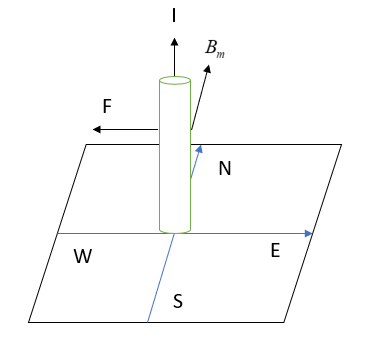
According to Fleming's left-hand rule, which states that if we stretch the thumb, forefinger, or the index finger and the middle finger so that they are mutually perpendicular to each other. The thumb gives the direction of the conductor's motion, the index finger gives the direction of the magnetic field, and the middle finger gives the direction of the current flowing through the conductor. If the direction of the current and magnetic field is known, Fleming's left-hand rule can be used to forecast the direction of the force or motion of the conductor.
So, the direction of force is found to be west by using either the Fleming left hand rule. So, option D is correct
Thus, the correct option is D.
Note:The Fleming left-hand rule and Fleming right-hand rule frequently cause confusion in students. Students should be aware of how these two rules are applied. Electric motors utilise the left-hand Fleming rule, while electric generators use the right-hand Fleming rule. The left-hand rule is used to determine an electric motor's motion's direction. When a conductor is moved in a magnetic field, the right-hand rule is used to determine the direction of the induced current.
Complete answer:
When a conductor is moved in a magnetic field, Fleming's right-hand rule is an interpretation that provides the direction of motion or force on the conductor.
According to Fleming's left-hand rule, which states that if we stretch the thumb, forefinger, or the index finger and the middle finger so that they are mutually perpendicular to each other. The thumb gives the direction of the conductor's motion, the index finger gives the direction of the magnetic field, and the middle finger gives the direction of the current flowing through the conductor. If the direction of the current and magnetic field is known, Fleming's left-hand rule can be used to forecast the direction of the force or motion of the conductor.
So, the direction of force is found to be west by using either the Fleming left hand rule. So, option D is correct
Thus, the correct option is D.
Note:The Fleming left-hand rule and Fleming right-hand rule frequently cause confusion in students. Students should be aware of how these two rules are applied. Electric motors utilise the left-hand Fleming rule, while electric generators use the right-hand Fleming rule. The left-hand rule is used to determine an electric motor's motion's direction. When a conductor is moved in a magnetic field, the right-hand rule is used to determine the direction of the induced current.
Recently Updated Pages
JEE Main 2023 April 6 Shift 1 Question Paper with Answer Key

JEE Main 2023 April 6 Shift 2 Question Paper with Answer Key
JEE Main 2023 (January 31 Evening Shift) Question Paper with Solutions [PDF]
JEE Main 2023 January 30 Shift 2 Question Paper with Answer Key
JEE Main 2023 January 25 Shift 1 Question Paper with Answer Key
JEE Main 2023 January 24 Shift 2 Question Paper with Answer Key
Trending doubts
JEE Main 2026: Session 2 Registration Open, City Intimation Slip, Exam Dates, Syllabus & Eligibility
JEE Main 2026 Application Login: Direct Link, Registration, Form Fill, and Steps
JEE Main Marking Scheme 2026- Paper-Wise Marks Distribution and Negative Marking Details
Understanding the Angle of Deviation in a Prism
Hybridisation in Chemistry – Concept, Types & Applications
How to Convert a Galvanometer into an Ammeter or Voltmeter
Other Pages
JEE Advanced Marks vs Ranks 2025: Understanding Category-wise Qualifying Marks and Previous Year Cut-offs
Dual Nature of Radiation and Matter Class 12 Physics Chapter 11 CBSE Notes - 2025-26
Understanding Uniform Acceleration in Physics
Understanding the Electric Field of a Uniformly Charged Ring
JEE Advanced Weightage 2025 Chapter-Wise for Physics, Maths and Chemistry
Derivation of Equation of Trajectory Explained for Students