




A small girl of height 1m can just see her image in a vertical plane mirror 4m away from her. Her eyes are 0.92m from the floor. In order that she sees her full image in the mirror, the shortest vertical dimension of the mirror is
(A)$0.50m$
(B)$0.70m$
(C)$0.46m$
(D)$0.56m$
Answer
 Verified
233.1k+ views
Hint: The minimum length of the mirror will be the length of the mirror which is sufficient to make the light through the head and feet of the person reach the person’s eyes. Angle of incidence and angle of reflection are the same in magnitude.
Formula used:
\[\angle i = \angle r\]
\[\angle i\]is angle of incidence and \[\angle r\]is angle of reflection.
Complete Step-by-step solution:
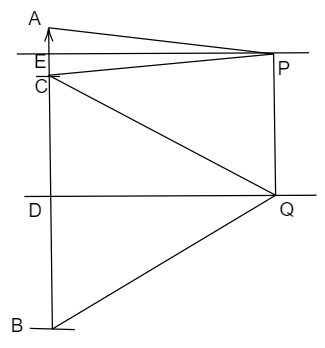
In the figure,
AB is the girl, PQ is the mirror, A is the topmost point on her head, B is the bottom-most part of her feet which are on the ground, C is the point on AB where her eyes are located, P and Q are the endpoints of the mirror. E and D are the points of intersection of the line representing the girl and the normal from the point where light through the head and feet of the person reach the person’s eyes i.e. line perpendicular to PQ from P and Q.
\[AB = 1m\], \[PE = QD = 4m\], \[BC = 0.92m\]
\[ \Rightarrow \angle i = \angle r\]
\[\angle i\]is angle of incidence and \[\angle r\]is angle of reflection.
Hence,
$\angle APE = \angle EPC = x$ and $\angle DQC = \angle BQD = y$
$ \Rightarrow AB = AC + BC$
So,$AC = 0.08m$
We can assert that $\tan x = \dfrac{{AE}}{{EP}}$
Similarly,
In $\Delta CPE$,$\Delta BQD$ and$\Delta DQC$ that $\tan x = \dfrac{{CE}}{{EP}}$,$\tan y = \dfrac{{BD}}{{DQ}}$,$\tan y = \dfrac{{CD}}{{DQ}}$
From the above equations, we can assert that,
$AE = CE = a$ and $BD = CD = b$
From the figure, we can assert that the minimum length of the mirror is $a + b$.
\[a = \dfrac{1}{2}AC = 0.04m\] and \[b = \dfrac{1}{2}BC = 0.46m\]
Hence,
$a + b = 0.50m$
The correct answer is (A)$0.50m$
Note:
In a right angle triangle $\Delta ABC$ right angled at B then $\tan (\angle C)$ will be equal to $\dfrac{{AB}}{{BC}}$. The above question is a very popular question hence one must remember that the minimum length of mirror required is half the height of the person viewing in the mirror.
Formula used:
\[\angle i = \angle r\]
\[\angle i\]is angle of incidence and \[\angle r\]is angle of reflection.
Complete Step-by-step solution:
In the figure,
AB is the girl, PQ is the mirror, A is the topmost point on her head, B is the bottom-most part of her feet which are on the ground, C is the point on AB where her eyes are located, P and Q are the endpoints of the mirror. E and D are the points of intersection of the line representing the girl and the normal from the point where light through the head and feet of the person reach the person’s eyes i.e. line perpendicular to PQ from P and Q.
\[AB = 1m\], \[PE = QD = 4m\], \[BC = 0.92m\]
\[ \Rightarrow \angle i = \angle r\]
\[\angle i\]is angle of incidence and \[\angle r\]is angle of reflection.
Hence,
$\angle APE = \angle EPC = x$ and $\angle DQC = \angle BQD = y$
$ \Rightarrow AB = AC + BC$
So,$AC = 0.08m$
We can assert that $\tan x = \dfrac{{AE}}{{EP}}$
Similarly,
In $\Delta CPE$,$\Delta BQD$ and$\Delta DQC$ that $\tan x = \dfrac{{CE}}{{EP}}$,$\tan y = \dfrac{{BD}}{{DQ}}$,$\tan y = \dfrac{{CD}}{{DQ}}$
From the above equations, we can assert that,
$AE = CE = a$ and $BD = CD = b$
From the figure, we can assert that the minimum length of the mirror is $a + b$.
\[a = \dfrac{1}{2}AC = 0.04m\] and \[b = \dfrac{1}{2}BC = 0.46m\]
Hence,
$a + b = 0.50m$
The correct answer is (A)$0.50m$
Note:
In a right angle triangle $\Delta ABC$ right angled at B then $\tan (\angle C)$ will be equal to $\dfrac{{AB}}{{BC}}$. The above question is a very popular question hence one must remember that the minimum length of mirror required is half the height of the person viewing in the mirror.
Recently Updated Pages
JEE Main 2023 April 6 Shift 1 Question Paper with Answer Key

JEE Main 2023 April 6 Shift 2 Question Paper with Answer Key
JEE Main 2023 (January 31 Evening Shift) Question Paper with Solutions [PDF]
JEE Main 2023 January 30 Shift 2 Question Paper with Answer Key
JEE Main 2023 January 25 Shift 1 Question Paper with Answer Key
JEE Main 2023 January 24 Shift 2 Question Paper with Answer Key
Trending doubts
JEE Main 2026: Session 2 Registration Open, City Intimation Slip, Exam Dates, Syllabus & Eligibility
JEE Main 2026 Application Login: Direct Link, Registration, Form Fill, and Steps
JEE Main Marking Scheme 2026- Paper-Wise Marks Distribution and Negative Marking Details
Understanding the Angle of Deviation in a Prism
Hybridisation in Chemistry – Concept, Types & Applications
How to Convert a Galvanometer into an Ammeter or Voltmeter
Other Pages
JEE Advanced Marks vs Ranks 2025: Understanding Category-wise Qualifying Marks and Previous Year Cut-offs
Dual Nature of Radiation and Matter Class 12 Physics Chapter 11 CBSE Notes - 2025-26
Understanding Uniform Acceleration in Physics
Understanding the Electric Field of a Uniformly Charged Ring
JEE Advanced Weightage 2025 Chapter-Wise for Physics, Maths and Chemistry
Derivation of Equation of Trajectory Explained for Students