




A ray of light is incident on an equilateral glass prism placed on a horizontal table. For minimum deviation, which of the following is true?
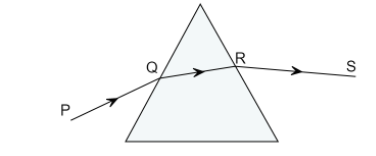
(A) QR is horizontal
(B) PQ is horizontal
(C) Either PQ or QS is horizontal
(D) RS is horizontal
Answer
 Verified
263.4k+ views
Hint: When the light travels from one medium to another (with different refractive indexes) it’s direction of propagation changes, in other words it is said to be deviated from its original path. The $\delta $gives deviation of light, and is defined as the angle between the incident and the emergent ray.
Complete step by step solution:
When the light travels through a prism, it is deviated two times during its course. First deviation occurs when it is incident on the prism, at point Q. The angle made by incident ray to the normal from the surface is represented by i, this ray is refracted inside by the glass prism.
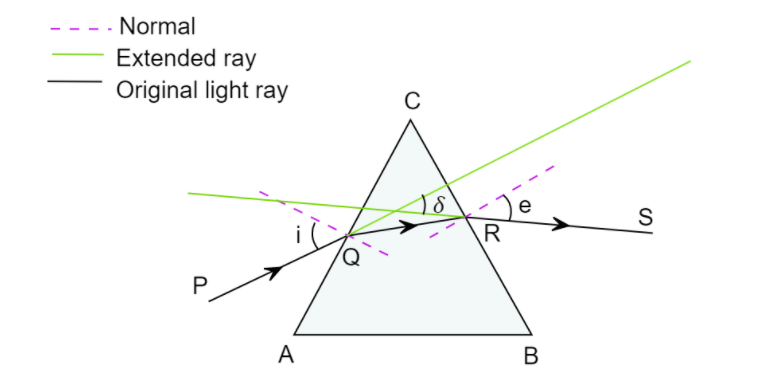
The refracted ray comes out through the point R, and the angle of emergence represented by e. If the incident and the emergence rays are extended , they intersect at a point. The one of the angles produced by the intersection gives the angle of deviation.
At the condition of minimum deviation,
$\angle i = \angle e$
This can only be reached when QR is parallel to AB. This will make the emergence and incident angles equally inclined from the prism, and the light will undergo minimum deviation. The other conditions for minimum deviation can also be derived using the geometry of the prism or the prism formula.
Thus, option (A) is correct.
Note:
The angle of incidence can have any value ,but for minimum deviation both of these quantities must be equal, and as another result for this, the line QR should be horizontal. Also, it is to be noted that light gets deviated two times when it travels inside a prism.
Complete step by step solution:
When the light travels through a prism, it is deviated two times during its course. First deviation occurs when it is incident on the prism, at point Q. The angle made by incident ray to the normal from the surface is represented by i, this ray is refracted inside by the glass prism.
The refracted ray comes out through the point R, and the angle of emergence represented by e. If the incident and the emergence rays are extended , they intersect at a point. The one of the angles produced by the intersection gives the angle of deviation.
At the condition of minimum deviation,
$\angle i = \angle e$
This can only be reached when QR is parallel to AB. This will make the emergence and incident angles equally inclined from the prism, and the light will undergo minimum deviation. The other conditions for minimum deviation can also be derived using the geometry of the prism or the prism formula.
Thus, option (A) is correct.
Note:
The angle of incidence can have any value ,but for minimum deviation both of these quantities must be equal, and as another result for this, the line QR should be horizontal. Also, it is to be noted that light gets deviated two times when it travels inside a prism.
Recently Updated Pages
Area of an Octagon Formula Explained Simply

Absolute Pressure Formula Explained: Key Equation & Examples
Difference Between Atom and Molecule: JEE Main 2026
Difference Between Vapor and Gas: JEE Main 2026
Carbon Dioxide Formula - Definition, Uses and FAQs
Central Angle of a Circle Formula Explained Quickly
Trending doubts
JEE Main 2026: Exam Dates, Session 2 Updates, City Slip, Admit Card & Latest News
JEE Main Participating Colleges 2026 - A Complete List of Top Colleges
Hybridisation in Chemistry – Concept, Types & Applications
Understanding the Electric Field of a Uniformly Charged Ring
Derivation of Equation of Trajectory Explained for Students
Understanding Atomic Structure for Beginners
Other Pages
CBSE Class 12 Physics Question Paper 2026: Download SET-wise PDF with Answer Key & Analysis
JEE Advanced 2026 Notification Out with Exam Date, Registration (Extended), Syllabus and More
JEE Advanced Marks vs Ranks 2025: Understanding Category-wise Qualifying Marks and Previous Year Cut-offs
JEE Advanced Weightage Chapter Wise 2026 for Physics, Chemistry, and Mathematics
JEE Advanced Marks vs Rank 2025 - Predict Your IIT Rank Based on Score
How to Convert a Galvanometer into an Ammeter or Voltmeter