




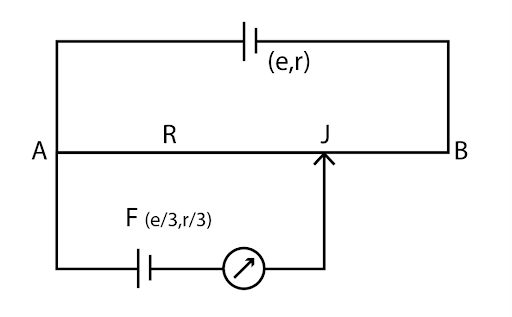
A potentiometer arrangement is shown in fig. The driver cell has emf e and internal resistance r. The resistance of potentiometer wire AB is R. F is the cell of emf e/3 and internal resistance r/3. Balance point (J) can be obtained for all finite values of
A. $R > \dfrac{r}{2}$
B. $R < \dfrac{r}{2}$
C. $R > \dfrac{r}{3}$
D. $R < \dfrac{r}{3}$
Answer
 Verified
259.2k+ views
Hint:The problem is from the current electricity section of physics. We need to know the concepts of the potentiometer to solve this problem. The potentiometer is a device used to measure an unknown voltage by comparing it to a known voltage. It can be used to compare the emf of several cells and to determine the emf and internal resistance of the specified cell.
Complete step by step solution:
Point J is the balance point of the given potentiometer. The current (I) will not flow through the galvanometer. current in wire AB (primary circuit) is given below.
\[I = \dfrac{e}{{R + r}}\]
The potential difference across the wire AB is,
\[{V_{AB}} = IR = \dfrac{{eR}}{{R + r}}\]
In order to obtain a balanced point of the potentiometer, the potential drop across wire should be greater than the emf of the cell in the secondary circuit.
\[\dfrac{{eR}}{{R + r}} > \dfrac{e}{3}\]
\[\therefore R > \dfrac{r}{2}\]
Hence, the correct option is option A.
Additional Information: A potentiometer is a three-terminal resistor with a sliding or revolving contact that serves as a voltage divider that may be adjusted. It functions as a variable resistor or rheostat when only two terminals are employed. Potentiometers are frequently used in the manufacture of electronic equipment that allows users to change electrical circuits to get the desired outputs. Although volume controls on radios and other audio-related electrical equipment are the most used applications
Note: The smallest change in the potential difference that a potentiometer can detect is its sensitivity. By lowering the potential gradient, the potentiometer's sensitivity can be improved. That is done by extending the potentiometer wire's length.
Complete step by step solution:
Point J is the balance point of the given potentiometer. The current (I) will not flow through the galvanometer. current in wire AB (primary circuit) is given below.
\[I = \dfrac{e}{{R + r}}\]
The potential difference across the wire AB is,
\[{V_{AB}} = IR = \dfrac{{eR}}{{R + r}}\]
In order to obtain a balanced point of the potentiometer, the potential drop across wire should be greater than the emf of the cell in the secondary circuit.
\[\dfrac{{eR}}{{R + r}} > \dfrac{e}{3}\]
\[\therefore R > \dfrac{r}{2}\]
Hence, the correct option is option A.
Additional Information: A potentiometer is a three-terminal resistor with a sliding or revolving contact that serves as a voltage divider that may be adjusted. It functions as a variable resistor or rheostat when only two terminals are employed. Potentiometers are frequently used in the manufacture of electronic equipment that allows users to change electrical circuits to get the desired outputs. Although volume controls on radios and other audio-related electrical equipment are the most used applications
Note: The smallest change in the potential difference that a potentiometer can detect is its sensitivity. By lowering the potential gradient, the potentiometer's sensitivity can be improved. That is done by extending the potentiometer wire's length.
Recently Updated Pages
JEE Main Mock Test 2025-26: Electromagnetic Induction & Alternating Currents

JEE Main Mock Test 2025-26: Optics Chapter Practice Online
JEE Main 2025-26 Mock Test: Properties of Solids and Liquids
JEE Main Mock Test 2025-26: Dual Nature of Matter & Radiation
JEE Main 2025-26 Electromagnetic Waves Mock Test with Solutions
JEE Main 2025-26 Mock Test: Electronic Devices Chapter Practice
Trending doubts
JEE Main 2026: Exam Dates, Session 2 Updates, City Slip, Admit Card & Latest News
JEE Main Participating Colleges 2026 - A Complete List of Top Colleges
JEE Main Marking Scheme 2026- Paper-Wise Marks Distribution and Negative Marking Details
Hybridisation in Chemistry – Concept, Types & Applications
Understanding the Electric Field of a Uniformly Charged Ring
Derivation of Equation of Trajectory Explained for Students
Other Pages
CBSE Class 12 Physics Question Paper 2026: Download SET-wise PDF with Answer Key & Analysis
JEE Advanced 2026 - Exam Date (Released), Syllabus, Registration, Eligibility, Preparation, and More
JEE Advanced Marks vs Ranks 2025: Understanding Category-wise Qualifying Marks and Previous Year Cut-offs
JEE Advanced Weightage 2025 Chapter-Wise for Physics, Maths and Chemistry
Understanding Atomic Structure for Beginners
Understanding Electromagnetic Waves and Their Importance