




A plane mirror 50 cm long, is hung on a vertical wall of a room, with its lower edge 50 cm above the ground. A man stands in front of the mirror at a distance 2 m away from the mirror. If his eyes are at a height 1.8 m above the ground, then the length (distance between the extreme points of the visible region perpendicular to the mirror) of the floor visible to him due to reflection from the mirror is 26x m. Find the value of x.
Answer
 Verified
309k+ views
Hint:The concept that is going to be used in this problem is the law of reflection. According to this law, the angle of incidence is equal to the angle of reflection. This means that the angle at which a light ray strikes a surface is equal to the angle at which it reflects off of the surface.To solve the problem, we can use the given information about the dimensions of the mirror and the distance between the man and the mirror, as well as the man's height. We can use this information to calculate the angles of incidence and reflection, as well as the lengths of the visible region.
Complete step by step solution:
Let’s try to make a drawing of the from the question and try to understand the situation
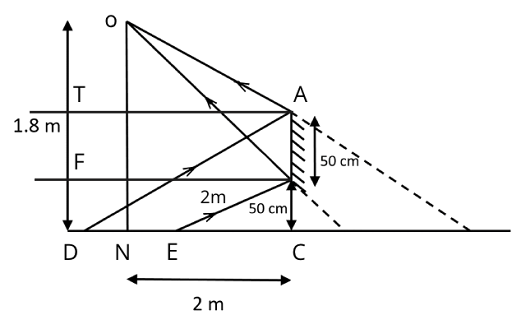
Given the upper extreme point of the mirror, $\overline{OA}$, reflects from the mirror and follows the path $\overline{OD}$, and the lower extreme point of the mirror, $\overline{OB}$, reflects and follows the path $\overline{BE}$.
We know that the angle of incidence is equal to the angle of reflection, so $\angle OAT = \angle FAT = \theta$ and $\angle OBF = \angle FBE = \beta$. Since $\overline{TA}$, $\overline{FB}$, and $\overline{DC}$ are parallel, $\angle BEC = \angle FBE$ and $\angle TAF = \angle ADC$.
Let $\overline{DC} = y$ and $\overline{NC} = x$. To find the length of floor visible by the man, we need to calculate $y - x$. We know that $\overline{AB} = \overline{CB} = 50 cm = 0.5 m$, so $\overline{AC} = \overline{AB} + \overline{BC} = 0.5 m + 0.5 m = 1 m$. Since $\overline{AC}$ and $\overline{TN}$ are parallel, we know that $\overline{AC} = \overline{TN} = 1 m$.
We can calculate $\overline{OT} = \overline{ON} - \overline{TN} = 1.8 m - 1 m = 0.8 m$.
Using trigonometry, in $\triangle OAT$, $\tan \theta = \overline{OT}/\overline{TA} = 0.8/2 = 0.4$. In $\triangle DAC$, $\tan \theta = \overline{AC}/\overline{DC}$, so $\overline{DC} = 5/2$.
To calculate $x$, in $\triangle OFB$, $\tan \beta = \overline{OF}/\overline{FB} = (\overline{ON} - \overline{FN})/\overline{FB} = (1.8 - 0.5)/2 = 1.3/2$. In $\triangle BAC$, $\tan \beta = \overline{BC}/\overline{EC}$, so $\overline{EC} = \overline{BC}/\tan \beta = 0.5 \times 2/13 = 1/13$.
Now we know that $x = 1/13$, so $y - x = 5/2 - 1/13 = 45/26$. The question asks for the value of $26x$, so $x = 45$.
Hence the correct answer is 45.
Notes: In case of reflection, angle of incident = angle of reflection. Always when solving this type of problem draw a clear picture of the question and then start thinking. Concept of alternate angles, supplementary angles etc. are also very important to solve this kind of problem.
Complete step by step solution:
Let’s try to make a drawing of the from the question and try to understand the situation
Given the upper extreme point of the mirror, $\overline{OA}$, reflects from the mirror and follows the path $\overline{OD}$, and the lower extreme point of the mirror, $\overline{OB}$, reflects and follows the path $\overline{BE}$.
We know that the angle of incidence is equal to the angle of reflection, so $\angle OAT = \angle FAT = \theta$ and $\angle OBF = \angle FBE = \beta$. Since $\overline{TA}$, $\overline{FB}$, and $\overline{DC}$ are parallel, $\angle BEC = \angle FBE$ and $\angle TAF = \angle ADC$.
Let $\overline{DC} = y$ and $\overline{NC} = x$. To find the length of floor visible by the man, we need to calculate $y - x$. We know that $\overline{AB} = \overline{CB} = 50 cm = 0.5 m$, so $\overline{AC} = \overline{AB} + \overline{BC} = 0.5 m + 0.5 m = 1 m$. Since $\overline{AC}$ and $\overline{TN}$ are parallel, we know that $\overline{AC} = \overline{TN} = 1 m$.
We can calculate $\overline{OT} = \overline{ON} - \overline{TN} = 1.8 m - 1 m = 0.8 m$.
Using trigonometry, in $\triangle OAT$, $\tan \theta = \overline{OT}/\overline{TA} = 0.8/2 = 0.4$. In $\triangle DAC$, $\tan \theta = \overline{AC}/\overline{DC}$, so $\overline{DC} = 5/2$.
To calculate $x$, in $\triangle OFB$, $\tan \beta = \overline{OF}/\overline{FB} = (\overline{ON} - \overline{FN})/\overline{FB} = (1.8 - 0.5)/2 = 1.3/2$. In $\triangle BAC$, $\tan \beta = \overline{BC}/\overline{EC}$, so $\overline{EC} = \overline{BC}/\tan \beta = 0.5 \times 2/13 = 1/13$.
Now we know that $x = 1/13$, so $y - x = 5/2 - 1/13 = 45/26$. The question asks for the value of $26x$, so $x = 45$.
Hence the correct answer is 45.
Notes: In case of reflection, angle of incident = angle of reflection. Always when solving this type of problem draw a clear picture of the question and then start thinking. Concept of alternate angles, supplementary angles etc. are also very important to solve this kind of problem.
Recently Updated Pages
JEE Main 2025-26 Atoms and Nuclei Mock Test – Free Practice Questions

JEE Main 2025-26 Mock Test: Electronic Devices Chapter Practice
Oscillations and Waves Mock Test 2025: Practice Questions & Answers
JEE Main 2025-26 Atoms and Nuclei Mock Test – Free Practice Online
JEE Main 2026-27 Oscillations and Waves Mock Test – Practice Online
JEE Main Kinetic Theory Of Gases Mock Test 2025-26
Trending doubts
Hybridisation in Chemistry – Concept, Types & Applications
Understanding Uniform Acceleration in Physics
What Are Current and Potential Difference in Electricity?
Understanding Collisions: Types and Examples for Students
Isoelectronic Species: Definition, Examples & Importance
Understanding Instantaneous Velocity
Other Pages
JEE Advanced 2026 Notification Out with Exam Date, Registration (Extended), Syllabus and More
JEE Advanced Weightage Chapter Wise 2026 for Physics, Chemistry, and Mathematics
Understanding Average and RMS Value in Electrical Circuits
Understanding the Angle of Deviation in a Prism
Understanding Elastic Collisions in Two Dimensions
What Are Elastic Collisions in One Dimension?