




A plane glass mirror of thickness 3 cm of the material of $\mu = \dfrac{3}{2}$ is silvered on the back surface. When a point object is placed 9 cm from the front surface of the mirror, then the position of the brightest image from the front surface is
A. 9 cm
B.11 cm
C. 12 cm
D. 13 cm
Answer
 Verified
300.3k+ views
Hint: In order to solve this problem we first need to draw the diagram and then we need to find the apparent height as the glass above the silver-coated film has the refractive index that is 1.5. So we need to find the apparent height by the suitable formula and then we have to find the point of the image formed according to the apparent height. Doing this gives you the right answers.
< b>complete step-by-step answer
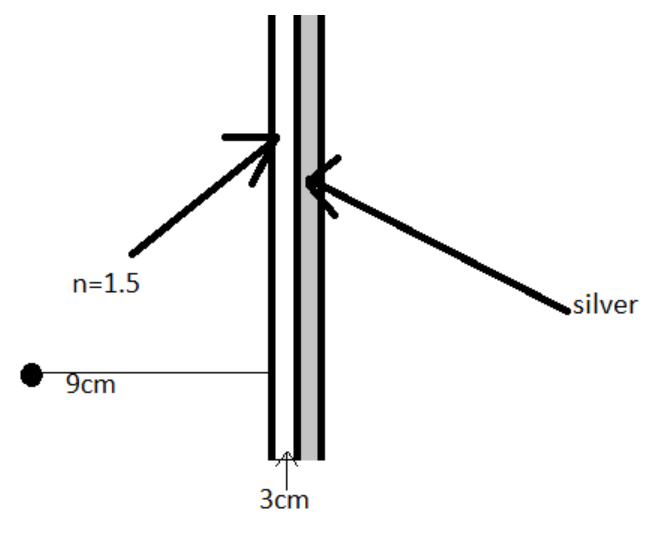
The above figure is the figure of the glass of refractive index 1.5 coated with the silver from the backside.
The object is 9 cm in front of the surface of the glass of the plane mirror and we know that the glass has a refractive index of 1.5 and of thickness 3cm.
So, the apparent height of the object from the mirror will be calculated after calculating the shift of the mirror.
Let the mirror be shifted x virtually because of the refractive index.
So,
$\Rightarrow \dfrac{{{\text{Real}}\,{\text{height}}}}{{{\text{apparent}}\,{\text{height}}}} = \dfrac{3}{x} = 1.5 \\
\Rightarrow x = 2cm $
So, the value of x is 2cm.
As we know that object distance is the same as that of image distance in the plane mirror, so we will add 2 twice with 9 to get the distance of the image that will be the same as the object distance from the virtual mirror.
So, we get the distance of the image as, $9 + 2 + 2 = 13 \text{cm}$.
Hence, the image distance is $13 \text{cm}$.
So, the correct option is D.
Note: When you get to solve such problems you always need to calculate the apparent distance of the image because of refractive index the image shifts itself and if the mirror is surfaced with a thick glass of refractive index then the mirror itself changes its position due to the refraction occurs and differ in the actual result due to refractive index then at that time the position of the image can be calculated b this method.
< b>complete step-by-step answer
The above figure is the figure of the glass of refractive index 1.5 coated with the silver from the backside.
The object is 9 cm in front of the surface of the glass of the plane mirror and we know that the glass has a refractive index of 1.5 and of thickness 3cm.
So, the apparent height of the object from the mirror will be calculated after calculating the shift of the mirror.
Let the mirror be shifted x virtually because of the refractive index.
So,
$\Rightarrow \dfrac{{{\text{Real}}\,{\text{height}}}}{{{\text{apparent}}\,{\text{height}}}} = \dfrac{3}{x} = 1.5 \\
\Rightarrow x = 2cm $
So, the value of x is 2cm.
As we know that object distance is the same as that of image distance in the plane mirror, so we will add 2 twice with 9 to get the distance of the image that will be the same as the object distance from the virtual mirror.
So, we get the distance of the image as, $9 + 2 + 2 = 13 \text{cm}$.
Hence, the image distance is $13 \text{cm}$.
So, the correct option is D.
Note: When you get to solve such problems you always need to calculate the apparent distance of the image because of refractive index the image shifts itself and if the mirror is surfaced with a thick glass of refractive index then the mirror itself changes its position due to the refraction occurs and differ in the actual result due to refractive index then at that time the position of the image can be calculated b this method.
Recently Updated Pages
If the magnetizing field on a ferromagnetic material class 12 physics JEE_Main

A point charge is placed at the corner of a cube The class 12 physics JEE_Main
What changes occur if the monochromatic light used class 12 physics JEE_Main
The unit of specific conductance is A Ohm B Ohmmetre class 12 physics JEE_Main
Which lens is used in magnifying glass A Concave lens class 12 physics JEE_Main
Sir C V Raman won the Nobel Prize in which year A 1928 class 12 physics JEE_Main
Trending doubts
JEE Main 2026: Exam Dates, Session 2 Updates, City Slip, Admit Card & Latest News
Understanding the Electric Field of a Uniformly Charged Ring
Electron Gain Enthalpy and Electron Affinity Explained
Derivation of Equation of Trajectory Explained for Students
Understanding Atomic Structure for Beginners
How to Convert a Galvanometer into an Ammeter or Voltmeter
Other Pages
CBSE Class 12 Physics Question Paper 2026: Download SET-wise PDF with Answer Key & Analysis
JEE Advanced Percentile vs Marks 2026: JEE Main Cutoff, AIR & IIT Admission Guide
Understanding Uniform Acceleration in Physics
Hybridisation in Chemistry – Concept, Types & Applications
Effective Nuclear Charge for JEE
Understanding the Angle of Deviation in a Prism